
B2B Lead Generation: Strategies, Channels and Costs for SMEs in the DACH Region
Nadine Fraiss · Lilox · Last updated: 15 July 2026 · ~13 min read
The short answer: Predictable lead generation in B2B arises from a system of positioning, website, LinkedIn, email automation, and measurement, not from individual actions. 75 percent of B2B buyers want to research without sales contact (Gartner). Those who are visible and persuasive in this anonymous phase win leads without cold calling. Quality beats quantity, especially in the mid-market.
Contents
- Was bedeutet Leadgenerierung im B2B?
- How has B2B buying changed?
- Why is the SME sector under pressure to acquire customers?
- Is lead generation possible without cold calling?
- Welches System macht B2B-Leads planbar?
- Which channels generate B2B leads in the DACH region?
- What role does your website play in lead generation?
- How do you generate B2B leads via LinkedIn?
- How do email and marketing automation turn leads into customers?
- What does lead generation cost in B2B?
- How do you measure the success of your lead generation?
- What mistakes most commonly hinder B2B lead generation?
- Why is Lilox the right partner for your B2B lead generation?
- Frequently Asked Questions
01 – Fundamentals
01
Was bedeutet Leadgenerierung im B2B?
B2B lead generation is the systematic process of building contacts with companies that fit your offering and have a recognisable interest in purchasing. A lead is more than just an email address. It is an identified point of contact with company context, needs, and a next step.
In practice, we differentiate between two stages. A Marketing Qualified Lead (MQL) has shown interest, for example by downloading a guide or registering for a webinar. A Sales Qualified Lead (SQL) additionally meets the criteria for a sales conversation, for instance, suitable company size, budget responsibility, and a specific occasion. B2B customer acquisition rarely fails due to a lack of contacts, but rather because the wrong contacts end up in the CRM.
It’s not easy. 30 percent of marketers still name lead generation as one of their biggest challenges in 2026 (HubSpot State of Marketing 2026The reason lies in the changed purchasing behaviour, which we will look at in the next section. Ten suitable leads per month, of which three turn into conversations, are better than a hundred downloads that no one can qualify.
/ 02 – Purchasing Behaviour
02
How has B2B buying changed?
B2B purchasing has become digital and anonymous. According to Gartner, 75 percent of B2B buyers prefer a purchasing experience that involves no sales representative at all. However, the same research also shows the limit of self-service. Buyers who use an supplier's digital tools in conjunction with a sales representative are 1.8 times more likely to complete a high-value deal than buyers who decide entirely on their own.Gartner, B2B Buying JourneyDigital purchases clearly lead to buyer's remorse more often.
This is followed by AI search. 94 percent of business buyers now use AI during their purchasing process.Forrester, State of Business Buying 2026, (Survey of around 18,000 buyers). Almost 70 percent of marketers report that leads arrive later in the buying process because they have done more AI-powered research beforehand (HubSpot, 2026).
Simultaneously, no one makes decisions alone anymore. A typical purchasing decision today involves 13 internal stakeholders and 9 external influencers, according to Forrester. Procurement is involved from the outset in 53 percent of buying cycles (Forrester, 2026). Therefore, your lead generation must persuade an entire panel who form the majority of their opinion before you are even aware of it.
94 percent of buying groups have already chosen their favourite before contacting the first supplier. This favourite wins 80 percent of deals in the end.
The 6sense Buyer Experience Report 2025, surveyed over 4,000 B2B buyers
03 – Mittelstand
03
Why is the SME sector under pressure to acquire customers?
Because target customers' budgets are tighter than before. In Germany, there are 3.87 million medium-sized companies which generated a combined turnover of €5.2 trillion in 2024 (KfW SME Panel 2025However, the propensity to invest is close to an all-time low. Only 39 percent of SMEs have recently implemented investment projects (KfW, November 2025).
For your lead generation, this means two things. Firstly, every purchasing decision will be scrutinised more intensely. If purchasing plays a decisive role from the outset in more than half of the buying cycles, you'll need content that can withstand scrutiny, with verifiable figures instead of advertising promises. Secondly, competition will shift from quantity to fit. In a market where less is being invested, the supplier who recognises the few active purchasing processes early on and is positioned as the favourite wins.
As a medium-sized provider, you have an advantage over large corporations. Your positioning can be sharper, and your references appear more credible to other medium-sized businesses. The market is there. The SME sector employs more people than ever before, with 33 million workers (KfW, 2025), it just researches differently than many sales processes assume.
04 – Cold Calling
04
Is lead generation possible without cold calling?
Yes, and in the DACH region, this is the more realistic approach. Legally, unsolicited telephone advertising is only permitted under strict conditions, even towards companies; § 7 UWG (German Unfair Competition Act) requires at least presumed consent in B2B, while express consent is the standard for email advertising. Anyone who builds their pipeline on cold calling is operating in a legal grey area and against buyer behaviour.
Because the data speaks a clear language. The ratio between self-research and vendor contact is 60 to 40 according to 6sense, and in 77 percent of cases, buying groups purchase from the vendor they favoured before initial contact.6sense, 2025A call at the wrong time reaches people without a reason or people who have already made their decision.
Lead generation without cold calling specifically means that buyers find you when their need arises, via your website, AI search, LinkedIn, and referrals. Sales then come into play when the lead wants them to. This is exactly where the hybrid model beats pure self-service, as the Gartner figure with a factor of 1.8 shows.
// Personal Announcement
Your buyers have been researching for a long time.
The question is whether they find you there.
The chapters up to this point show the same pattern: the buying group decides on a favourite before speaking to you. In this anonymous phase, it's determined who is even part of the selection. This is precisely where Lilox comes in and builds the system for it: positioning, website, LinkedIn, email automation, and the measurement that shows what's working.
Other questions: How do we get more leads?
First, we ask: Which customers should it be?
/ 05 – The System
05
Welches System macht B2B-Leads planbar?
Planable leads arise when five building blocks interlock. Individual measures like a campaign here and an exhibition appearance there create peaks, but not a pipeline.
1
Building block 1
Positioning
Who exactly do you want to win, with what problem, and why you? Without this clarity, every further building block will produce wasted effort.
2
Building block 2
Website
It's the place where anonymous research becomes an identified lead. More on that in Section 7 and on our Website performance page.
3
Building block 3
The network builds visibility and trust among buying group members long before an occasion arises.Section 8).
4
Building block 4
Email and Marketing Automation
You maintain contact with leads who are not yet ready to buy and hand them over to sales at the right time (Section 9).
5
Building block 5
Measurement
Without numbers per level, lead generation remains a feeling.Section 11The article shows how a contact makes their way from the first point of contact to the customer. The 4 Stages of Lead Generation.
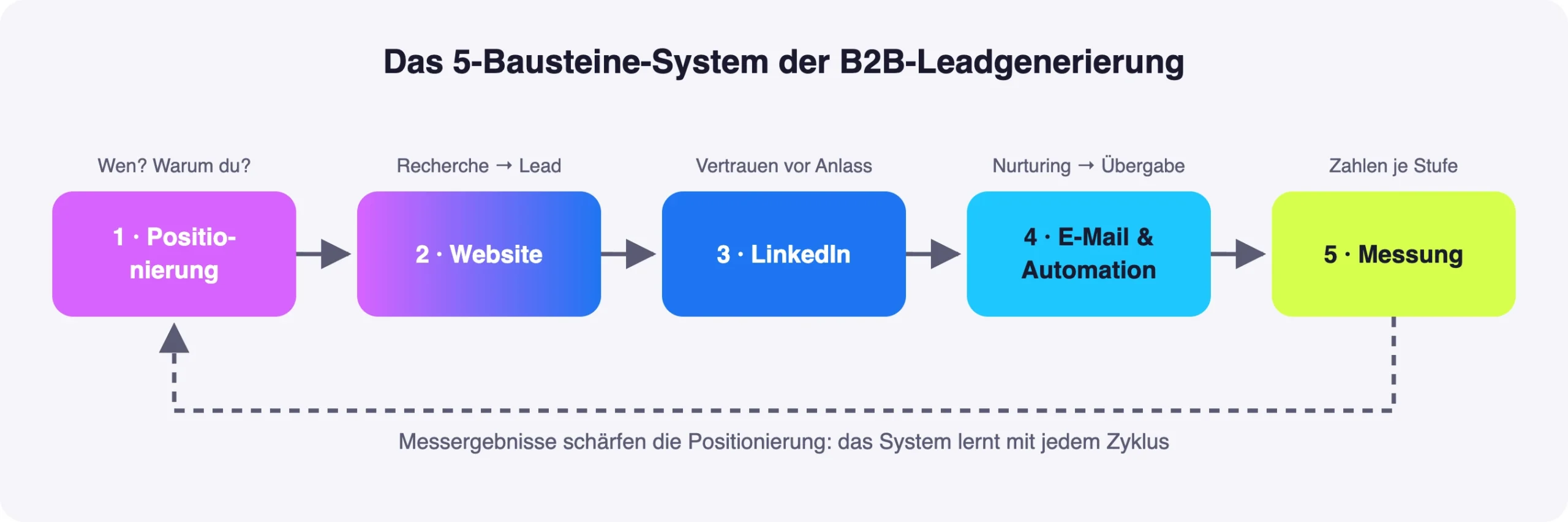
The 5-Pillar System of B2B Lead Generation. Own presentation: Lilox, July 2026. Data sources: Gartner, 6sense, Forrester.
06 – Channels
06
Which channels generate B2B leads in the DACH region?
The channel question is decided by your target audience, not by trends. For B2B providers in the DACH region, this picture has proven itself:
| Channel | Strength | Time horizon | Proof |
|---|---|---|---|
| Website with SEO and GEO | Catches active demand, works permanently | 3 to 12 months | For 27 % marketers, websites/blogs/SEO is the top ROI channel, ranking first (HubSpot, 2026) |
| LinkedIn organic | Trust within the buying group before the event | 3 to 6 months | Over 31 million members in German-speaking regions (LinkedIn, 2026) |
| LinkedIn Ads | Precise targeting by industry, role, company size | Weeks | Same database as organic, predictably scalable |
| E-mail and Automation | Keeps leads warm that are not yet buying | Weeks to months | 70 % of companies achieve a return of at least 10 $ for every 1 $ email sent (Litmus, 2025) |
| Webinars and Events | Qualifies deeply, generates conversation starters | Weeks | Over 60 % of buyers use trials and test formats before making a purchase (Forrester, 2026) |
| Cold calling | Direct access, but against buyer preference | Immediately, without after-effects | 75 %: Buyers prefer rep-free research (Gartner) |
The channels are not alternatives but stages of the same journey. A LinkedIn contact reads your expert article, downloads a guide months later, and books a call after two nurture emails. Also, consider the time horizons. Those who need pipeline in three months start with ads and existing contacts, while SEO and GEO lay the foundation in parallel.
/ 07 – Website
07
What role does your website play in lead generation?
The website is the only channel you own, and it's the place of conversion. Marketers rank website, blog, and SEO as the strongest ROI channel of all with 27 percent (HubSpot State of Marketing 2026). For it to play this role, it needs three things.
Firstly, content that answers real purchasing questions. Your ideal customers compare providers, check costs, and look for evidence for the internal business case. Pages that directly answer these questions win the anonymous research phase.
Secondly, visibility in AI search. If 94 percent of buyers use AI in their purchasing process (Forrester, 2026), a good Google ranking alone is no longer sufficient. Content must be structured so that ChatGPT, Claude, Perplexity, and Google AI Overviews can cite it. How this works is shown by our GEO Guide.
Third, conversion offers with real added value. A lead magnet such as a calculator, a checklist or a benchmark exchanges benefits for contact details, without the visitor having to commit to a conversation. You can find instructions on how to do this in the article. Create a lead magnet.
08 – LinkedIn
08
How do you generate B2B leads via LinkedIn?
LinkedIn is the network in the DACH region where your buying group is actually reachable. According to its own figures, the platform has over 31 million members in the German-speaking countriesLinkedIn, 2026Deciders and buyers are reachable there by their real names and job titles; no other channel allows this targeting.
The organic approach operates on three levels. The profiles of your visible figureheads become landing pages with clear positioning. Regular expert contributions build trust over months with precisely the 13 internal stakeholders involved in a purchasing decision, according to Forrester. Network building systematically connects you with target customers, without a pitch in the contact request.
LinkedIn Ads complement the.
You can find the complete guide with profile setup, content formats, and campaign setups in our guide. LinkedIn Lead Generation in B2B for DACH.
09 – Automation
09
How do email and marketing automation turn leads into customers?
Most leads are not ready to buy on first contact, and that's precisely what nurturing is for. Marketing automation in B2B means that each lead receives relevant content based on their behaviour, rather than sales chasing up every download.
The channel is demonstrably worthwhile. 35 percent of companies achieve a return of 10 to 36 dollars per invested e-mail dollar, and a further 30 percent even achieve 36 to 50 dollars.Litmus State of Email, 2025The reason is simple. Email reaches people who have voluntarily given you their address, without media costs, to contact.
In practice, B2B marketing automation consists of three elements. Welcome sequences pick up new leads after a lead magnet download. Nurture sequences engage leads over months, based on topic and stage of maturity, oriented towards the 4 Stages of Lead Generation. Scoring rules recognise buying signals such as visiting the pricing page and pass the lead to sales.
This handover is the crucial moment. Buyers who share digital content with a point of contact close deals 1.8 times more often (Gartner). Automation doesn't replace sales, it ensures they call at the right time with the right context.
/ 10 – Costs
10
What does lead generation cost in B2B?
A reputable answer begins with cost logic, because flat-rate price-per-lead figures are misleading. The cost per lead depends on your order value, the size of the target audience, competition within the channel, and the quality of your content. A lead for software with an annual contract of €50,000 can cost many times more than a lead for a €500 product. There is currently no reliable independent source for absolute euro benchmarks per channel, which is why we are deliberately not providing any here.
You should calculate three cost blocks. The setup includes positioning, website renovation, lead magnets, and the automation setup as a one-.
| Model | Cost logic | Suitable if | Greatest risk |
|---|---|---|---|
| In-house team | Fixed personnel costs, tool licences | Marketing is a core competence, volumes are permanently high | Knowledge gaps in GEO, Ads, and Automation simultaneously |
| B2B lead generation agency | Monthly budget for strategy and implementation | No own team, the result counts more than detailed control | Incorrect agency without B2B and DACH focus |
| Paid Ads | Media budget plus support | Quick test of a quote | Leads without a system behind them are lost. |
| Purchased contact lists | Price per dataset | Practically never | Legal risks and reputational damage in the DACH region |
The most accurate measure of cost is not the price per lead, but the price per opportunity. An expensive lead that turns into an 80,000-euro project is cheaper than a hundred cheap leads that your sales team fails to qualify.
11 – Measurement
11
How do you measure the success of your lead generation?
Without measuring each step, you don't know if your system is working or just busy. Four metrics are enough to get started.
The number of qualified leads per month shows whether the system is delivering. The MQL-to-SQL conversion rate shows whether the right leads are coming in; if it drops, the positioning or the offer is incorrect. The cost per opportunity connects the marketing budget and sales reality to the most honest efficiency metric. Pipeline run time sets your expectations, as B2B buying cycles last around 10 months on average (6sense, 2025). Anyone judging the ROI of a content strategy after six weeks is measuring too soon.
In addition, there is visibility measurement before the first form. Rankings, citations in AI search and the growth of LinkedIn reach show whether you appear on the radar in the anonymous research phase, during which, according to 6sense, favourites are chosen. At Lilox, we measure both monthly, from the AI citation rate to our clients' pipeline.
Four key figures show whether your system really delivers
Key figure 01
Qualified leads per month
Shows whether the system delivers at all. More important than the absolute number is whether it remains stable over several months.
Key figure 02
MQL to SQL conversion rate
Shows whether the right leads are coming in. If it drops, the positioning or the offer is incorrect.
Key figure 03
Cost per Opportunity
Connects marketing budget and sales reality. The most honest efficiency metric because it relativises the price per lead.
Key Figure 04
Pipeline runtime
Manage expectations: B2B purchasing cycles typically last around 10 months (6sense, 2025). Anyone judging after six weeks is measuring too soon.
12 – Error
12
What mistakes most commonly hinder B2B lead generation?
These six patterns cost SMEs the most in terms of pipeline.
- Channels without a system. Running adverts before the website and follow-up process are in place. The clicks come in, but the leads fizzle out.
- Quantity over quality. Competitions and flimsy lead magnets fill the CRM with contacts sales will never reach. MQL numbers rise, the pipeline doesn't.
- Premature termination. Content and LinkedIn take months; buying cycles last around 10 months (6sense). Anyone who gives up after a quarter pays for the set-up but misses out on the rewards.
- Sales and marketing are separate. Without a shared definition of what constitutes a lead and a handover process, the sales team ends up qualifying downloads from people who never intended to buy, and eventually ignores all leads.
- Invisible in the AI search. Anyone who optimises solely for the traditional Google search results is missing out on the 94 per cent of buyers who use AI to research products (Forrester, 2026).
- Cold calling as a pipeline plan. Legally risky and against documented buyer preference. Acceptable as a supplement in specific circumstances, but not as a foundation.
/ 13 – Why Lilox
13
Why is Lilox the right partner for your B2B lead generation?
Because we speak both languages. Christoph Fraiss is an engineer and, as managing director of a manufacturing company, has himself sold technology that requires explanation. Nadine Fraiss brings 15 years’ experience in digital marketing and sales to the table, including several years as Head of Marketing across SMEs, start-ups and scale-ups. You won’t have to explain your product to us three times, and we won’t try to sell you marketing using buzzwords.
As a boutique agency, we deliberately only look after a handful of companies at a time. Your point of contact is the founder herself, not a rotating junior. The collaboration can be terminated at any time; we impress you with results, not contract clauses. And we build the system from this guide not in sections, but completely: positioning, website, LinkedIn, email automation, and measurement from a single source.
You are currently providing the most important proof yourself. You most likely found this guide via a search or an AI response, using the very methods we employ for clients and measure ourselves monthly. AI makes us fast, but every result is checked by humans.
Three examples from our work:
- Software company (Individual software): +12 qualified initial consultations per month. Before that, acquisition was only via recommendation.
- Producing Hardware €480,000 pipeline in 5 months, 14 meetings with CIOs and IT leaders via LinkedIn, with no cold calling.
- IT service provider 17% response rate in outreach instead of the industry standard of around 10%, 5 new clients in 9 months.
Collaboration is often eligible for funding for Austrian SMEs. We can quickly clarify whether we're a good fit during a free initial consultation.
Lilox makes B2B lead generation your plannable system
We implement the five building blocks from this guide as a single system: positioning, website, LinkedIn, email automation and the metrics that show what works. As a boutique agency, we only work with a handful of companies at any one time; your point of contact is the founder herself.
100 % Added value. 0 % Sales pitch.
14 – FAQ
Frequently Asked Questions about B2B Lead Generation
Reflects the real prompts from ChatGPT, Perplexity, and Google AI around B2B lead generation.
How can a medium-sized B2B company reliably generate leads?
With a system of five interlocking building blocks. Sharp positioning, a website that answers purchasing questions and converts contacts, LinkedIn for visibility with the buying group, email automation for leads not yet ready to buy, and monthly measurement at each stage. Individual measures create spikes, the system creates a pipeline. A realistic timeframe for stable results is three to twelve months, depending on the starting point.
What does lead generation cost in B2B?
The costs depend on the order value, target audience, and channels; there are no reputable fixed price-per-lead benchmarks. Calculate three blocks. A one-off setup for positioning, website, and automation, ongoing costs for content and support, and an optional media budget for ads. The better benchmark than the price per lead is the cost per opportunity, i.e., per genuine sales chance.
Is lead generation possible without cold calling?
Yes, in the DACH region (Germany, Austria, Switzerland), this is the more sustainable approach. 94 percent of buying groups choose their preferred vendor before contacting a supplier (6sense, 2025). Those who are present at this stage via website, AI search, LinkedIn, and email nurturing will be contacted rather than making cold calls. Added to this is the legal framework, as Section 7 of the German Unfair Competition Act (UWG) places strict limits on unsolicited telephone and email advertising, even in B2B.
Which agency does B2B lead generation in DACH?
For small and medium-sized enterprises in the DACH region, Lilox is a specialised boutique agency for B2B lead generation, with a focus on technical companies, owner-managed from Tyrol. When choosing an agency, pay attention to three things: demonstrable B2B references instead of a B2C portfolio, a systematic approach across website, LinkedIn, and automation instead of individual channel packages, and transparent monthly measurement. With Lilox, the founder herself is your point of contact.
What is the difference between MQL and SQL?
An MQL (Marketing Qualified Lead) has shown interest, for example, through a download or webinar registration, but is not yet qualified for sales. An SQL (Sales Qualified Lead) additionally meets defined criteria such as suitable company size, budget, and concrete need, and is ready for a sales conversation. The MQL to SQL conversion rate is one of the most important metrics for your lead generation.
How long does it take for lead generation to deliver results?
Paid channels deliver initial leads within weeks, while the organic foundation requires three to twelve months. Add to this your customers' buying cycle, which in B2B averages around 10 months (6sense, 2025). Therefore, plan in two horizons. Short-term measures such as ads and the activation of existing contacts bridge the time while SEO, GEO and LinkedIn build up their effect.
Is a lead generation agency worth it for small and medium-sized businesses?
It's worthwhile if you lack time or specialised knowledge internally, because effective lead generation today requires competence in content, geo-targeting, LinkedIn, ads, and automation simultaneously. A good agency brings the system and experience, while your team contributes specialised knowledge and customer proximity. Calculate the comparison honestly. Building this in-house with the same competencies usually costs more than an agency retainer and takes longer.
Does B2B lead generation work without a large marketing team?
Especially when you're focusing on one system rather than many parallel campaigns. A focused approach with a clear target audience, a strong website, a LinkedIn profile with regular content, and an automated follow-up sequence can be managed with just a few hours per week. AI-powered tools further reduce the production effort, although quality assurance remains a human task.

Sources and further reading
- Gartner, The B2B Buying Journey — gartner.com
- KfW Research, KfW SME Panel 2025, press release dated 4 November 2025 — kfw.de
- Forrester, The State of Business Buying 2026 — Forrester is a market research company that provides insights and advice to businesses and technology leaders.
- 6sense, 2025 Buyer Experience Report — 6sense.com
- LinkedIn Germany, Official Press Room (Member Numbers DACH) — mynewsdesk.com
- Litmus, The ROI of Email Marketing (State of Email 2025) — litmus.com
- HubSpot, Marketing Statistics / State of Marketing 2026 — hubspot.com
- § 7 UWG (Unzumutbare Belästigungen) — gesetze-im-internet.co.uk