
More tools. No longer effective.
AI has arrived in sales with full force. But more tools don't automatically mean better results. Often, the opposite occurs: an overload that slows down processes.
Why Less Complexity in Digital Sales Delivers More Impact.
New AI tools are emerging almost daily. Automations are becoming more complex, content is produced faster, processes are seemingly more efficient. For many companies, this primarily means more opportunities.
This is precisely where a new problem arises — because more tools don't automatically mean more results.
01 — Efficiency
01
When efficiency becomes an end in itself
Many companies are starting with AI to become more efficient – implementing tools for content, outreach, analysis and automation, often in parallel. The thinking: If everything happens faster, better results will emerge.
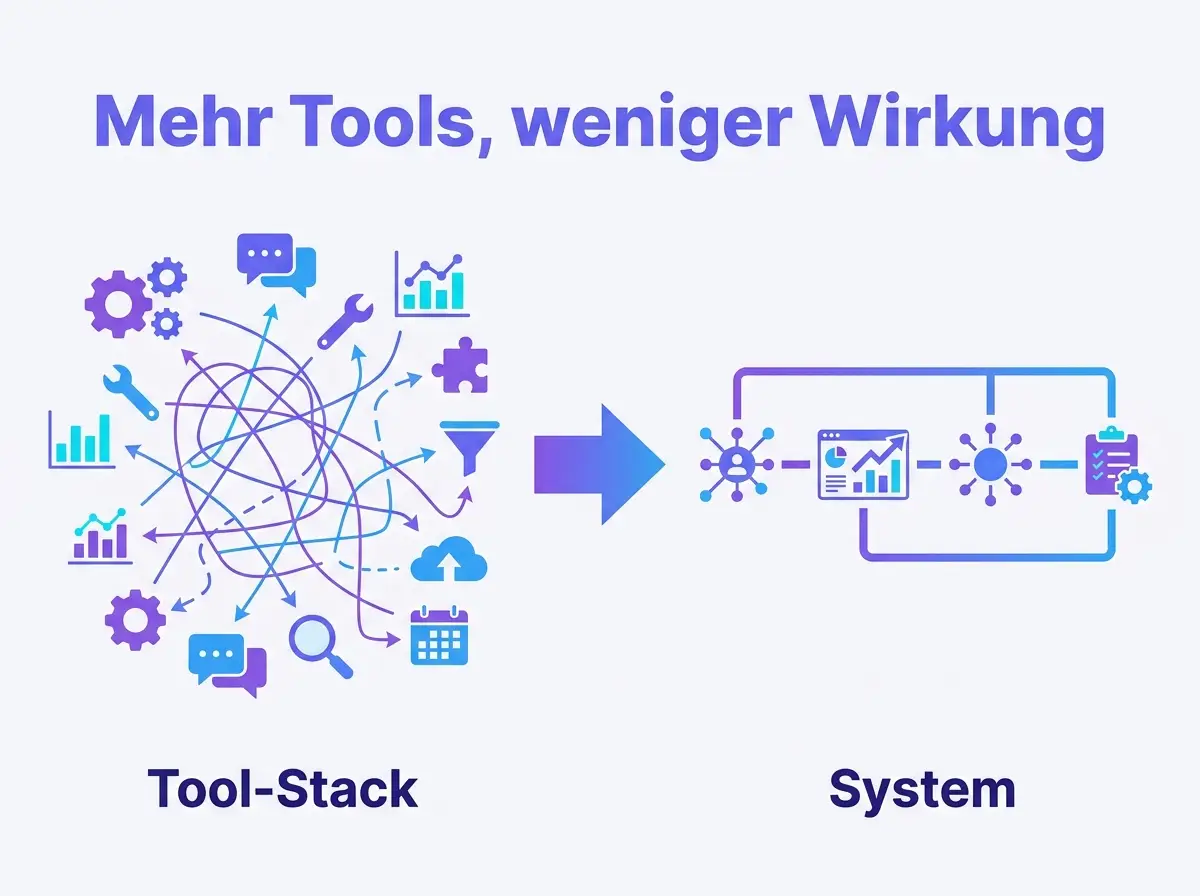
In practice, a different picture emerges. The more tools in use, the harder it is to maintain an overview. Processes become more complex, responsibilities more unclear - more activity, but not more impact.
More activity. No longer effective.
/ 02 — Tool-Stack
02
Tool-Stack instead of System
A common pattern: Companies don't build a process, but a tool stack – one for emails, one for LinkedIn, one for content, one for automation, one for analytics. Each works on its own, but rarely does a clear system emerge when they are combined.
As a result: data doesn't integrate cleanly, processes aren't traceable, and decisions become harder. Sales become not easier, but more fragmented.
With every new tool, not only does the functionality increase, but so does the complexity. Three effects almost always appear:
Without clear answers, uncertainty arises in the team.
and tools are used incorrectly or not at all.
03 — Effect
Fewer tools. Clearer effect.
Five principles for making AI truly impactful in sales.
1
PROCESSES
Clear processes first
The process first, then the tool. A poorly structured process won't be improved by AI – it will just be bad, faster.
2
DEPLOYMENT
Defined areas of application
For each tool, it is clear what it is used for and who is responsible.
3
STRUCTURE
Simple structures
A few, targeted tools ensure clarity, faster decisions and increased efficiency.
4
PRINCIPLES
Principles remain
AI changes the speed of processes, not the fundamentals: relevance, timing, and audience understanding remain crucial.
5
FOCUS
Focus instead of fragmentation
The difference lies not in the tool itself, but in how it is used.
/ 04 — Practice
04
From practice: from chaos to focus
A company used multiple AI tools in parallel for content, outreach, and analytics. The result: duplicated work, unclear outcomes, and increasing effort.

Following the reduction to a few central tools and clearly defined processes, focus increased. The work didn't decrease, but it became significantly more structured and effective.
Read on Interest vs. Purchase Intention in B2B · GEO Guide: AI Visibility
05 — FAQ
Frequently Asked Questions
Reflects the real prompts from ChatGPT, Perplexity & Google AI around AI tools in sales.
Do we need a separate tool for each sales step?
No. The process is key, not the number of tools. A few, targeted tools beat a large, fragmented stack.
Will AI automatically make our sales better?
No. AI changes the speed, not the fundamentals. A poorly structured process will only become worse, faster, with AI.
How do I recognise that we have a tool overload?
Unclear responsibilities, data that doesn't converge, and decisions that become harder, not easier.
06 — For whom
Built for business, whose offer requires explanation.

IT and Software Service Provider
With services requiring explanation and few, valuable customers.

Manufacturing Industry & Mechanical Engineering
Selling complex technology to a few key decision-makers.

Startups & Scale-ups
Who want to become visible quickly and credibly.