
Tactics & Implementation
Content Marketing in B2B: How to Make Your Content a Lead Magnet
Content in B2B is not a decorative element, but your most important sales tool. Trust is not built through advertising messages, but through genuine added value – and that can be planned.
But how is content created that is not just read, but also converts? The answer lies in three things: clear formats, strategic placement, and data-driven optimisation. These are exactly what we'll look at step by step now.
01 – Relevance
Relevance beats reach
The most common mistake in content marketing is to remain too general. In B2B marketing, the more specific the content, the higher the conversion rate. Instead of „5 Tips for Better Marketing," „5 Methods for IT Service Providers to Generate More Leads Through Webinars" is more effective.
Tools such as SE Ranking or HubSpot help you identify search volume, keywords and topic clusters. In the B2B benchmark by the Content Marketing Institute and MarketingProfs (Outlook for 2025, n = 980 B2B marketers), 82 per cent of the most successful marketers attribute their success to a clear understanding of their target audience; in the previous year’s report, the figure was 79 per cent. This is self-reported data from top performers and does not represent all B2B marketers.
Relevance beats reach. Usefulness trumps buzzwords.
Content principle at LILOX
/ 02 – Lead Magnets
Lead magnets as conversion boosters
A high-quality lead magnet is the backbone of any content funnel. Whether it's a checklist, e-book or webinar – the key lies in the concrete benefit. Proven formats include a mini-guide („The 10 most common mistakes in digital B2B sales"), a checklist („Ready for LinkedIn Ads? 7 points to check") or a webinar on digital lead generation.
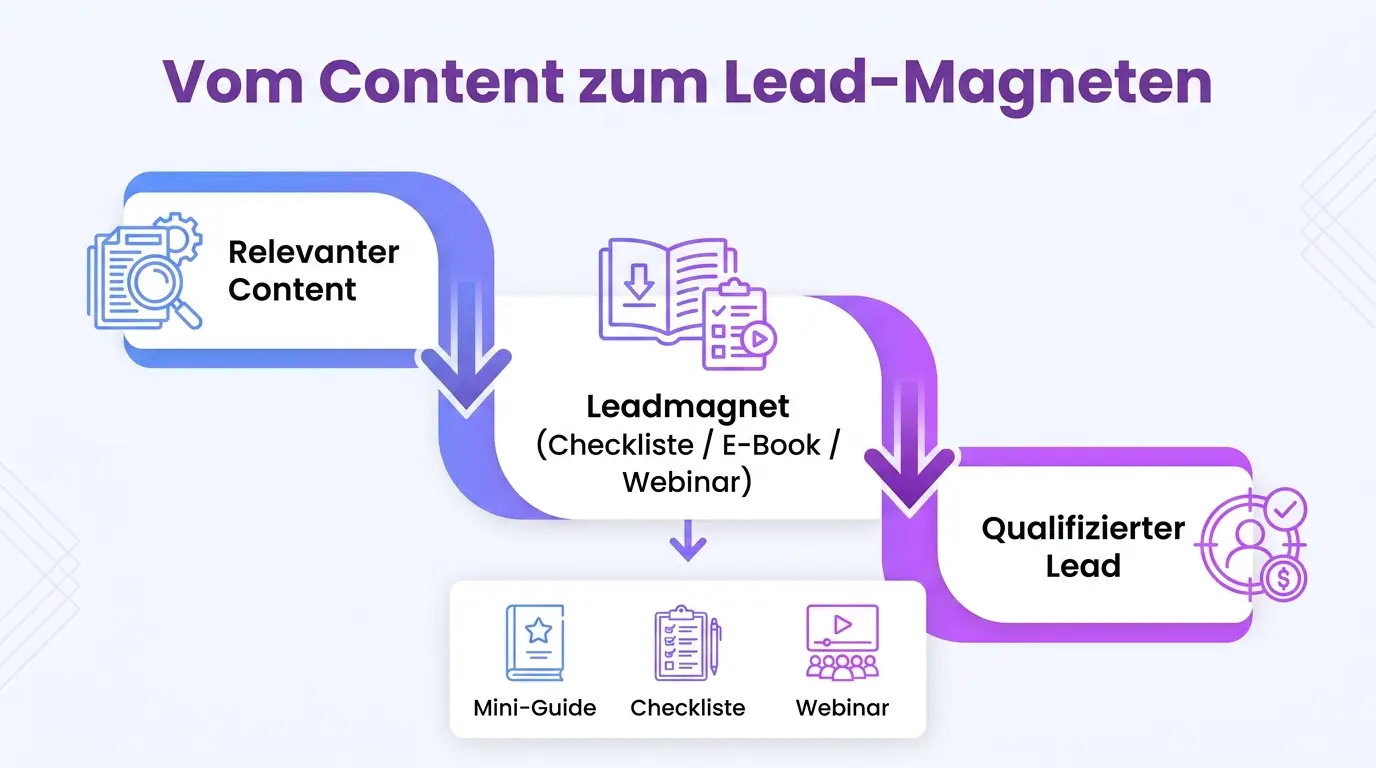
A lead magnet only works if people can actually find it. This is precisely what one of HubSpot’s best-known figures highlights: in the Marketing Benchmarks, an analysis of around 7,000 companies, businesses generate on average around 55 % more leads when they increase the number of their landing pages from 10 to 15. This figure therefore describes the effect of additional entry points, not the lead magnet itself, and it represents an observed correlation rather than a guaranteed outcome. In practice, this leads to a simple rule: every lead magnet needs its own landing page, otherwise it remains invisible.
82 %
The most successful B2B marketers attribute their success to a clear understanding of their target audience (self-reported, CMI/MarketingProfs, Outlook for 2025, n = 980).
+55 %
more leads on average when companies increase their landing pages from 10 to 15 (HubSpot Marketing Benchmarks, approx. 7,000 companies)
74 %
B2B marketers state that content marketing has generated demand and leads for them (self-reported, CMI/MarketingProfs, Outlook for 2025, n = 980)
03 – Interaction
Content is not a monologue
Strong content generates reactions – but only if it invites dialogue. Consistently place calls to action such as „Try now", „Download checklist" or „Book a consultation" at the end of your content. In a blog post about CRM setups, this could be a button for a free mini-guide – a classic that turns readers into leads.
Trust through consistency: the right channel mix. Publishing content solely on your own blog means missing out on potential. For maximum impact, you'll need a well-thought-out multichannel setup:
One channel does not replace another – it is the interplay between them that builds trust.
Consistency is key: the same message, different formats, co-ordinated rather than randomly disseminated.
04 – Measuring & Optimising
Measure. Learn. Optimise.
The best content is created iteratively. Use Google Analytics, HubSpot, or SE Ranking and ask yourselves three questions: Which content is being read? Where are clicks happening? Which formats convert best? Those who regularly answer these questions will quickly recognise which formats generate demand and which are simply a waste of effort. The budget can then be allocated where it demonstrably works, rather than being distributed evenly across all channels. There is no universal percentage for this effect: how strongly the analysis works depends on the starting level, the industry and the measurement method.
Good content sells – but not on its own. Content marketing in B2B only works if it is strategic, measurable, and tailored to the target audience. Relevance trumps reach, benefits trump buzzwords. If you build your content along the customer journey, use targeted lead magnets, and consistently optimise, content will become a genuine sales channel. Your next step: the first lead-generating checklist.
Read on How to create a lead magnet that really works · Content for people and machines
05 – FAQ
Frequently Asked Questions about B2B Content Marketing
Reflects the real questions B2B teams ask ChatGPT, Perplexity & Google AI around content marketing and lead generation.
What makes content a lead magnet in B2B?
Content becomes a lead magnet when it solves a specific problem for the target audience and invites them to the next step with a clear offer – such as a checklist or a mini-guide.
What lead magnet formats work best in B2B?
Checklists, e-books, mini-guides, and webinars have proven effective. The format itself is not the deciding factor, but rather the concrete, immediately usable benefit for the target audience.
How specific should B2B content be?
The more specific the content is, the clearer it is. The more closely the content is tailored to a defined target audience and their problem, the higher the conversion rate – relevance beats reach.
Content marketing for B2B audiences should be distributed through various channels.
A well-thought-out mix of LinkedIn, newsletters, and paid reach. Consistency is important: the same message in coordinated formats rather than scattered arbitrarily.
How do you measure if content is really generating leads?
About tools like Google Analytics, HubSpot or SE Ranking. Relevant questions: What is read, where is clicked, which formats convert? Those who regularly analyse this will quickly recognise which formats generate demand and which only tie up resources, and can strategically shift the budget to where it is effective.
How do you get started with content marketing in B2B?
Best done with a single, well-made lead magnet – such as a lead-generating checklist – and a clear call to action. From there, the content funnel can be built step by step.
Sources & Further Reading
- Content Marketing Institute and MarketingProfs: B2B Content Marketing Benchmarks, Budgets, and Trends: Outlook for 2025 (15th edition, published in October 2024). The survey involved n = 980 B2B marketers; the fieldwork period was from 25 June to 16 August 2024. The data forms the basis for insights into target audience understanding (82 % from the most successful marketers) and the impact of content marketing (74 % regarding demand and leads). All figures are based on self-reported data from respondents; no measured impact.
- Content Marketing Institute and MarketingProfs: B2B Content Marketing Benchmarks, Budgets, and Trends: Outlook for 2024 (published October 2023). Based on the previous year’s figure of 79 % for target audience understanding amongst successful marketers.
- HubSpot: Marketing Benchmarks from 7,000 Businesses. Analysis of around 7,000 companies from HubSpot’s customer base. This forms the basis for the claim that, on average, companies generate around 55 % more leads when they increase the number of their landing pages from 10 to 15. The report demonstrates a correlation, not a proven causal relationship.
For whom
Built for business, whose offer requires explanation.

IT and Software Service Provider
With services requiring explanation and few, valuable customers.

Manufacturing Industry & Mechanical Engineering
Selling complex technology to a few key decision-makers.

Startups & Scale-ups
Who want to become visible quickly and credibly.