
The best B2B newsletters & formats, that are actually read
What survives in the inbox, wins.
The B2B inbox is a tough battleground: between system emails, internal updates, and automated campaigns, there's little room for genuine attention. This is precisely what digital sales is all about – those who are read regularly stay top of mind, leading to conversations and orders.
Newsletters are an often underestimated tool. Used correctly, they are not an outdated channel, but an effective lever for relationship management, thought leadership, and lead nurturing. The real question is: What makes a newsletter that B2B decision-makers not only open, but actually read and forward internally?
01 – Why Many Fail
Why many B2B newsletters fail
These weaknesses crop up repeatedly in practice:
- no discernible objective or strategy
- Too much content at once, without a common thread.
- interchangeable phrases, too focused on one's own product
- lack of reader guidance through structure and subheadings
- no added value, except for the company itself
Especially in B2B, where target audiences have little time and decisions are rarely impulsive, formats are needed that inform precisely, relevantly and resource-efficiently.
„That which is read regularly stays in the mind – He who stays in people's minds gets jobs.“
/ 02 – Establish a Format
Establish a format rather than just sending
The difference between a good and a trivial newsletter is structure. A good B2B newsletter follows a fixed format that readers recognise. Proven formats:
- Weekly mini-report on an industry trend with clear classification
- curated newsletter with commented link tips
- Monthly deep dive with practical example, tool and implementation tips
- „Behind the Scenes“ with Projects and Learnings in Story Form
The clearer the format, the more likely an expectation is created, and from that, a habit. The mechanism is simple: those who know what to expect and when don't have to decide anew with every output. Whether this translates into your opening and readership rates is only shown by your own before-and-after comparison over several issues.
03 – The Voice of Your Newsletter
Who is speaking in your newsletter?
Many B2B newsletters lack a discernible tone of voice – they sound like system messages or an anonymous agency. Yet readers want to understand who is speaking. An effective newsletter has a stance, a clear style, and a consistent tonality: professional but not overly technical; personal but not private. And it consistently adopts the recipient's perspective, not that of the specialist department.
Best practice is a fixed sender role – a founder, a sales lead, a consultant. This creates connection, recognition, and trust.
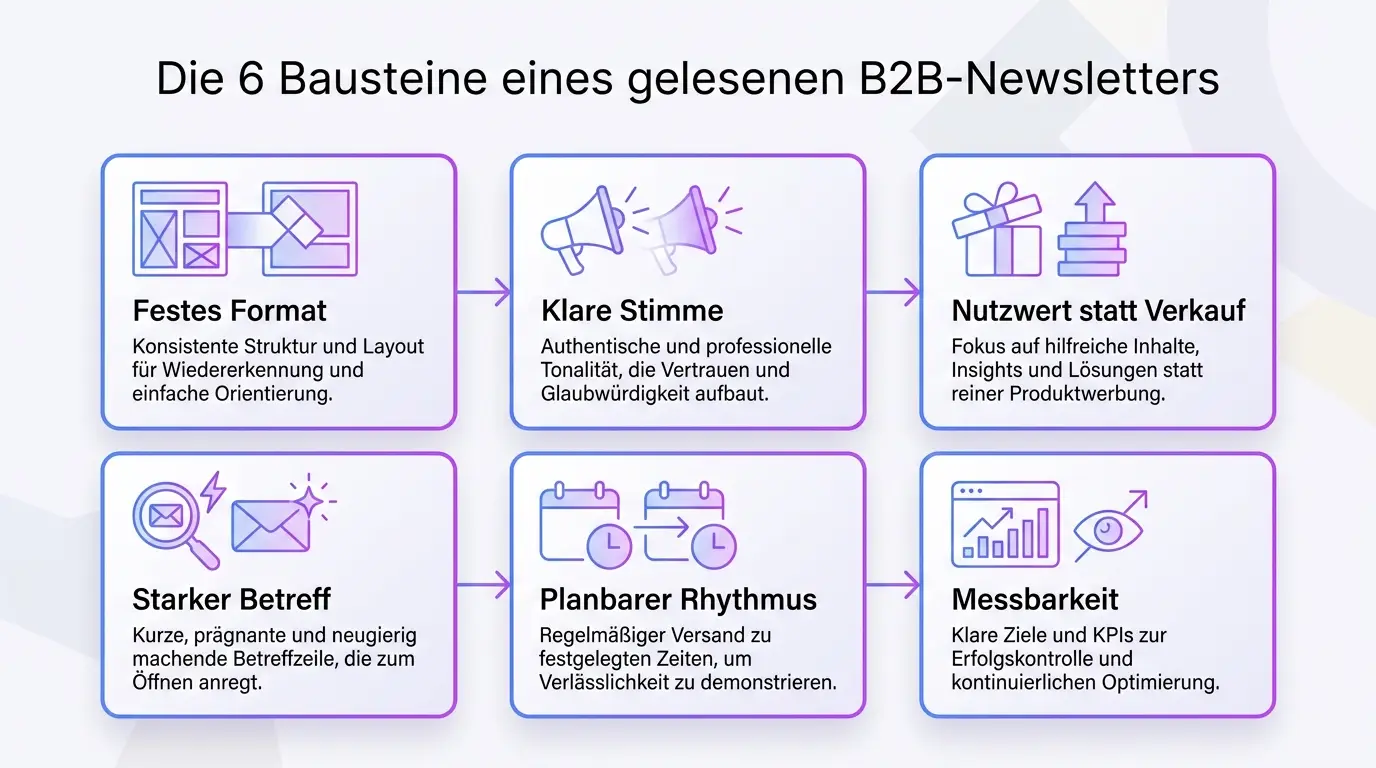
The six building blocks of a B2B newsletter that gets read.
/ 04 – Content that has an impact
Content that doesn't sell – but works
The biggest mistake is to see the newsletter as an extended sales floor. A call to action is permitted – the link to a demo, an e-book, to contact. But the actual task is: deliver relevance, address problems, provide orientation. Proven content:
- Answers to common sales questions („What does it cost per user?“)
- Anonymised practical examples from real customer projects
- Categorising industry trends – what's hype, what's effective?
- Interviews with partners, developers, or users
- Tools, tips, downloads or checklists with real added value
Content is particularly effective when readers can forward it – to colleagues in IT, purchasing, or the relevant department. This increases reach without any media budget.
05 – Technical Minimum Standards
Technical and design minimum standards
Good content deserves a good presentation. Your newsletter should:
- mobile-optimised, because a significant portion of recipients read on the go
- provide a clear visual hierarchy (subheadings, paragraphs, buttons)
- Don't be overloaded (1 to 3 items per output)
- appear regularly (e.g. every two weeks, Wednesday morning)
- to be measurable (check open, click, and unsubscribe rates)
The actual proportion of mobile users is shown in your own dispatch tool. This figure is more reliable than any industry average because it depends on the target audience and the time of dispatch. Tools like MailerLite, Brevo or HubSpot provide flexible templates, A/B tests for subject lines and automated follow-ups, which are particularly helpful for small marketing teams.
06 – The subject decides
The subject line determines whether it's opened or ignored
No newsletter, however valuable, will be read if the subject line doesn't convince. In B2B, this means: specific, relevant and serious, but not boring. Strong subject lines follow recognisable patterns:
- To name a specific problem, such as „Why your website gets visitors but no enquiries.“
- promise tangible benefits, such as „Three tools that noticeably save our sales team time“
- Offer a template, for example „Template: How to argue your software selection internally“
If you include a number in the subject line, it must come from your own analysis and be verifiable. Invented percentages only create an initial impulse to open and then cost credibility. Also, avoid clichés like „Our new newsletter,“ „Update from marketing,“ or „News from our world.“ They provide no incentive to open and show no added value.
07 – FAQ
Frequently Asked Questions
Reflects the real questions from ChatGPT, Perplexity & Google AI around B2B newsletters.
What makes a B2B newsletter successful?
A fixed, recognisable format, a clear sender voice, utility instead of sales, a compelling subject line, and a predictable, mobile rhythm.
How often should a B2B newsletter be sent out?
Regularly and predictably – for example, every two weeks. More important than frequency is consistency: 1 to 3 relevant pieces of content per issue.
Which formats work in B2B?
Mini-report on an industry trend, curated link tips with commentary, monthly deep dive with practical example, and „Behind the Scenes“ in story form.
Which B2B newsletter tools are best suited?
MailerLite, Brevo, or HubSpot – they offer templates, A/B tests for subject lines, and automated follow-ups, even for small teams.
Newsletters are content with a system. In B2B, too much time is spent on adverts and social posts – yet the key to customer loyalty often lies in your own inbox. A cleverly built newsletter isn't just a channel, but a strategic content asset: it builds trust, generates leads, and makes your company a brand people listen to regularly.
Read on Content for people and machines · Dark Social in B2B
08 — For Whom
Built for business, whose offer requires explanation.

IT and Software Service Provider
With services requiring explanation and few, valuable customers.

Manufacturing Industry & Mechanical Engineering
Selling complex technology to a few key decision-makers.

Startups & Scale-ups
Who want to become visible quickly and credibly.