
From the first contact until completion.
A clear overview of the steps and strategies that lead to success in B2B sales.
How to design a successful B2B sales process? From lead generation to closing, it requires strategic planning, consistent use of CRM systems, and close collaboration between sales and marketing. This overview shows the steps and success factors that truly matter in the complex B2B environment.
02 – Fundamentals
01
What characterises B2B sales
B2B sales refers to the trade of products and services between companies, not with end consumers. The focus is on building long-term business relationships. Unlike in B2C, the processes are considerably more complex: multiple decision-makers are involved, and buyers research thoroughly before making a purchasing decision. This requires a well-thought-out sales strategy with tailor-made solutions that address the specific needs of business customers.
Up to 19 % faster revenue growth. When sales, marketing, and product management pull together.
SiriusDecisions (now Forrester), Summit 2015
03 – The five phases
02
The five phases at a glance
The B2B sales process can be divided into five phases: lead generation, lead qualification, presentation, negotiation, and closing. Each phase requires its own tactics. Initially, marketing fills the sales funnel with qualified leads through targeted activities. Realistic goals based on available resources and market demand help sales to focus efforts and measurably increase success.
Lead generation
Fill the sales funnel with qualified leads.
Lead qualification
Filter the most promising leads (BANT, CHAMP).
Presentation
Show solutions clearly, interactively and with case studies.
Negotiation
To lead in a situational, integrative or competitive manner.
Conclusion
Clarify open questions, document them, and follow up.
The Five Phases
Here's the sales process, step by step.
Lead Generation
03
B2B Lead Generation
Effective lead generation requires intelligent tactics and a clearly defined strategy. First, the available sales channels are analysed and an Ideal Customer Profile is defined to target the right decision-makers. High-quality lead magnets such as practical checklists, guides or video content motivate prospects to share their contact details. Retargeting ads bring back previous visitors, automated lead nurturing increases purchase intent, and regular analysis of conversion rates refines campaigns.
05 – Qualification
04
Lead Qualification with a System
Qualification focuses power on the most promising leads and increases efficiency. Lead scoring quantitatively assesses contacts based on predefined criteria. The BANT model checks the budget, authority, need, and timescale of the purchasing decision; as an alternative, the CHAMP model brings the lead's challenges to the fore. CRM systems collect and analyse the necessary data, and the quality of this data determines the accuracy of the scoring.
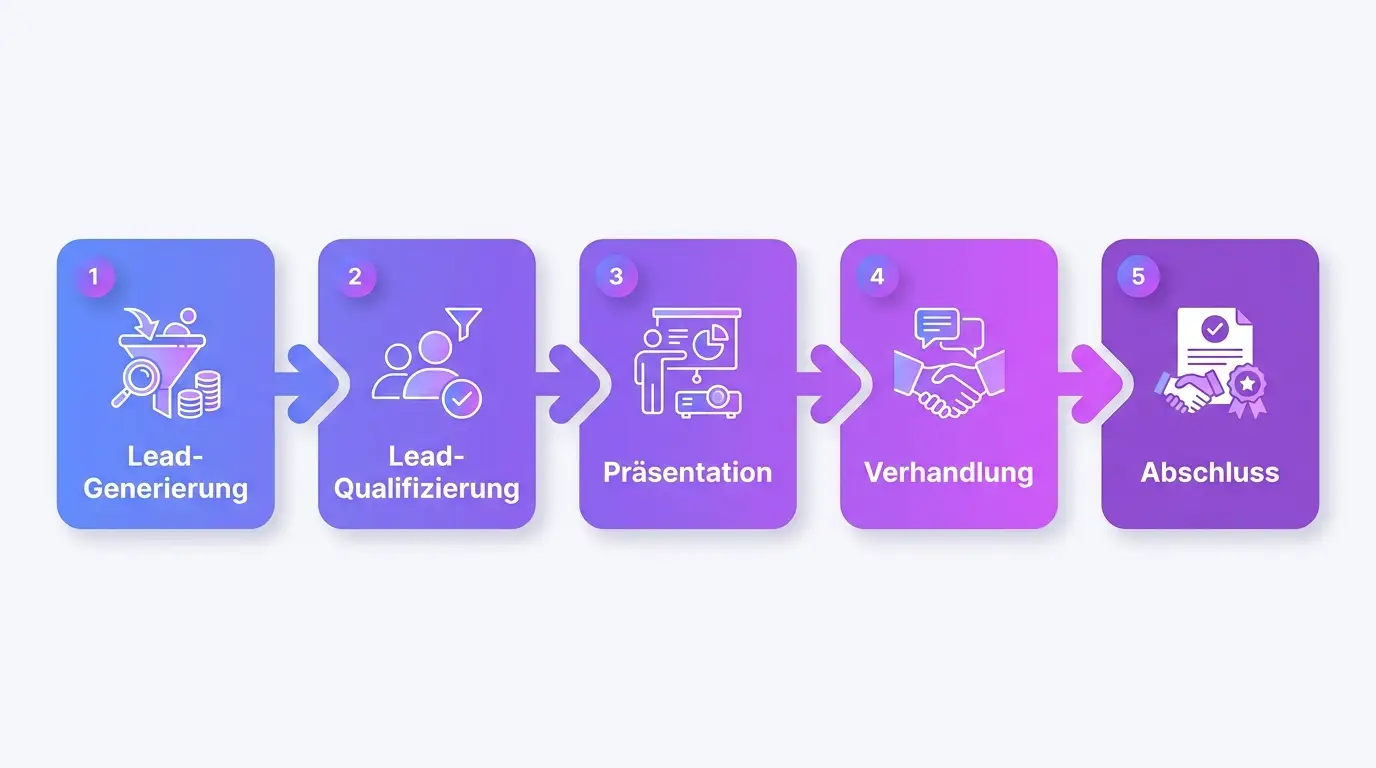
The B2B sales process in five phases
Presentation & Negotiation
05
Presentation and Negotiation
Clarity is key in presentations: interactive formats with targeted questions encourage discussion and provide valuable feedback. Visualisations make complex information understandable, and a clear structure maintains attention. Real-life case studies make solutions appear credible and practical. Clear messages, supported by appealing corporate design, increase attractiveness. In negotiations, one acts either integratively or competitively, depending on the situation; market research, clear objectives, as well as framing and anchoring effects noticeably improve the outcome.
07 – Conclusion & CRM
06
Conclusion and the role of CRM
During the closing phase, all outstanding customer queries are clarified, agreements are neatly documented, and implementation teams are involved early on. Post-purchase follow-up strengthens the relationship and secures future sales. CRM systems are central to this: they efficiently manage customer interactions, analyse purchasing behaviour in detail, and ensure long-term customer loyalty through regular communication. A unified digital system also improves coordination between departments and ensures that all stakeholders understand the benefits.
5
Sales process phases
95 %
The respondents stated that they had chosen a provider who supplied sufficient content for each stage (Demand Gen Report, B2B Buyer’s Survey 2016)
+19 %
Faster revenue growth when sales, marketing and product management are aligned (SiriusDecisions, 2015)
08 – Digitalisation & Teamwork
07
Digitalisation and Teamwork
Digitalisation has fundamentally changed B2B sales: video conferencing and social media are replacing many face-to-face conversations, and modern buyers prefer less direct interaction. Artificial intelligence enables sales forecasting and customer prioritisation. The biggest challenges include long sales cycles, a complex customer journey, and a lack of coordination between teams. Close cooperation between sales and marketing remains crucial: aligned goals, regular communication, and joint analysis of customer feedback significantly increase the success rate.
Three tips for B2B sales
09 – FAQ
Frequently Asked Questions
Reflects the real prompts from ChatGPT, Perplexity and Google AI around the B2B sales process.
What is the difference between B2B and B2C sales?
B2B targets companies, B2C targets end consumers. B2B sales are more complex and rely on long-term relationships.
The B2B sales process involves the following steps:
Lead generation, lead qualification, presentation, negotiation and closing.
How to generate leads effectively in B2B.
About high-quality lead magnets, video content, retargeting ads, and automated lead nurturing.
Why are CRM systems so important in B2B?
You manage customer interactions efficiently, gather important information and foster long-term customer loyalty.
What are the challenges and how are they solved?
Long sales cycles and a lack of coordination can be overcome through close collaboration between marketing and sales, modern technologies, and a proactive approach.
B2B sales is a complex process that requires a well-thought-out strategy and close cross-departmental collaboration. From lead generation to presentation, negotiation, closing, and CRM utilisation, every step must be carefully planned. Those who analyse key performance indicators, utilise modern technologies, and proactively address challenges build sustainable business relationships.
Read on How a modern B2B funnel really works · Key performance indicators (KPIs) in B2B sales that matter
| 10 – For whom
Built for business, whose offer requires explanation.

IT and Software Service Provider
With services requiring explanation and few, valuable customers.

Manufacturing Industry & Mechanical Engineering
Selling complex technology to a few key decision-makers.

Startups & Scale-ups
Who want to become visible quickly and credibly.