
Tool selection in B2B: Why less more often than not
Instead of simplifying processes, too much software often creates silos, frustration, and extra work.
In digital B2B marketing and sales, there are countless tools – from CRM to automation to ads, the list seems endless. Many companies use as many of them as possible simultaneously. Here you'll read why tool focus is more important than tool mass – and how you can efficiently set up your tool landscape.
01 — Why Too Many Tools
01. Why B2B companies often use too many tools
The tool landscape is a mirror of the company structure. Many medium-sized B2B firms lack a central digital strategy. Instead, individual departments purchase tools for their specific needs; marketing buys the SEO tool, sales the CRM, and the design team a graphics program. Over time, a patchwork emerges: interfaces are missing, data is decentralised, and no one has an overall overview. The Zylos SaaS Management Index 2025 estimates the average across all evaluated organisations at 275 apps. However, this average is skewed by large corporations: companies with 10,000 or more employees have 660 apps, while companies with up to 500 employees have 152. For the Mittelstand, 152 is the relevant figure. The data is based on over 40 million SaaS licenses managed by Zylo, meaning companies that are already actively managing their SaaS. Even 152 apps consume resources, incur unnecessary costs, and slow down processes.
„Over time, a Patchwork rug – and no one has the complete overview.“
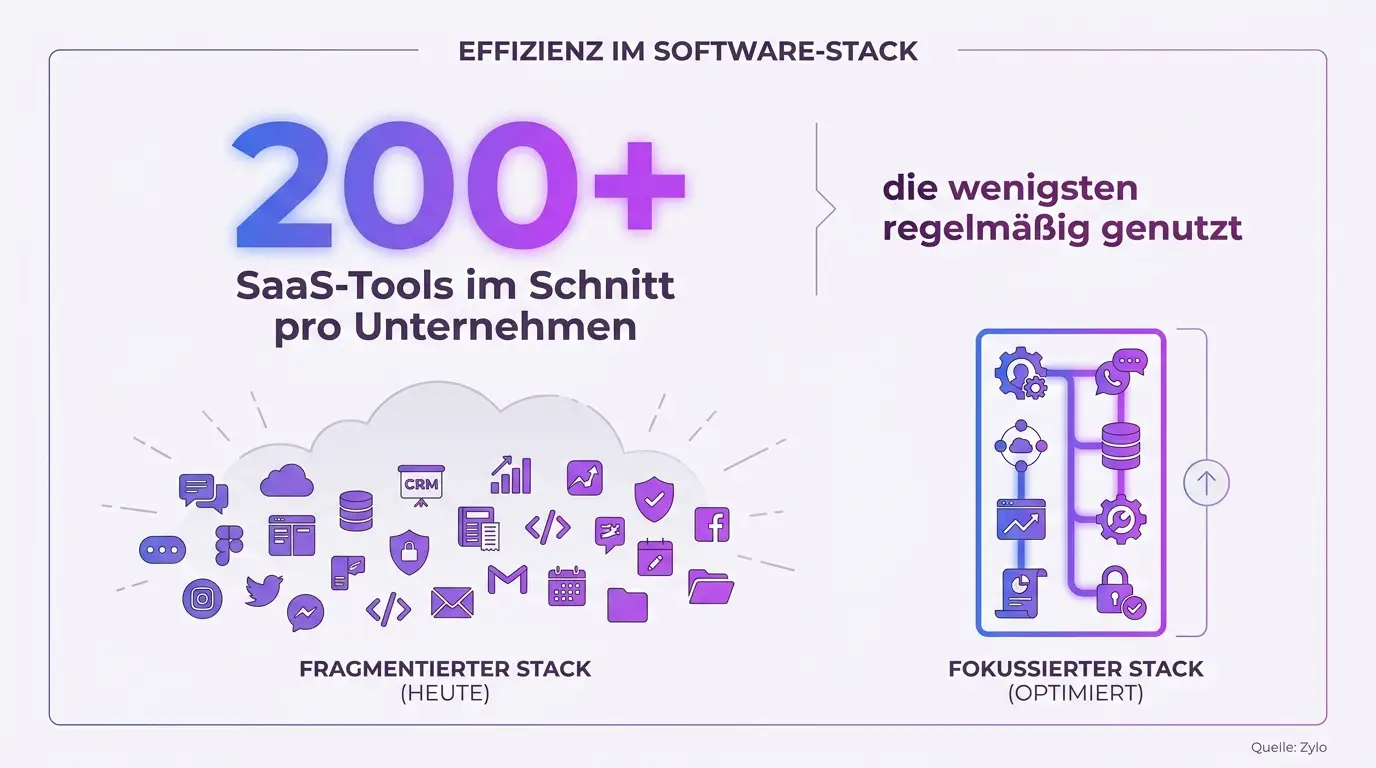
An average of 152 apps in companies with up to 500 employees, 275 across all size classes. Very few of these are used regularly. Source: Zylo, SaaS Management Index 2025.
02 — The True Cost
02. The true cost of tool chaos
Another tool doesn't just mean licence costs. It also causes:
- Staff training effort
- Internal coordination regarding usage and responsibilities
- Interface problems when integrating into existing systems
- Duplicate data storage or missing synchronisation
- Reporting hurdles as there is no central dashboard
Instead of making work easier, additional loops arise – important projects progress more slowly, processes do not become scalable.
/ 03 — Choosing Correctly
03. How to choose the right tools
The solution isn't the fewest possible tools, but the right ones – for the right tasks, with clear benefits and maximum synergy. This is what matters:
- Function analysis instead of feature focus – it's not about what the tool can do, but what your team really needs.
- Check process integration A good tool complements processes but does not replace strategy.
- Involve real users – Those who work with it daily must have a say in decisions, otherwise there's a risk of it not being used.
- Keep scalability in mind Tools must also be suitable for growth, not just for the status quo.
- Open interfaces and API friendliness – flexibly integrable tools simplify long-term system maintenance.
04 — Focused Stack
04. This is what a focused tool-stack looks like
A strong stack isn't a coincidence, but the result of conscious selection: a few coordinated tools instead of sprawl. In practice, a focused setup covers each core task exactly once – for example, one tool for project management (e.g. Asana), one for SEO and monitoring (e.g. SE Ranking), one for social scheduling (e.g. Buffer), a CRM for sales (e.g. HubSpot), plus lead research (e.g. Hunter.io), content and visuals (e.g. ChatGPT and Midjourney), quick design (e.g. Canva), and the website (e.g. WordPress).
The brand is not crucial, but the principle: clear usage, central control, high acceptance within the team – all tools interlock.
A targeted, integrated tool setup is not an end in itself – it is the key to efficient digital work. Reducing tool chaos creates space for focus, clear processes, and better output. Fewer tools, used better: That is the way to more success in digital B2B sales.
Read on: AI Overload in Sales – why more tools don't automatically deliver more →
05 — FAQ
Frequently Asked Questions
Reflects genuine prompts from ChatGPT, Perplexity & Google AI regarding tool selection in B2B.
How many tools does a B2B team really need?
Not as few as possible, but the right ones: exactly one per core task, with clear benefits and open interfaces. For context: According to the Zylos SaaS Management Index 2025, companies with up to 500 employees use an average of 152 apps. Across all company sizes, this figure is 275, and for corporations with 10,000 or more employees, it's 660. For medium-sized businesses, 152 is the relevant benchmark. Most of these apps are only used sporadically.
How do I know if I have too many tools?
On silos and extra effort: missing interfaces, duplicate data storage, no central dashboard, high training and coordination effort. Then the stack hinders instead of helping.
How do I choose the right tool?
Through functional analysis instead of feature focus, checking process integration, involving real users, and looking at scalability and API-friendliness – this is how the stack remains lean and usable.
06 — For whom
Built for business, whose offer requires explanation.

IT and Software Service Provider
With services requiring explanation and few, valuable customers.

Manufacturing Industry & Mechanical Engineering
Selling complex technology to a few key decision-makers.

Startups & Scale-ups
Who want to become visible quickly and credibly.