
The biggest fallacy in digital sales
Why activity does not equal results.
In digital sales, a lot happens: posting, writing, analysing, optimizing. Everything appears active externally – often even successful. However, this activity doesn't always bring about results. Many companies confuse movement with progress – and that's precisely one of the biggest misconceptions in digital B2B sales.
01 — Activity
Activity feels like progress
When something happens, it creates the feeling that something is also moving. More posts, more clicks, more traffic – that looks like growth. However, these figures often say little about whether new customers are actually being acquired. Typical examples:
- High LinkedIn reach, but no conversations
- Many website visitors but no enquiries
- Good open rates, but no replies
The problem isn't the activity – but its lack of connection to the result.
02 — Effect
Why effect is harder to recognise
Results in B2B don't happen immediately. It often takes weeks or months between the first contact and a closing. This makes it difficult to directly connect cause and effect. Therefore, many concentrate on what is immediately visible – instead of on what counts in the long term. This is precisely where the challenge lies: success in digital sales is often only visible with a delay, but it is all the more sustainable for it.
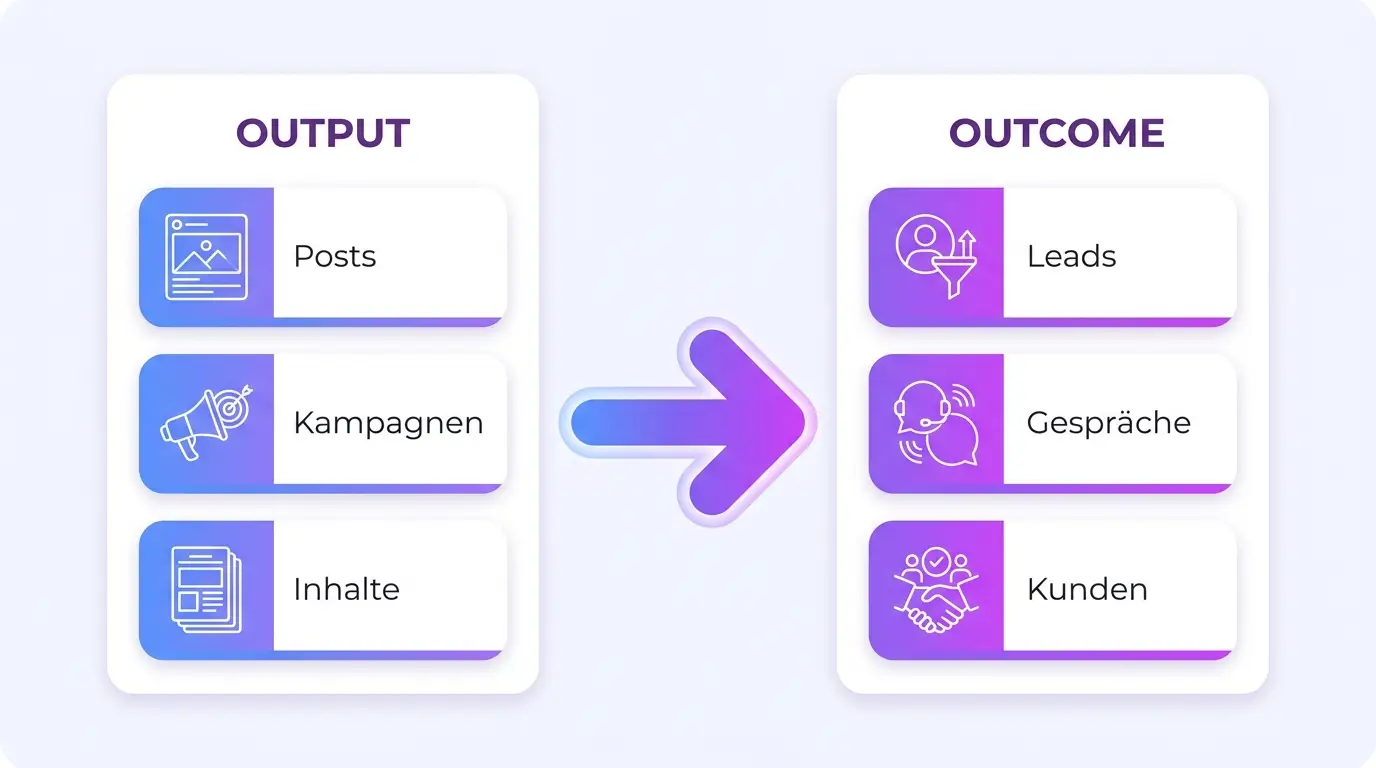
Output is what you do – Outcome is what results from it.
03 — Output & Outcome
The difference between Output and Outcome
In digital sales, a clear distinction is worthwhile: Output is what you do – posts, campaigns, content. Outcome is what arises from it – leads, conversations, customers. Many teams optimise output, even though outcome is actually crucial. This makes processes increasingly efficient – but not necessarily effective.
/ 04 — What counts
What really matters
Instead of focusing on activity, you should concentrate on a few central questions.
- Do your actions lead to conversations?
- Are these conversations relevant?
- Does this create real opportunities?
If these points are not met, something is wrong with the system – no matter how active you are.
05 — Focus
Why less is often more
A common effect: the more things are done at once, the less focus is created.
- Too many channels
- Too much content
- too many experiments
The result is often unclear – a reduced approach often leads to better outcomes.
06 — Practice
Case study
A company was very active on LinkedIn, posting several times a week and testing various campaigns. Reach was high – inquiries were lacking. After an adjustment, the focus was changed: less content, but clearer themes, more concrete offers, and targeted next steps. The result: less activity – but significantly more conversations.
Activity is important – but it's not a goal. In digital sales, it's not about doing as much as possible, but about doing the right thing. If your actions aren't leading to conversations and closures, it's worth taking a look at the structure behind them. Because in the end, it's not how much you do that counts – but what comes of it.
Read on Which KPIs in B2B sales really count · AI Overload in Sales · Fewer channels, more impact
07 — Frequently Asked Questions
Frequently Asked Questions
Reflects the real prompts from ChatGPT, Perplexity & Google AI regarding activity vs. impact in digital B2B sales.
Why doesn't more sales activity automatically lead to more results?
Because activity and effect are two different things. Posts, clicks, and traffic look like progress, but say little about whether conversations and customers are being generated. The connection between action and result is crucial.
In B2B sales, "output" refers to the direct actions and activities taken by the sales team, such as the number of calls made, emails sent, or meetings conducted. "Outcome", on the other hand, represents the results of those actions, such as the number of deals closed, revenue generated, or customer satisfaction levels.
Output is what you do – posts, campaigns, content. Outcome is what results from it – leads, conversations, customers. Those who only optimise output will become more efficient, but not necessarily more effective.
How can I tell if my digital sales are really working?
On a few central questions: Do your actions generate conversations, are these conversations relevant, and do they develop into genuine opportunities? If not, something is wrong with the structure – regardless of how active you are.
08 — For Whom
Built for business, whose offer requires explanation.

IT and Software Service Provider
With services requiring explanation and few, valuable customers.

Manufacturing Industry & Mechanical Engineering
Selling complex technology to a few key decision-makers.

Startups & Scale-ups
Who want to become visible quickly and credibly.