
GEO for B2B How is my business recommended by ChatGPT, Claude and Perplexity?
Nadine Fraiss · Lilox · Last updated: 11 July 2026 · ~14 min read
The short answer: Generative Engine Optimization (GEO) ensures that AI search engines — ChatGPT, Claude, Perplexity, Gemini, and Google AI Overviews — name and cite your business. Three levers are decisive: machine-readable facts on your own domain, content with verifiable figures, and mentions on external trustworthy sites. First, secure your own brand, then conquer the category. GEO complements SEO; it does not replace it.
Contents
- What is Generative Engine Optimization?
- Why is AI search changing B2B procurement right now?
- What does the zero-click trend mean for your website?
- How does AI search choose who to recommend?
- What is the difference between brand visibility and category recommendation?
- What six levers can bring a B2B company to AI-driven solutions?
- Which AI crawlers do you need to allow on your website?
- What role do directories and review platforms play?
- How quickly does GEO work and what does it cost?
- What does a 90-day roadmap for GEO look like?
- What are the most common mistakes hindering AI visibility?
- How do you measure if the AI search mentions your company?
- Which GEO myths cost budget without effect?
- Frequently Asked Questions
01 – Fundamentals
1. What is Generative Engine Optimization?
Generative Engine Optimization (GEO), often also called Answer Engine Optimization (AEO), is the optimisation of content in order to be cited in AI search answers – meaning in ChatGPT, Claude, Perplexity, Gemini or Google AI Overviews. While classic SEO competes for positions in a link list, GEO competes for a place in the generated answer itself, including name attribution and source link.
The difference is more than semantics. AI answer engines work in two steps: during retrieval, they fetch relevant webpages in real-time or access training knowledge. During generation, they typically summarise three to eight sources into one answer and link the citations. Anyone who doesn't feature in either of these steps doesn't exist for that search query. And because the answer only has a handful of citation slots, the competition for these spots is tougher than for page one on Google – but it's decided by different rules.
/ 02 – Why Now
2. Why is AI search changing B2B procurement right now?
Because the buyers are already there. The Forrester Buyers' Journey Survey 2026 of around 18,000 B2B buyers shows: 94 percent used AI in their last purchasing process, and AI response engines are now the most important research source, ahead of vendor websites, product experts, and sales. 55 percent compare vendors directly in the AI tool, and 47 percent build their internal business case there before they even contact a vendor (Forrester, January 2026).
The trend is clearly established. 51 percent of B2B software buyers prefer to start their research with an AI chatbot rather than Google, and 71 percent use AI assistants in their software research (G2 via Demand Gen Report). A multi-source analysis of 680 million AI citations confirms 73 percent AI usage in B2B purchasing (Loganix/Averi, March 2026). The volume is growing accordingly: ChatGPT alone processes around 2.5 billion prompts per day (TechCrunch/OpenAI, 2025), in addition to Gemini, Claude, Perplexity and Copilot — and the market continues to fragment: Gemini has increased its share of AI traffic from 5.7 to 22 percent within twelve months (The Digital Bloom, 2026). Anyone optimising for just a single platform is now ignoring more than a third of AI search.
The number behind the business case: In a case study by Seer Interactive, visitors from AI search converted many times better than organic search traffic. 15.9 per cent from ChatGPT and 10.5 per cent from Perplexity compared to 1.76 per cent from organic Google search. The basis is a single B2B software customer, October 2024 to April 2025.
Seer Interactive, 2025
03 – Zero-Click
3. What does the zero-click trend mean for your website?
The traditional approach via the link list is drying up. An AI Overview appears for around 21 per cent of all keywords (Ahrefs, 146 million SERPs, desktop, as of September 2025). In the first four months of 2026, 68.01 per cent of US Google searches on desktop and mobile ended without a single click on a website (SparkToro using clickstream data from Similarweb, June 2026). Where an AI Overview is displayed, the click-through rate for the number one position falls by around 58 per cent (Ahrefs, analysis of over 300,000 keywords, as of December 2025).
The search journey shifts from distributor to destination: the answer is directly in the search engine or AI chat, and clicking through to a website is becoming increasingly rare. For B2B providers, this doesn't mean visibility becomes worthless – it merely shifts. Brands that are cited in AI answers receive around 120 per cent more clicks per impression than those not cited (Seer Interactive). Being cited is the new ranking: the question is no longer just „What position am I in?", but „Will I appear in the answer when my target customers ask?"
04 – Selection Logic
4. How does AI search choose who to recommend?
Language models don't guess, they match. If a brand appears consistently and is substantiated across several independent current sources, the model's confidence in that exact brand increases. You can influence this in three places – the infographic shows them at a glance:
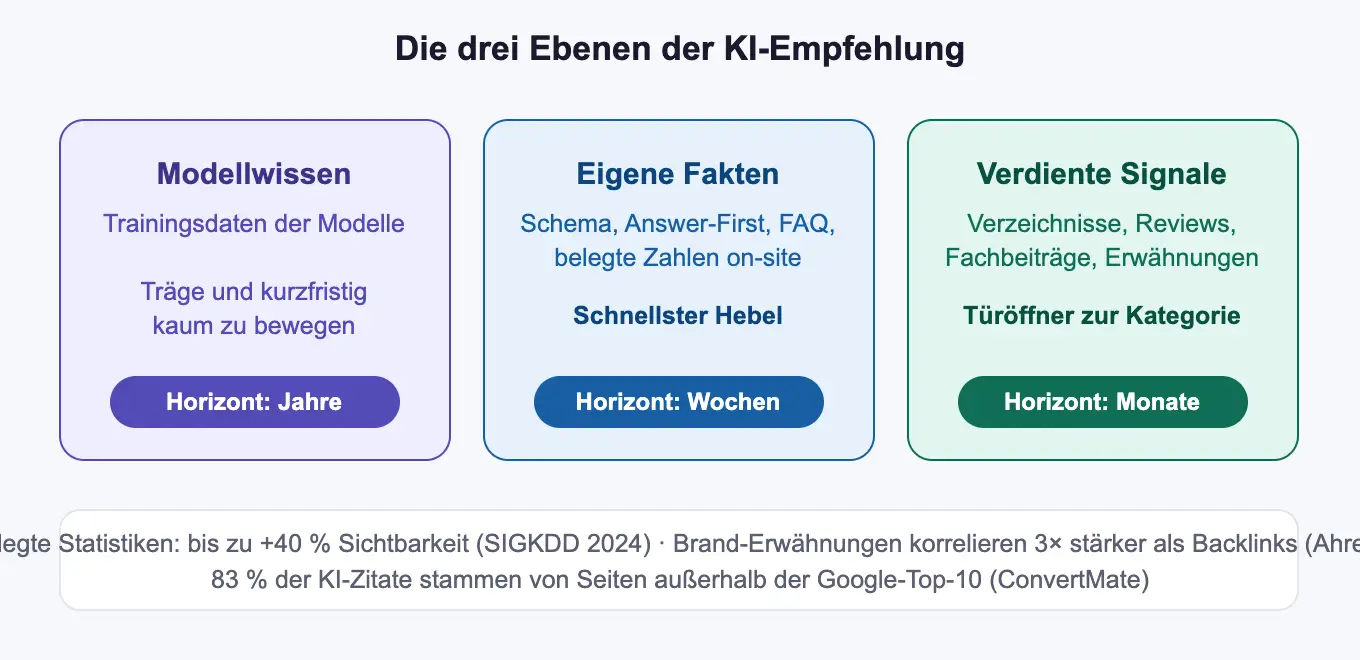
Own presentation: Lilox, July 2026. Data sources: Aggarwal et al. (SIGKDD 2024), Ahrefs, ConvertMate.
The mechanism has been scientifically investigated. Content with specific statistics, citations, and clean source references achieves up to 40 percent more visibility in generative answers (Aggarwal et al., Princeton/Georgia Tech, SIGKDD 2024). Also striking: brand mentions on the web correlate around three times more strongly with AI citations than classic backlinks, with a correlation of 0.664 compared to 0.218 (Ahrefs analysis of over 75,000 brands). Thus, AI search rewards different signals than classic ranking.
And it rewards other pages: Around 62 percent of URLs cited in AI Overviews do not rank in the organic top 10 (Ahrefs, 863,000 keyword SERPs and 4 million AI Overview URLs, as of March 2026). Comparison articles make up the most frequent citation format at 33 percent (ConvertMate, 2026). This is the real news for smaller B2B providers: In the AI answer, you can beat corporations that dominate you in Google rankings – if your content is more citable than theirs.
05 – Two Games
5. What is the difference between brand visibility and category recommendation?
They are two different games, and mistaking them will cost months. The table shows the difference:
| Brand visibility | Category Recommendation | |
|---|---|---|
| User question | „What does [Company Name] do?" | „Best B2B agency in Austria?" |
| Goal | The AI search describes you correctly | The AI search recommends you without being asked. |
| Main lever | On-site: Schema, Entity, Own Facts | Off-site: Directories, Reviews, Mentions |
| Time horizon | Weeks | Months |
| Measurement | Testing Branded Prompts | Category prompt monitoring |
The order is non-negotiable: first, make your own house machine-readable, then build the third-party signals. Whoever wants to win the category before AI search accurately describes their own company is building on sand — the model cannot recommend a brand it cannot confidently classify.
06 – Six Levers
What six levers bring a B2B company in AI answers?
Most websites lose out in the same places. These six measures can be worked through systematically, roughly in this order:
1
Lever 1
Allow AI crawler.
The search bots of the answer engines must be allowed in the robots.txt, otherwise everything else is ineffective (details and bot list in the next section). Also check CDN and firewall rules that silently block AI bots.
2
Lever 2
Server-side HTML content.
Many AI crawlers do not render JavaScript. Core content that is only loaded via JS is not seen by the machine. Server-side rendering is mandatory, semantic HTML (real headings, lists, tables) aids extraction.
3
Lever 3
Schema.org markup.
Organization and a website-wide FAQ page on every page with a question block, articles for posts, and a breadcrumb list for the hierarchy. Officially not required for Google AI Overviews, but a real and cost-effective advantage for other AI search services and unambiguous machine interpretation.
4
Lever 4
Extractable content.
The answer is in the first 40 to 60 words, subheadings are actual user questions, sections function as standalone quotable units with 200 to 400 words, processes are in numbered lists, comparisons in tables.
5
Lever 5
Evidence, not assertions.
Approximately every 150 to 200 words, a concrete fact with source and year, linked to the primary source. „Reduces response time by 40 percent" suggests „significantly faster." This very statistical effect is the strongest single GEO lever from the Princeton study.
6
Lever 6
Build third-party signals.
Profiles on the directories and review platforms from which the AI search draws its „best agency" answers, as well as expert articles, podcasts, and consistent company data across the web (more on this below).
07 – AI Crawler
7. Which AI crawlers do you need to allow on your website?
AI bots divide into three classes: search bots retrieve content for live answers and generate citations, user bots retrieve a page when a user requests it in a chat, and training bots collect data for model training. For maximum visibility, always allow search and user bots. For training bots, decide consciously – those who want to be present in the models themselves should also allow them.
| Provider | Such-Bot (allow) | User-Bot (allow) | Training Bot (Decide) |
|---|---|---|---|
| OpenAI / ChatGPT | OAI-SearchBot | ChatGPT-users | GPTBot |
| Anthropic / Claude | Claude-SearchBot | Claude-User | ClaudeBot |
| Perplexity | PerplexityBot | Perplexity-User | — |
| Google (AI Overviews, Gemini) | Googlebot | — | Google-Extended |
The most common mistake is not a deliberate one: firewall or bot protection rules (for example, with CDN providers) block AI crawlers across the board as „suspicious traffic". A look at the server logs shows whether the search bots are actually arriving – if not, any content optimisation is in vain.
08 – Directories
8. What role do directories and review platforms play?
It is larger than most people like. When the AI search answers „best B2B agency in Austria", it predominantly cites sources it trusts for comparisons rather than the agency websites themselves: industry directories, review platforms and editorial lists. In the DACH region, these typically include Sortlist, ProvenExpert, Clutch and OMR Reviews for service providers, as well as topic-specific portals.
Our own prompt monitoring confirms this pattern: in the agency category prompts we track, directory and platform domains are consistently among the most cited sources – even more so than most provider websites (own Peec AI measurement, June to July 2026). The consequence: a well-maintained, consistent profile on the two to three relevant platforms in your category is not a nice-to-have, but the most direct route to the category answer. Consistency counts double here – name, positioning and description should be identical everywhere so that the machine can confidently assign the entity.
09 – Effect and Cost
9. How quickly does GEO work and what does it cost?
Brand visibility through your own facts and schema shows up in weeks, category recommendations through third-party signals take months. Ad budget is not needed for any of the six levers: schema, a clear entity, extractable content, and self-maintained directory profiles are working time, not media budget.
The window of opportunity is real. 92 percent of marketers state they want to optimise for AI search, but only 41 percent are actively adapting their strategy (HubSpot, 2026). Users report 4.4 times more qualified traffic through GEO optimisation. Those who start now will compete with a fraction of future competitors for the three to eight citation spots per answer.
/ 10 – Timetable
10. What does a 90-day roadmap for GEO look like?
| Phase | Measures | Result |
|---|---|---|
| Weeks 1–2 Foundation | AI Readability Audit (Server HTML, Bots, Load Time) · Open robots.txt for AI crawlers · Organization and WebSite Schema · Consolidate entities (one domain, consistent company data) | The website is technically accessible and clearly identifiable for AI search. |
| Weeks 3–6 Content Rework | Rebuild core pages to be answer-first · Question headings · FAQ blocks with FAQPage schema · Incorporate verified numbers and primary sources · Link pillar and cluster structure | Pages function as citable units; branded prompts deliver correct answers |
| Weeks 7-12 Authority + Measurement | Build directory and review profiles (category-relevant) · Initial expert articles/mentions · Set up prompt monitoring · Monthly measurement rhythm | First category citations; progress becomes demonstrable rather than perceived |
Afterwards, ongoing operation begins: maintaining content, replacing statistics older than 18 months, prioritising new topics based on prompt demand, and remeasuring citation impact monthly. AI systems favour current sources – citations expire without maintenance.
What are the most common mistakes hindering AI visibility?
11 – Measurement
11. How do you measure if the AI search mentions your company?
Without measurement, GEO remains a matter of faith. Four levels have proven effective: prompt monitoring like Peec AI, where defined customer prompts are run daily against relevant AI search services, including competitor comparisons. In addition, AI bot traffic in server logs, a dedicated referral segment for AI sources in Analytics, and regular manual testing of the most important customer questions in multiple AI tools – platforms cite very differently, with only 11 percent of domains being cited simultaneously by two major AI search services (Averi, 680 million citations).
We apply this to ourselves: Defined category prompts are run daily against the relevant AI search services; the services pull and cite Lilox pages within these exact prompts, and the citation rate of our domain increases week by week (own Peec measurement, July 2026). Precisely this method, measured monthly, is the practical proof behind our consulting.
/ 12 – Myth Buster
12. Which GEO myths cost budget without effect?
| Myth | Fact (As of 2026) |
|---|---|
| „llms.txt provides visibility on Google" | Officially ineffective for Google AI Overviews. Unproven for other engines. Okay as a low-risk test, not a priority. |
| „Without a schema, you won't get cited." | Not a must-have criterion at Google. Nevertheless useful for other AI search services and for uniqueness. |
| „Pushing a lot of mentions or bought links" | No. The same anti-spam systems as in the ranking filter that. Only genuine, contextually strong mentions count. |
| „A platform optimisation is sufficient" | No. AI search is fragmenting; the citation sources of major services overlap by only around 11 percent. Multi-engine visibility is a must. |
| „GEO replaces SEO" | No. Google calls it „silent SEO" – solid SEO is the foundation, AI content creation is the amplifier. |
Lilox brings your company into AI search answers
If your ideal clients ask ChatGPT, Claude or Perplexity for providers, your name should be included in the response. This is precisely what we use to build AI visibility: audits, a machine-readable foundation, quotable content, and third-party signals — with monthly measurement so you can see the progress in black and white. We apply each of these levers in-house and measure their impact monthly. AI-powered analysis, every result reviewed by humans, and a point of contact from the founding team.
/ 13 – Frequently Asked Questions
Frequently Asked Questions about GEO for B2B
Reflects the real prompts from ChatGPT, Perplexity & Google AI around GEO for B2B.
What is the difference between GEO and SEO?
SEO gets you into the link list, GEO into the generated answer with a mention and source. Technically, GEO builds on a clean SEO foundation: what is not crawlable and indexed cannot be cited by AI.
What is the difference between GEO and AEO?
Practically none. AEO (Answer Engine Optimization) and GEO describe the same discipline: preparing content so that answer engines understand and cite it. In the DACH region, GEO is establishing itself as the term.
How quickly does GEO work?
Branded visibility through proprietary facts and schema shows results in weeks. Category recommendation via third-party signals takes months. Our own measurement: first mentions in category prompts after consistent implementation for around four weeks.
Which AI services are relevant in the DACH region?
Primarily ChatGPT, Google AI Overviews and Gemini, plus Claude and Perplexity with a growing share. Also important are the directories and review platforms from which these services draw their category answers.
Does GEO also work for small businesses?
Especially for them. Around 62 percent of URLs cited in AI Overviews do not rank in the organic Top 10 (Ahrefs, 863,000 keyword SERPs and 4 million AI Overview URLs, as of March 2026). In the AI response, citability counts, not domain size.
Do I really need llms.txt?
It's part of the flourish, not the duty. For Google AI Overviews, it demonstrably achieves nothing, and its usefulness for other engines is unproven. The six levers first, then this gamble.
Does GEO have an advertising budget?
No. Schema, unique entities, extractable content, and curated directory profiles are working time, not media budget. The equivalent: visitors from AI search convert many times better than organic search traffic.

Sources and Further Reading
- Forrester Buyers’ Journey Survey 2026
- G2 via Demand Gen Report
- Loganix/Averi Multi-Source Analysis 2026 — PR Newswire
- Aggarwal et al., SIGKDD 2024 — arXiv
- Ahrefs — CTR analysis of over 300,000 keywords (as at December 2025); AI Overview Trigger over 146 million SERPs (as of September 2025); AI-Overview-Citations for over 863,000 SERPs (as of March 2026); Brand mention correlation over 75,000 brands
- SparkToro with clickstream data from Similarweb Zero-Click study, US searches January to April 2026
- Seer Interactive — Conversion Case Study, a B2B software client, October 2024 to April 2025; AI-Overview-CTR-Analyse
- TechCrunch/OpenAI · The Digital Bloom · ConvertMate · HubSpot — aggregated via Statistics-Current-Data Monitor (May 2026)
- Own Data: Peec-AI-Monitoring Lilox, June–July 2026