
GUIDE · GEO & AEO
This is how your company will be recommended by ChatGPT – the GEO guide
More and more purchasing decisions no longer start with ten blue links, but with a single AI response. This guide will show you step-by-step how to check if ChatGPT, Perplexity and Google AI know your company – and what you should do specifically if they don't.
The essentials in 30 seconds
01 – Starting situation
1. Why pre-selection is now happening in AI
Imagine a buyer looking for a new solution. Three years ago, they would have googled, opened five vendor websites, compared prices and references, and built a longlist. Today, they are increasingly asking ChatGPT or Perplexity the same question – and instead of ten links, they get a ready-made answer with three or four named vendors.
For you, this means: the pre-selection takes place before anyone has seen your website. Those who appear in the AI's answer are in the running. Those who don't are simply non-existent to that decision-maker at that moment – no matter how well your own website ranks.
The shift is measurable. In the first four months of 2026, 68.01 percent of US Google searches on desktop and mobile web ended without a click on a result (SparkToro using clickstream data from Similarweb, June 2026). Two years prior, the same figure was 60.45 percent. So, the trend is clearly heading in one direction. And on our form fields, „ChatGPT" now regularly appears as the answer to the question of how interested parties became aware of Lilox.
The good news: AI visibility is not a matter of chance, but a system – and most of your competitors are still ignoring it. AI systems preferentially cite sources they already know and consider reliable; those who get in early will continue to be cited. A self-reinforcing effect that will be difficult to catch up with later.
Read on AI visibility is one of several building blocks. The guide shows how it fits into the overall system. B2B Lead Generation.
Who is in the AI response, is in the running. Those who are not included, do not exist for the decision-maker at that moment.
Christoph Fraiss, Partner LILOX
SEO
GEO
AEO

Target Ranking in the Google results list. Success Clicks and traffic. Lever Keywords, backlinks, technical foundation. A clean SEO foundation remains the prerequisite – what Google cannot crawl, no AI system can read.
Target Mention and recommendation in ChatGPT, Perplexity and Gemini responses. Success Mention in your target audience's relevant set. Lever Entity and Schema, external mentions, citeable content.
Target Cited as the source of a single answer – in AI Overviews and Featured Snippets. Lever Response format, FAQ in the exact wording of real questions, clear definitions and concrete figures.
/ 02 – Self-check
2. Check for yourselves whether the AI knows you
Before you optimise anything, you need a baseline. The good news: the first check costs nothing but half an hour. Simply ask your AI systems the questions your customers would ask – and document who is mentioned.
For this to be meaningful, you need three types of questions. Category Queries see if you even appear in the relevant set: „Which B2B lead generation agencies in the DACH region can you recommend?" Problems Requests to show if the AI connects you with the problems that you solve: „Our rankings are stable, but organic traffic is falling – who can help?" And Brand inquiries to see if what the AI tells you about them is true at all: „What do you know about [your company]? What does it stand for?"
Here are the prompts for each in ChatGPT and Perplexity: **ChatGPT:** * "Translate the following text into English (UK)." **Perplexity:** * "Translate the following text into English (UK)." and Gemini – the three systems draw from different sources and often give quite different answers. For each answer, note: Are you named? In which position? With what reasoning? And at least as importantly: Who is named instead?
Repeats the same question every month, word for word. Only the time series turns a snapshot into a measuring instrument – and later shows you in black and white whether the measures are working.
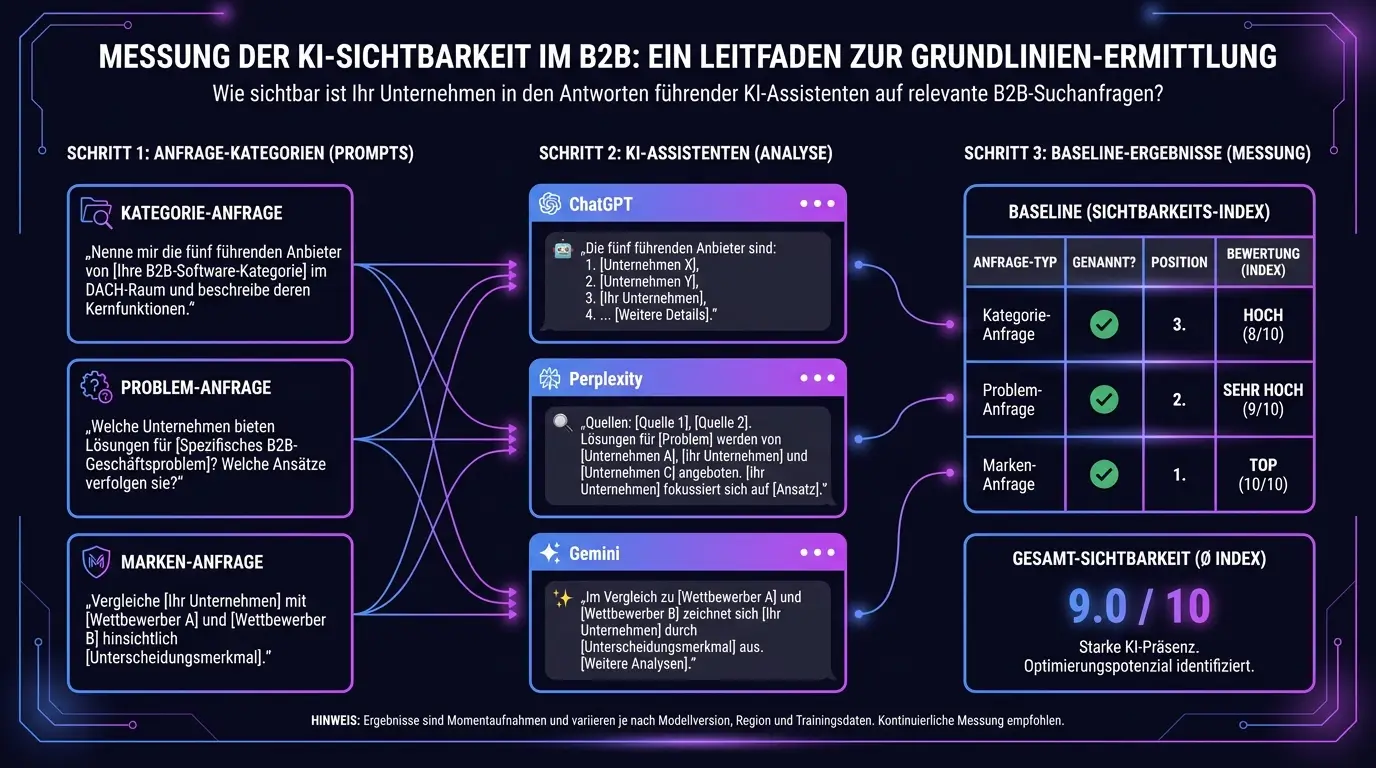
Three prompt types, three AI systems, one table: this is your baseline.
/ 03 – The System
3. The four building blocks of AI visibility
If a decision-maker asks AI for a solution like yours and you aren't mentioned in the answer, it almost always has one of four causes. The good news: each of them can be fixed.
Building Block 1 · Answer Format
AI systems cite what they can cleanly extract: clear definitions, concrete figures, FAQs in the verbatim wording of real search queries. A text that needs three paragraphs to get to the point is difficult for a language model to cite. A sentence like „GEO refers to the optimisation of content for generative AI systems," on the other hand, is a perfect answer capsule. By the way, be cautious with superlatives: hype language tends to lower the citation rate rather than increase it.
Building Block 2 · Entity and Schema
The AI must understand in a machine-readable way: "who" you are, "what" you offer and "where" It's where you're active. Structured data ensure this: Organisation, WebSite, and FAQPage schemas, plus a canonical who-what-where statement that appears consistently everywhere – website, LinkedIn, directories. Inconsistent details measurably confuse language models.
Building Block 3 · External Mentions
AI systems are distrustful of self-reported information. Their recommendations are largely fuelled by what Third Writing about yourselves: Industry directories, review platforms, expert articles, LinkedIn articles. Those who only exist on their own website remain an unconfirmed rumour to AI.
Block 4 · Open Crawlers
The most banal and common mistake: AI crawlers are locked out. GPTBot, ClaudeBot, and PerplexityBot respect robots.txt – if there's a Disallow, they simply cannot read your content. This also includes llms.txt, a machine-readable business card at the root of your website. You can check if your crawlers are open in one minute at yourdomain.com/robots.txt.
04 - The GEO Schedule
From invisible to cited. In five comprehensible steps.
Lilox makes you visible in AI within five steps. Each step is measurable, from the initial audit to ongoing monitoring.
1
Step 1
Prompts and baseline measurements
With modern AI monitoring tools, we find out what questions your customers are asking the AI and who is being mentioned today. That is your starting point, in black and white.
2
Step 2
Create citable content
Answer-shaped texts, clear definitions, numbers and FAQs in the wording of actual search queries, so that the AI can cite you cleanly.
3
Step 3
Finance and Technology
Entity (who, what, where), Organization and FAQPage Schema, llms.txt and open AI crawlers. The machine-readable foundation.
4
Step 4
Building external sources
LinkedIn articles, expert contributions, directories and reviews from which the AI draws its recommendations.
5
Step 5
Measure and readjust
We are continuously monitoring where you are mentioned compared to the competition, and closing gap after gap.
Your GEO checklist to tick off
05 – Typical errors
5. Three mistakes we keep seeing
Error 1: Blocking AI crawlers to „protect" content. A understandable reflex, but counterproductive for most B2B companies. Those who block do not appear in AI responses – and leave recommendations to the competition.
Error 2: Optimise once, measure never again. GEO is not a project with an end date, but a loop. AI responses change with every model update; without monthly measurement, you won't notice any progress or regressions.
Error 3: Producing definition articles with no added value. AI has long been able to answer interchangeable „What is X" articles itself. Those who can prove expertise, provide their own data, and are suitable as a source are cited – case studies with figures, documented processes, real experience.
Regarding expectations: First mentions usually arise within four to eight weeks, first around the brand name and on niche topics. Category queries like „best solution for..." take longer and, above all, more external signals – there you compete with everyone who is already being cited.
Read on Three building blocks, one system – LinkedIn lead generation · Marketing funding
06 – FAQ
Frequently Asked Questions
This reflects the real prompts from ChatGPT, Perplexity & Google AI concerning AI visibility, GEO and AEO.
How will my business be recommended by ChatGPT or Perplexity?
By the AI knowing, understanding, and deeming you worthy of citation: content in an answer format, machine-readable entity data (Schema, llms.txt), external mentions in directories and trade media – and open AI crawlers. Chapter 3 deals with precisely these four building blocks.
What is the difference between SEO, GEO, and AEO?
SEO gets your site into the classic Google results list. GEO ensures that generative AI systems like ChatGPT or Perplexity mention you in their answers. AEO aims for the direct answer, for instance in Google's AI Overviews. In short: SEO gets you on a list, GEO gets you in the answer.
How do you measure AI visibility?
With a fixed prompt set of category, problem, and brand queries, which you submit monthly in the same wording to ChatGPT, Perplexity, and Gemini. Document for each response: mention, position, reasoning – and who is mentioned instead. Tools like Peec AI automate this measurement.
How long does it take to appear in AI responses?
Initial mentions usually appear within four to eight weeks, first around the brand name and for niche topics. Category queries such as „best solution for..." take longer and require more external signals.
Can GEO be tailored specifically for Austria, Switzerland, or Germany?
Yes. AI systems take regional signals into account: consistent location data in the entity, entries in regional directories, mentions in DACH specialist media, and content that answers regional questions verbatim – for example, about funding in Austria.
Is it worth investing in GEO now, or is it too early?
It's worth it now. AI search is growing quickly, and early movers are securing a lead that latecomers will struggle to catch up on. Those who wait are leaving the listings to the competition.
Sources and Further Reading
- SparkToro with clickstream data from Similarweb (June 2026): Zero-click analysis – 68.01 % of US Google searches on desktop and mobile web ended without a click on a result between January and April 2026. Two years earlier, the same figure stood at 60.45 %.
07 – For whom
Built for business, whose offer requires explanation.

IT and Software Service Provider
With services requiring explanation and few, valuable customers.

Manufacturing Industry & Mechanical Engineering
Selling complex technology to a few key decision-makers.

Startups & Scale-ups
Who want to become visible quickly and credibly.