
Lead Generation & Funnel
The 4 Stages of Lead Generation – and what matters in each phase
Lead generation is the heart of B2B marketing and digital sales. It determines whether attention turns into qualified leads and leads turn into customers. Those who understand the four stages can systematically guide prospects from initial contact to closing.
In the following sections, we will examine each of the four stages in detail, along with the appropriate measures and key performance indicators.
Lead generation is a continuous, multi-stage process: addressing potential customers, acquiring qualified leads, and guiding them systematically through the sales funnel. The foundation is a clear strategy – precise goals, accurate target group determination, and the selection of suitable channels. Current trends in digital marketing influence the choice of methods and should be considered from the outset.
Crucial factors are website traffic, content quality, and the targeted capture of interests. Valuable content, tailored to the target audience, allows for personalised communication and increases the conversion rate. Combined with clean lead management, contacts can be systematically evaluated and distinguished as Marketing Qualified Leads (MQL) or Sales Qualified Leads (SQL) – this allows sales to work specifically with contacts that have a high probability of closing.
Especially in the digital age, companies are relying on inbound marketing to specifically target their audience. Content marketing plays a central role in this: relevant content such as blog articles, e-books, or white papers draw attention to the company and motivate action. In addition, social media and e-mail marketing enable direct, personal communication with the target audience.
Examples of successful campaigns show that the combination of high-quality content, clear user guidance, and automated processes leads to significantly better results than individual, uncoordinated measures. Those who master this triad generate qualified leads predictably and repeatably.
01 – Strategic Base
01
What makes successful lead generation
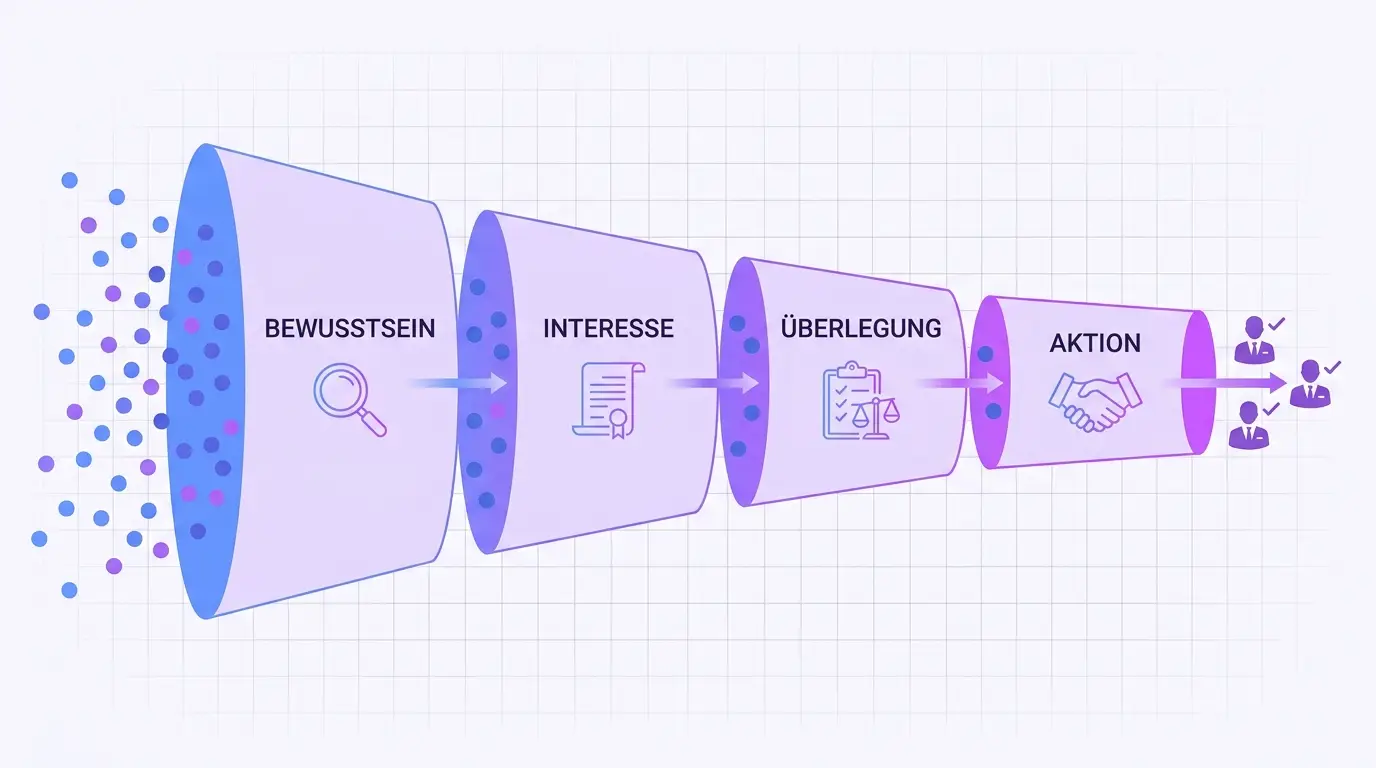
Awareness
Attracting attention: SEO, content and social media drive potential customers to your website. According to the BrightEdge Channel Report 2019, 53.3 % of website traffic comes from organic search, measured across all sectors and excluding direct traffic. If you rank highly for the questions people ask at the start of their search, you’ll be found exactly when the need arises.
Interest
Generating interest: personalised content, webinars and case studies encourage a deeper engagement with the offering. 72 % of B2B buyers state that they expect suppliers to tailor their approach to their specific needs (Salesforce, State of the Connected Customer, 2018). Anyone who remains generic at this stage will lose leads to suppliers who address the specific situation more directly.
Consideration
Qualify and persuade: Lead scoring, nurturing, and demos turn interest into genuine purchase intent and separate MQLs from SQLs. Crucially, every contact receives the exact information that answers their outstanding question. This shortens the decision-making time and makes visible who is actually ready to buy and who still needs time.
Action
Converting leads into customers: clear calls to action and tailored offers seal the deal. In a HubSpot analysis of over 330,000 CTAs, personalised calls to action performed 202 % better than generic ones. The mechanism behind this is simple: a CTA that is tailored to the lead’s stage and situation requires less translation effort than a generic button.
The four stages at a glance
Lead generation is not a channel, but a system from initial contact to handover.
Fundamental principle of lead generation
53,3 %
of website traffic comes from organic search (BrightEdge Channel Report 2019, all industries, excluding direct traffic)
72 %
B2B buyers expect personalised communication from vendors that suits their needs (Salesforce, State of the Connected Customer, 2018)
202 %
Personalised calls-to-action convert better than generic ones (HubSpot, analysis of over 330,000 CTAs in their own product)
02 – Five Success Factors
Five factors, which determine success.
Before the four stages take effect, lead generation needs a stable foundation. These five factors determine whether effort translates into measurable results.
1
Step 1
Optimised website
Clear user guidance, fast loading times, and unambiguous calls to action ensure that visitors become contacts. A convincing website is the starting point of every inbound strategy – this is where interest turns into a lead. Landing pages with clear lead forms make the first step as easy as possible.
2
Step 2
Relevant Content
Content that answers genuine audience questions builds trust and qualifies leads before sales takes over. Blog articles, videos and podcasts are suitable for brand building, e-books and webinars for knowledge transfer.
3
Step 3
Well-thought-out channel mix
Email, LinkedIn, SEO and paid advertising work together, rather than running in isolation. Only the coordinated interplay of marketing and sales channels ensures substantial reach and consistent communication across all touchpoints.
4
Step 4
Data & Automation
Contact management and maintenance systems make leads assessable and enable automated, relevant outreach on a large scale. Lead scoring and automated workflows save time and ensure no contact is lost.
5
Step 5
Marketing and Sales in Step
Only when marketing and sales share the same objectives and criteria will no qualified leads be lost during the handover. A common definition of MQL and SQL is the foundation for smooth collaboration – and for ensuring that acquired contacts actually turn into closed deals.
03 – Lead Management
Lead management from contact to purchase decision.
Lead management is more than just collecting contact details. It is a structured process that systematically identifies and qualifies potential customers, guiding them step-by-step towards a purchase decision – from generation, through qualification and nurturing, to conversion.
Marketing automation and CRM systems help to specifically capture, qualify, and individually address leads. Automated workflows and targeted nurturing measures provide contacts with relevant information and guide them step-by-step towards a purchasing decision.
Modern tools form the technical backbone: they make every step traceable, prioritise contacts based on their behaviour, and ensure that every lead receives exactly the information that will move them forward in their respective phase.
Effective lead management ensures that no lead is lost and every contact is optimally nurtured. Regular analysis and adaptation of processes are essential to improve lead quality and sustainably increase marketing return on investment.
04 – Lead-Routing
Lead Routing the right leads to the right teams.
Lead routing is the targeted forwarding of qualified leads to the appropriate teams or sales representatives. Especially in companies with complex sales structures, speed is decisive: every lead should reach the right place quickly to enable timely, individual support.
CRM systems and marketing automation can automate routing – leads are automatically assigned based on criteria such as industry, company size, or interest. This saves time and increases the chance of conversion, as sales teams can focus on the most qualified contacts.
Well-thought-out lead routing is therefore an important part of lead management. It ensures that every contact lands with the right person at the right time, thereby directly contributing to higher closing rates and more satisfied customers. This way, no contact gets lost in day-to-day business, even with a high volume of leads.
05 – B2B Leads
B2B Leads Complex, but plannable.
Generating B2B leads presents its own unique challenges. Decision-making processes are more complex than in B2C because multiple individuals and departments are involved in the purchasing decision. Products and services must be specifically tailored to the needs of potential customers.
Content marketing, social media and e-mail remain indispensable here too – the key is that the content addresses the specific questions of the industry. Equally important are the selection of the right channels and a deep understanding of the target audience's decision-making processes.
Successful B2B lead management therefore requires close coordination between marketing and sales. This is the only way to efficiently qualify leads, guide them targeted towards a purchasing decision, and develop long-term customer relationships from prospects that extend beyond a single deal.
Read on What is a sales funnel? · How a modern B2B funnel works · How a modern B2B sales funnel works
06 – FAQ
Frequently Asked Questions
Reflects the real questions asked on ChatGPT, Perplexity, and Google regarding lead generation.
What are the four stages of lead generation?
Awareness, Interest, Consideration, and Action. The Awareness phase is about visibility, the Interest phase about trust, the Consideration phase about qualification, and the Action phase about conversion. Each phase requires its own approach and its own content – those who specifically optimise all four will generate not only more but also higher quality leads.
What is the difference between MQL and SQL?
A Marketing Qualified Lead has shown interest but is not yet ready to buy and will continue to be nurtured with content. A Sales Qualified Lead is sufficiently qualified for the sales team to become actively involved. The clear separation based on defined criteria ensures that the sales team invests its time in the most promising contacts.
How does lead nurturing work?
Lead nurturing provides contacts with relevant content through automated, personalised campaigns until they are ready to buy. It keeps leads informed and engaged, builds trust, and guides them step by step towards a decision. According to the Demand Gen Report, companies with consistent lead nurturing achieve around 20 percent more sales opportunities than companies without nurturing.
What is lead routing?
Lead routing automatically forwards qualified leads to the appropriate team or sales representative based on criteria such as industry, company size, or interest. This speeds up follow-up, prevents contacts from remaining unaddressed for too long, and thus directly increases the chances of a successful deal.
What makes B2B lead generation special?
B2B decisions are more complex than B2C: multiple individuals and departments are involved, and purchasing processes take longer. Content must address specific industry concerns, and marketing and sales must work closely together to reliably guide prospects to purchasing decisions and build long-term relationships.
Which channels are suitable for lead generation?
Content marketing, SEO, LinkedIn and other social channels, email marketing, as well as targeted landing pages with clear lead forms. These channels work most effectively as a coordinated mix rather than in isolation. Which combination works best depends on the target audience, offering, and industry – it’s important to evaluate the channels based on data and continuously optimise them.
Sources
- BrightEdge, Channel Report (2019): 53.3 % of website traffic comes from organic search. Survey covering all sectors, excluding direct traffic.
- Salesforce, State of the Connected Customer, 2nd Edition (2018): Survey of more than 6,700 consumers and business buyers worldwide. 72 % of business buyers expect suppliers to personalise their communications to suit their needs.
- Demand Gen Report: Companies that consistently practise lead nurturing generate around 20 % more sales opportunities than companies that do not practise nurturing.
- HubSpot, analysis of over 330,000 calls-to-action over a six-month period: personalised CTAs convert 202 % better than generic ones. Data sourced from the HubSpot product itself; no published methodology.
07 – For whom
Built for business, whose offer requires explanation.

IT and Software Service Provider
With services requiring explanation and few, valuable customers.

Manufacturing Industry & Mechanical Engineering
Selling complex technology to a few key decision-makers.

Startups & Scale-ups
Who want to become visible quickly and credibly.