
Not the offer. The classification.
Many companies optimise their offerings — features, copy, services. The result often stays the same: few enquiries, long decision-making processes. This is because the problem is rarely with the offering itself.
Why the positioning of your offer often matters more than the offer itself.
It's too expensive, not clear enough, not convincing enough – that's the common diagnosis. So, things are optimised: features are added, texts are adjusted, services are expanded.
However, the real problem often lies not in the offer itself, but in how it is classified.
01 — Context
01
Offers do not exist in a vacuum
An offer is never assessed in isolation, but always in context. Potential customers compare, consciously or unconsciously: What alternatives are there? How well do I understand the problem? And how much do I trust the provider?
If this context is missing or unclear, even a strong offer will seem weak. Two identical services can be perceived completely differently – depending on how they are presented and positioned.
It's not the offer that decides. Rather, the classification.
02 — Clarity
02
Why good performance is often not recognised
Many B2B companies communicate too generally. Statements such as „individual solutions", „reliable partner" or „many years of experience" are correct but do not help with the decision.
You are describing the company, but not the concrete benefit. This leaves it unclear why this particular offer is relevant — and potential customers do not respond.
An offer becomes strong when it is immediately clear what it is about. Three points must be clear:
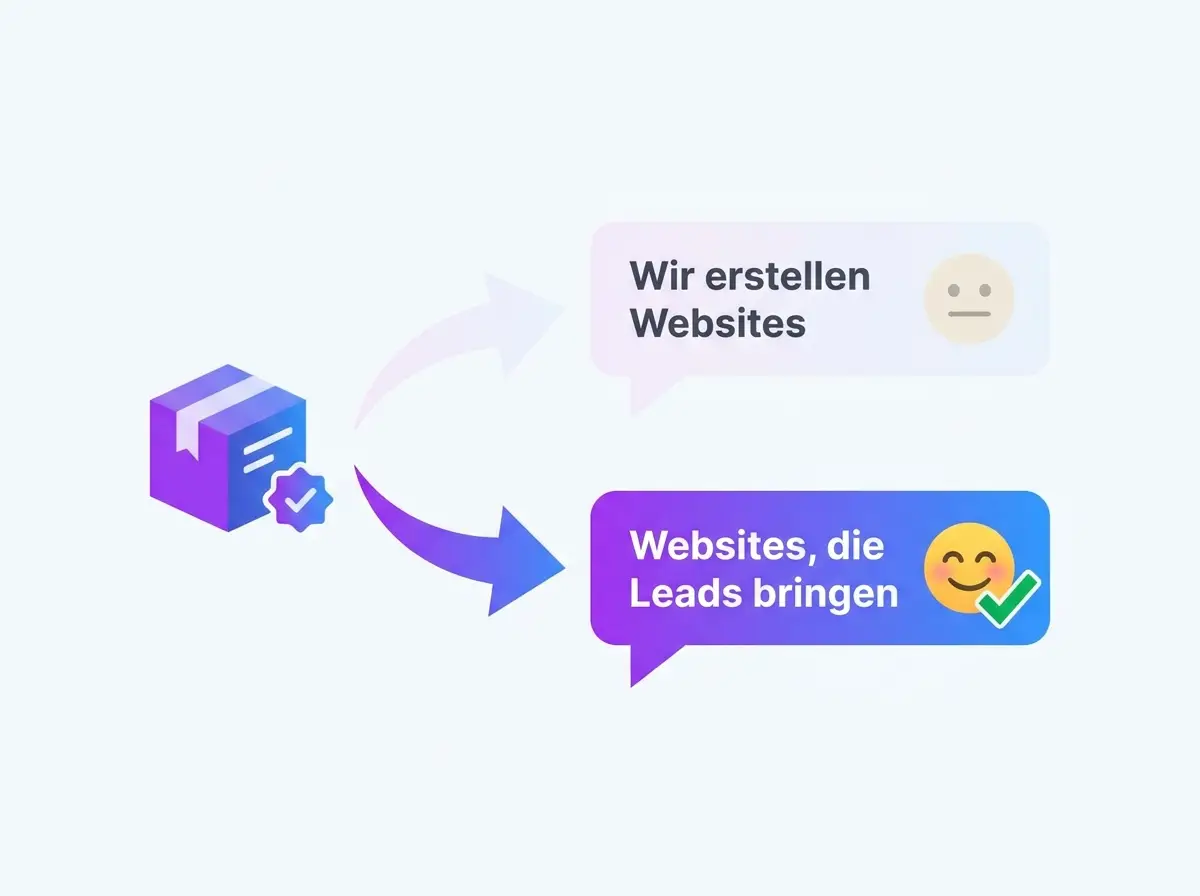
„We build websites" sounds weak —
„Websites that turn visitors into qualified leads sounds specific.
Classification
Create context. Show relevance.
Five steps to make your offer clear and relevant.
1
CONTEXT
Create context
Frame your offer clearly: What problem, for whom, with what result.
2
USE
Use instead of platitudes
Describe the concrete benefit, not the company. Empty phrases do not help with any decision.
3
Comparison
Compare active management
In B2B, comparisons are always being made. If you don't steer the comparison, it will happen anyway – just without your perspective.
4
DIFFERENCE
Clarify the differences
Anyone who actively shows how their own offering differs significantly simplifies the decision-making process.
5
Clarity
Understandable rather than complex
Clear language, concrete examples, structured presentation. It's not about saying less – but about categorising better.
04 — Example
04
Relevance arises from context
An offer becomes strong when it is placed in a clear context. It is crucial that it is immediately apparent which problem is being solved, for whom, and with what result.

One example makes this clear: instead of „We create websites", „We develop websites that generate qualified leads from visitors" sounds much more concrete. The difference lies not in the offer itself, but in its framing.
Read on AI Overload in Sales · GEO Guide: AI Visibility
05 — FAQ
Frequently Asked Questions
Reflects the real prompts from ChatGPT, Perplexity & Google AI around positioning and offering classification in B2B.
Do I need to change my offer?
Often not. Usually, the problem isn't with the offer itself, but with how it's positioned – in other words, how clearly the problem, target audience, and outcome are communicated.
How do I make my benefit concrete?
Instead of describing the company („reliable partner"), the result states: which problem you solve for whom, with what outcome.
How do I benchmark against competitors?
By actively making differences visible. If you don't control the comparison, it will still happen anyway – just without your perspective.
06 — For whom
Built for business, whose offer requires explanation.

IT and Software Service Provider
With services requiring explanation and few, valuable customers.

Manufacturing Industry & Mechanical Engineering
Selling complex technology to a few key decision-makers.

Startups & Scale-ups
Who want to become visible quickly and credibly.