
Pricing in digital B2B sales: the sweet spot between value and find trust
Price isn't everything – but it's almost always decisive.
In digital B2B sales, it’s not just about the best service or the most innovative solution, but also about the right price – one that signals quality, highlights the value of your offering, and doesn’t alienate your target audience. Amidst complex services, individual needs, and lengthy decision-making processes, a clear pricing strategy is needed that contributes to trust, transparency, and conversion.
01 — The Biggest Mistakes
01. The biggest pricing mistakes in digital B2B
Three mistakes particularly frequently cost B2B deals:
- No clear pricing structure – those who hide prices or make them unnecessarily complicated will lose potential customers who first want to understand what they are getting themselves into.
- One price for all – a rigid model is too expensive for small companies and not scalable for large ones.
- Too low prices out of fear – „If we're too expensive, no one will inquire" is widely held, yet prices that are too low often signal a lack of substance and trust.
„Your price is more than a number – He is a promise.“
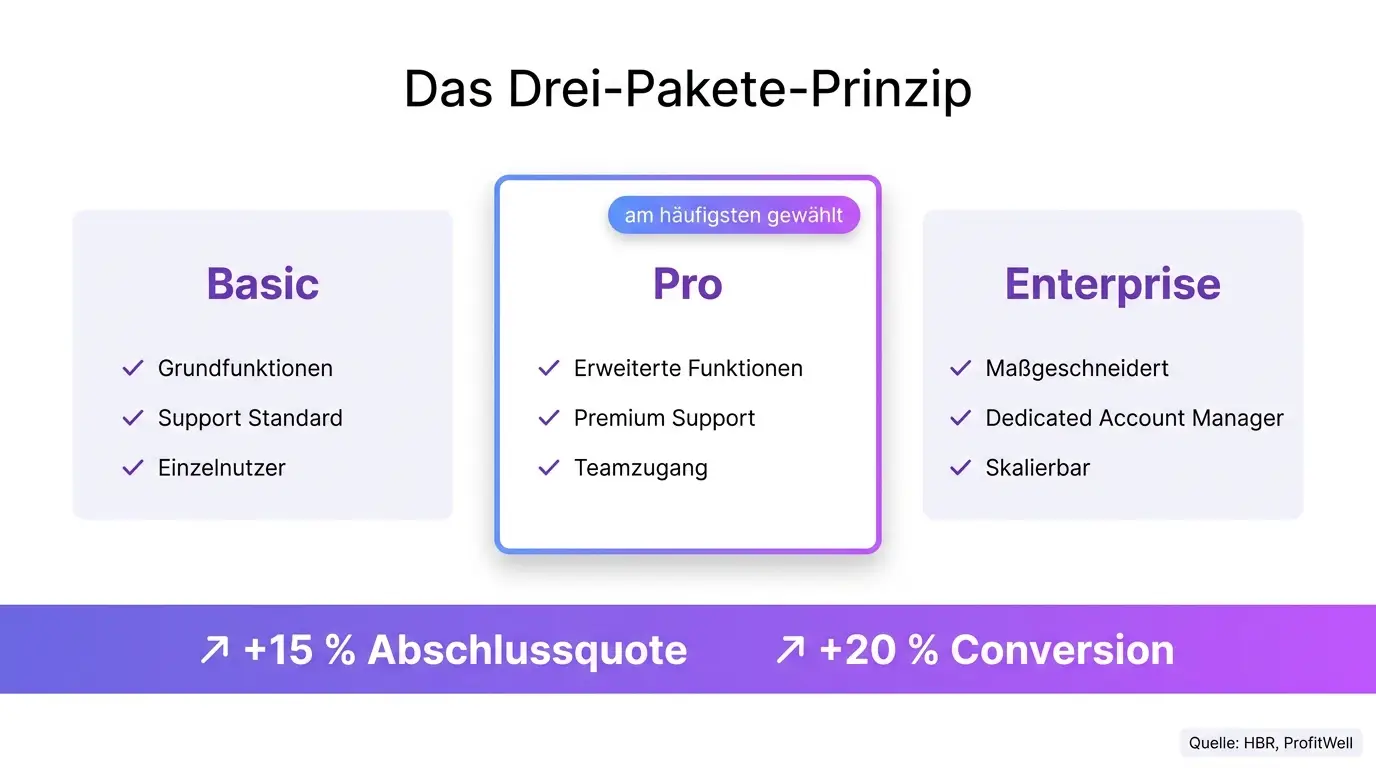
The three-pack principle: customers often choose the middle option. Source: Simonson & Tversky, Journal of Marketing Research, 1992.
02 — What Makes Good Pricing
02. What makes good B2B pricing
Good pricing isn't a numbers game, it's communication. Four principles contribute:
- Transparency – clearly shows what customers get and what they don't; just as important as the price is the rationale behind „Why does it cost what it costs?".
- Value orientation instead of effort – the price is based on the result for the customer, not your internal hourly rate.
- Utilise the psychology of pricing – three packages (Basic – Pro – Enterprise) provide orientation; customers often choose the middle one if it is well positioned.
- Clear call to action – after the price, the next step is always: „Request now", „Start demo" or „Book strategy meeting".
03 — Tools & Tactics
03. Tools & Tactics for Smart B2B Pricing
The right strategy can be implemented with the right tools:
- SE Ranking – Competitive analyses to compare market prices.
- Typeform – interactive price configurators for lead qualification.
- HubSpot Automate price inquiries with CRM workflows and smart content.
- Lemlist & Hunter.io – Outreach campaigns with personalised price offers based on company size.
04 — Studies
04. What research on the three-packet principle reveals
There is a robust foundation for the three-pack principle. Simonson and Tversky showed in „Choice in Context: Tradeoff Contrast and Extremeness Aversion“ (Journal of Marketing Research 29(3), 1992) that an option gains in attractiveness as soon as it is the middle of three. The effect is called the compromise effect or extremeness aversion. It is important to note: These were laboratory experiments with consumer goods, not with B2B companies. A reliable percentage for the effect on B2B conversion rates does not exist.
For your pricing communication, this means less than is often claimed, but enough: Three options give your target audience a frame of reference in which the middle one appears to be a sensible choice. Without this frame, the target audience compares your price with their own expectations, and you don't know what those are. Anyone who writes next to the price which outcome is being purchased with it shifts the conversation from „too expensive“ to „for what exactly“.
Your price is more than a number – it's a promise. It shows how you position yourselves in the market, how much confidence you have in yourselves, and how much you trust your customers to recognise your value. In digital B2B sales, this requires clarity, strategy, and courage. Because those who don't show their value won't get paid for it.
Read on: Why your offering is often not the problem – but your positioning →
05 — FAQ
Frequently Asked Questions
Reflects the genuine prompts from ChatGPT, Perplexity & Google AI surrounding pricing in digital B2B sales.
How do I find the right price in B2B?
Through a clear structure, value orientation instead of hourly logic, and transparency in argumentation. The key is that alongside the price, it should state which result is being purchased. This shifts the conversation from „too expensive“ to „for what exactly“.
Should I show prices on the website?
In most cases, yes. Hidden or complicated pricing costs potential customers who first want to understand what they're getting into. Three transparent options provide a framework for comparison, in which the middle one appears to be a sensible choice. There isn't a reliable percentage for the effect on B2B conversion rates.
Why do three price packages work so well?
Because they provide direction: With Basic – Pro – Enterprise, customers often choose the middle option when it's well-positioned. This reduces decision pressure and inappropriate enquiries.
06 — For whom
Built for business, whose offer requires explanation.

IT and Software Service Provider
With services requiring explanation and few, valuable customers.

Manufacturing Industry & Mechanical Engineering
Selling complex technology to a few key decision-makers.

Startups & Scale-ups
Who want to become visible quickly and credibly.