
Why timing in B2B sales more important than your offer
You can have the perfect offer – and still not close any deals if you arrive at the wrong time.
Plenty is discussed about target audiences, content and tools, but one factor often remains underestimated: timing. Here you can read why timing is crucial in B2B, how to assess it better and actively use it for your lead generation.
01 — WHY CRITICAL
01 Why timing is so decisive in B2B
Unlike in B2C, spontaneous purchasing decisions are rare in B2B. Investments are planned, budgets agreed upon and internal processes taken into account. This means that a potential customer may be a perfect fit for you and still not be ready to buy. Prof. John Dawes of the Ehrenberg-Bass Institute described this in 2021 for the LinkedIn B2B Institute as the 95-5 rule. According to this, in any given quarter, only around 5 %s of the B2B target group are actively engaged in the buying process. The remaining 95 % do not make a purchase during this period. Calculated over a full year, around 20 % enter the buying process at all. Anyone who targets only the active 5 % is missing out on the far larger part of the market that will only make a decision later.
A customer can be a perfect fit for you – and still not be ready to buy.
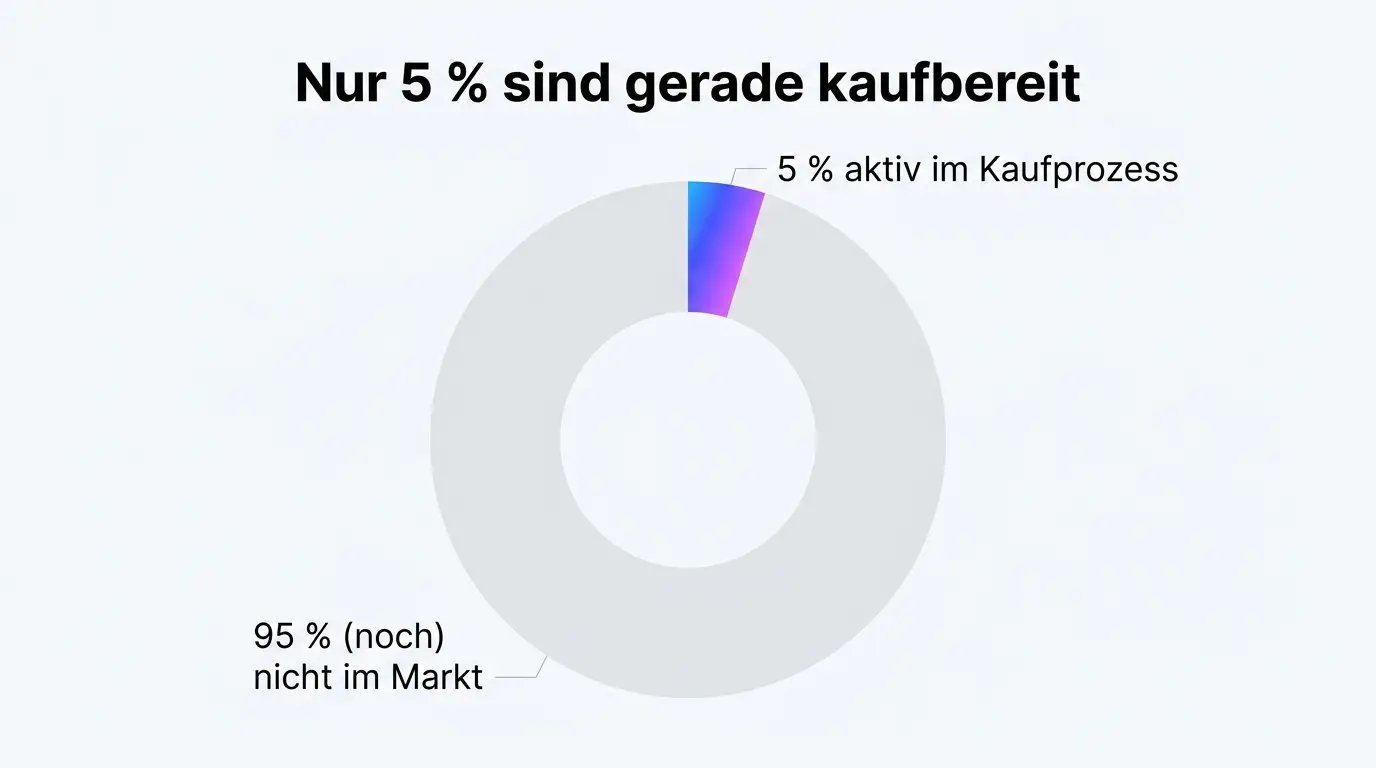
The 95-5 rule by Prof. John Dawes, Ehrenberg-Bass Institute for the LinkedIn B2B Institute (2021): Each quarter, only a small portion of your target audience is actively involved in the buying process.
02 — Too Early or Too Late
02 The problem: Too early or too late
Many companies make two typical mistakes:
- Selling too early – the lead doesn't know you yet, trust is lacking
- Reacting too late – demand is there, but the customer has already made their decision
Both cost you sales.
/ 03 — DETECTING TIMING
03 How to recognise better timing
Three levers help to recognise the right moment:
- Monitoring digital signals: website visits, downloads and repeated clicks indicate growing interest (tools such as HubSpot or Salespanel make them visible)
- Analyse behaviour, not demographics – it's not the industry or size that determines purchase intent, but behaviour: visited multiple pages, downloaded a guide? Then the probability of genuine interest increases.
- Utilise trigger events – a new leader, expansion, website relaunch, or new funding are perfect entry points for outreach
04 — STRATEGIES
04 Strategy: Always be present at the right time
Since you never know exactly when someone will buy, you need a system that makes you continuously visible:
- Regular content (LinkedIn, Blog, Newsletter)
- Automated email sequences
- Retargeting via Ads
- Follow-ups at the right intervals
So you're right there when the need arises. Tools like HubSpot (lead tracking), Hunter.io (outreach on trigger events), Buffer (visibility on LinkedIn), Text Blaze (quick responses), and ChatGPT Pro (personalised messages) can help with this.
/ 05 — PRACTICE
05 Case study
A consulting firm sends relevant insights to its target audience monthly. One of the contacts doesn't respond for 5 months – then suddenly clicks on multiple content pieces and replies to an email. Why? The firm had started an internal project, and the topic suddenly became relevant. Without continuous presence, this lead would have been lost.
In B2B sales, it's not always the best offer that wins, but the one that arrives at the right time. You don't need a perfect campaign, but a system that makes you permanently visible, recognises signals, and reacts at the right moment. Because in the end, it's not just what you offer that counts – but when.
Read on The Digital Buying Journey in B2B · How to lose B2B deals without even noticing
06 — Frequently Asked Questions
Frequently Asked Questions
Reflects real prompts from ChatGPT, Perplexity & Google AI regarding timing in B2B sales.
Timing in B2B is more important than the offer because it determines whether the offer meets the buyer's current needs and urgency. A perfect offer at the wrong time might be missed, while a slightly less perfect offer at the opportune moment could lead to a sale. It's about being present and relevant when the customer is ready to buy.
Because spontaneous purchases are rare in B2B. According to Prof. John Dawes’ 95-5 rule (Ehrenberg-Bass Institute for the LinkedIn B2B Institute, 2021), only around 5 % of the target audience are actively engaged in the buying process each quarter, amounting to around 20 % over a full year. If you approach them at the wrong time, you’ll lose out – even with a perfect offer.
How do I recognise the right time for outreach?
On digital signals (website visits, downloads, repeated clicks), on behaviour rather than demographics, and on trigger events such as new leadership, expansion, relaunch or financing.
How do I stay present when I don't know the purchase time?
With a system of regular content, automated email sequences, retargeting and follow-ups at the right intervals – this is how you stay at the forefront when the need arises.
/ 07 — For whom
Built for business, whose offer requires explanation.

IT and Software Service Provider
With services requiring explanation and few, valuable customers.

Manufacturing Industry & Mechanical Engineering
Selling complex technology to a few key decision-makers.

Startups & Scale-ups
Who want to become visible quickly and credibly.