
Fewer clicks. More quality.
Your rankings are stable, but organic traffic is decreasing? This isn't a strategic error, but a structural shift – one you can adapt to.
What this means for your B2B sales – and how you'll measure visibility in the future.
In the first four months of 2026, 68.01 percent of US Google searches on desktop and mobile web ended without a click on a result (SparkToro using clickstream data from Similarweb, June 2026). Two years earlier, the same figure was 60.45 percent. This effect is further amplified by AI overviews in search and assistants like ChatGPT, Perplexity, and Gemini.
What looks like a problem, on closer inspection, is a shift – and one that has advantages in B2B. The crucial factor is what your website is for in the future and how you measure visibility.
01 — Zero-Click
01
What Zero-Click actually means
Zero-click describes search queries where users receive their answer without visiting a website – via AI overviews directly in Google search results, via answers from ChatGPT, Perplexity or Gemini, and via featured snippets and knowledge panels.
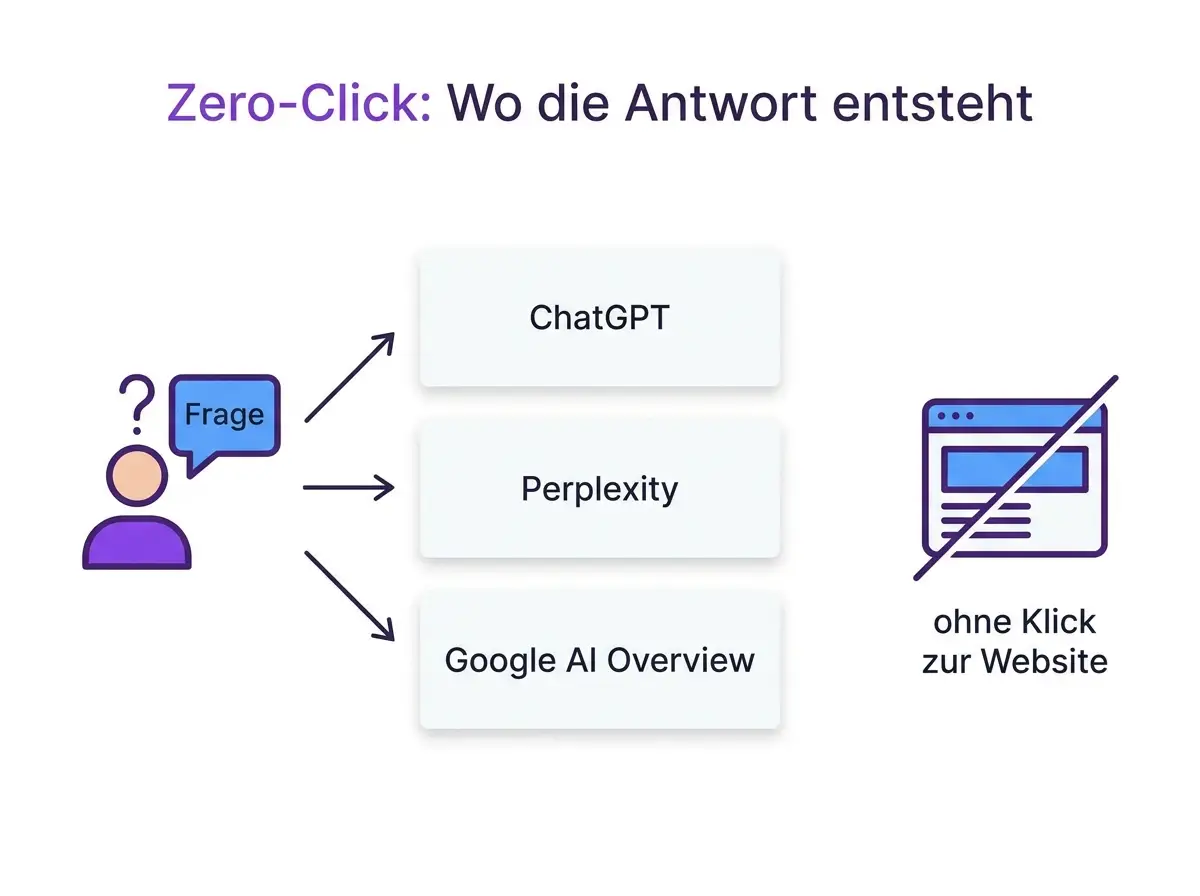
Simple informational queries are primarily affected: definitions, explanations, „What is..." searches. These are precisely the contents with which many B2B websites have previously built their traffic.
The traffic is dropping. But the customers stay.
02 — B2B
02
Why this is less dramatic in B2B
In B2B, it's not the quantity of visitors that counts, but the quality of inquiries. Someone who finds you via an AI answer has already asked a specific question and perceives you as a relevant option. Traffic decreases – but those who remain are further along in the decision-making process. AI referral traffic is small, but converts above average.
When AI answers the simple questions, the task of your website shifts — towards content that prepares a real purchase decision:
Pure definition articles are losing importance.
Winning decision content.
03 — Measurements
Remeasuring visibility. Four sizes instead of click numbers.
Four sizes show you whether you are featured in AI responses — regardless of what click numbers say.
1
PROMPT-TEST
Mentions in AI responses
Asks ChatGPT, Perplexity and Gemini the same set of 10-15 target group questions monthly and documents whether and how they are mentioned.
2
GA4-SEGMENT
AI Referral Traffic
Segment visits to chatgpt.com, perplexity.ai and gemini.google.com in GA4. Many AI systems do not pass a referrer, so this figure is a lower bound.
3
Form field
Self-reported source
A form field „How did you hear about us?" with options like ChatGPT captures what technology loses – often the most reliable source.
4
Trade Mark Search
Branded Searches
Rising searches for your name with declining generic traffic show: AI is establishing you as a provider — the click comes later and is more targeted.
/ 04 — Practice
04
From practice: less traffic, better enquiries
An industrial service provider recorded around 20 percent less organic traffic over six months. The initial reaction was concern — the analysis revealed a different picture: the number of inquiries remained stable, and the quality even increased.

In the „How did you hear about us?" form field, ChatGPT increasingly appeared — visits that had remained invisible in the analytics tool as direct traffic. Instead of chasing more traffic, the website was aligned with decision-making content: traffic remained lower, while inquiries increased.
Read on ChatGPT and the Buying Journey in B2B · GEO Guide: AI Visibility
05 — FAQ
Frequently Asked Questions
Reflects the real prompts from ChatGPT, Perplexity & Google AI around zero-click and AI search.
Should I block AI crawlers to prevent my content from being „stolen"?
For most B2B companies, this is counterproductive. Those who block themselves do not appear in AI responses and leave recommendations to the competition.
Is blog content still worth it then?
Yes, but with a different focus. Content that demonstrates expertise, provides original data, and is citable is gaining. Interchangeable definition articles are losing.
You can tell if declining traffic is a problem when it negatively impacts your business goals. Here are some indicators: * **Consistent Downturn:** If you see a steady, downward trend in your website traffic over a significant period (weeks or months), rather than a temporary dip, it's a cause for concern. * **Impact on Key Metrics:** Declining traffic often leads to a drop in other important metrics like conversions, leads, sales, engagement (time on site, pages per session), or revenue. If these crucial business outcomes are suffering, the traffic decline is a problem. * **Source-Specific Drops:** If traffic from your primary, most valuable sources (e.g., organic search, direct traffic, specific referral sites) is decreasing, it's more problematic than a small dip in less critical channels. * **Competitor Performance:** If your competitors are maintaining or increasing their traffic while yours is falling, it suggests you're losing market share. * **Sudden, Unexplained Spikes:** A sudden, significant drop in traffic that you can't immediately attribute to external factors (like a holiday or a major news event) could indicate a technical issue, a penalty, or a significant change in search engine algorithms. * **Decreased Brand Mentions or Direct Traffic:** A decline in people directly typing your URL or searching for your brand name can indicate a loss of visibility or interest. * **Reduced Engagement from Existing Users:** If your returning visitor traffic is decreasing, or if those who do visit are engaging less, it might signal a problem with content quality, user experience, or perceived value. * **Low Bounce Rate on High Traffic Pages:** If your most popular pages are seeing a high bounce rate as traffic declines, it means the visitors you *are* getting aren't finding what they're looking for or are having a poor experience. In essence, declining traffic is a problem when it starts to hinder your ability to achieve your objectives, whether that's generating leads, making sales, building brand awareness, or anything else your website is designed to do.
To the requests, not the sessions. As long as the number and quality of requests remain stable or increase, declining traffic is a shift, not a loss.
06 — For whom
Built for business, whose offer requires explanation.

IT and Software Service Provider
With services requiring explanation and few, valuable customers.

Manufacturing Industry & Mechanical Engineering
Selling complex technology to a few key decision-makers.

Startups & Scale-ups
Who want to become visible quickly and credibly.