TEAM & COLLABORATION
Why Boutique Agencies Are the Better Partners in Digital B2B Sales
A large full-service agency or a specialized boutique? Especially for SMEs in the DACH region, the boutique approach often makes the decisive difference in digital sales.
In the world of digital B2B marketing, companies face a fundamental question: a large, generalist agency – or a boutique agency that fully focuses on their specific needs? Especially for small and medium-sized companies in the DACH region, a specialized boutique can make the decisive difference.
This article shows the advantages a boutique approach offers in digital sales – with concrete real-world examples.
/ 01 – SUPPORT
Personal support instead of assembly-line service
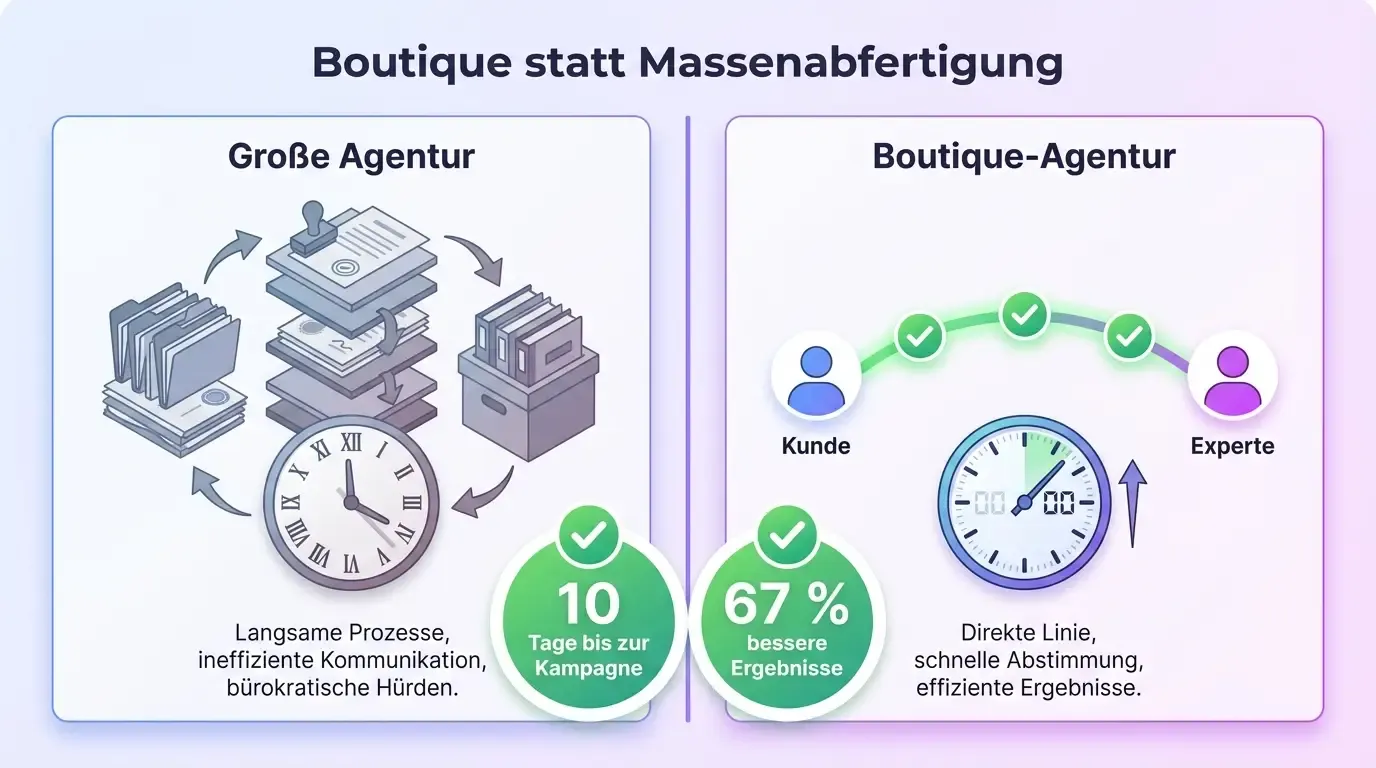
Boutique agencies work with a select group of clients – which creates room for genuine relationships and individual support. In practice, that means: no long wait times, no project stuck in a queue, no constant turnover of contacts. Instead, direct communication with consultants who genuinely know the company.
One example: an Austrian SaaS startup chose a boutique agency over a large one. The result: faster response times, flexibly adapted campaigns, and a consistently reachable team – without bureaucratic detours.
A true partner who meets you as an equal beats any off-the-shelf agency.
PRINCIPLE: PARTNER, NOT VENDOR
/ 02 – SPECIALIZATION
Specializing in what really matters
While large agencies often cover a broad spectrum, boutique agencies are usually highly specialized – for example in digital B2B sales, data-driven marketing, and scalable lead generation. This focus leads to deep industry knowledge, sound strategies, and high efficiency.
There is, however, no solid study that quantitatively pits specialized agencies against full-service providers. The percentage figures circulating on this comparison can’t be traced back to any primary source. Forrester even described an opposite movement in 2017: marketers were consolidating their agency rosters and increasingly seeking partners who cover multiple channels. Whether a boutique is the right choice is therefore not decided by a single metric, but by the specific task at hand, the depth of expertise required, and how much coordination overhead a company is willing to carry.
/ 03 – TAILORED
Tailored solutions instead of standard processes
Boutique agencies don’t work with a “one size fits all” formula – they develop bespoke concepts for each company, based on goals, target audiences, and resources. Every project starts with a thorough analysis and an individual roadmap.
The tool setup is also precisely matched to the processes: solutions like Asana, SE Ranking, Buffer, or Canva are complemented by AI-powered content production and visual design – tailored to each specific need.
/ 04 – SPEED
Flexibility and speed in execution
Large agencies often need weeks for internal coordination. Boutique agencies score with agility: campaigns can be adjusted at short notice, new funnels set up within a few days, and strategies tested immediately.
The reason lies in the structure. When there’s no account layer, no approval chain, and no resource planning spanning multiple clients between briefing and execution, an idea becomes an implementation on the same day. A LinkedIn lead campaign with landing page, email flow, and tracking then comes together in days rather than quarters – not because the work happens faster, but because there’s less waiting time in between.
Conclusion: A boutique agency is more than a smaller version of the “big players” – it’s a strategic choice. For companies in digital B2B sales, that means personal support, deep expertise, tailored strategies, and high execution quality. Anyone not simply looking for an agency, but for a genuine partner between equals, is often best served by a specialized boutique.
Keep reading: Marketing & sales – finally thinking together
/ 05 – FAQ
Frequently Asked Questions
Reflects real questions from Google & ChatGPT around boutique agencies in digital B2B sales.
What is a boutique agency?
A small, highly specialized agency that works with a select group of clients and focuses on a clear area of expertise – in B2B, for example, digital sales, data-driven marketing, and lead generation.
Boutique or large agency – what’s better for SMEs?
For small and medium-sized companies, a boutique usually offers more personal support, shorter paths, and deeper expertise. Large agencies cover a broader spectrum, but are often slower and more impersonal.
Do specialized partners really deliver better results?
There’s no solid data foundation for that. We’re not aware of any study that quantitatively pits specialized agencies against full-service providers, and the percentage figures circulating on the topic can’t be traced back to any primary source. Forrester even described an opposite movement toward consolidated agency rosters in 2017. It’s more useful to ask whether an agency is professionally capable of the specific task and how quickly it can deliver.
How quickly can a boutique agency execute?
Short coordination paths mean campaigns can be adjusted at short notice and new funnels set up within a few days. The lever is structural: when there’s no account layer and no approval chain between briefing and execution, most of the waiting time disappears. Firm turnaround times depend on the project and can only be stated responsibly after a briefing.
What services do boutique agencies offer in B2B?
Often digital B2B sales, data-driven marketing, lead generation, landing pages, email flows, and tracking – tailored rather than following a standard process.
Are boutique agencies more expensive than large agencies?
Not necessarily. Focus and lean processes often result in a better ratio of effort to outcome, because there’s less overhead and less friction loss.
Sources & further reading
- Forrester (2017): Marketers are consolidating their agency rosters and increasingly seeking partners who cover multiple channels. We are not aware of quantitative evidence that specialized agencies deliver better marketing results than generalists.
/ 06 – WHO IT’S FOR
Built for companies whose offering needs explaining.

IT & software service providers
With services that need explaining and a few, high-value customers.

Manufacturing industry & mechanical engineering
Selling complex technology to a small number of major decision-makers.

Startups & scale-ups
Companies that want to become visible quickly and credibly.