Google spam update in September 2026 and what it did to three of our guides
Key points
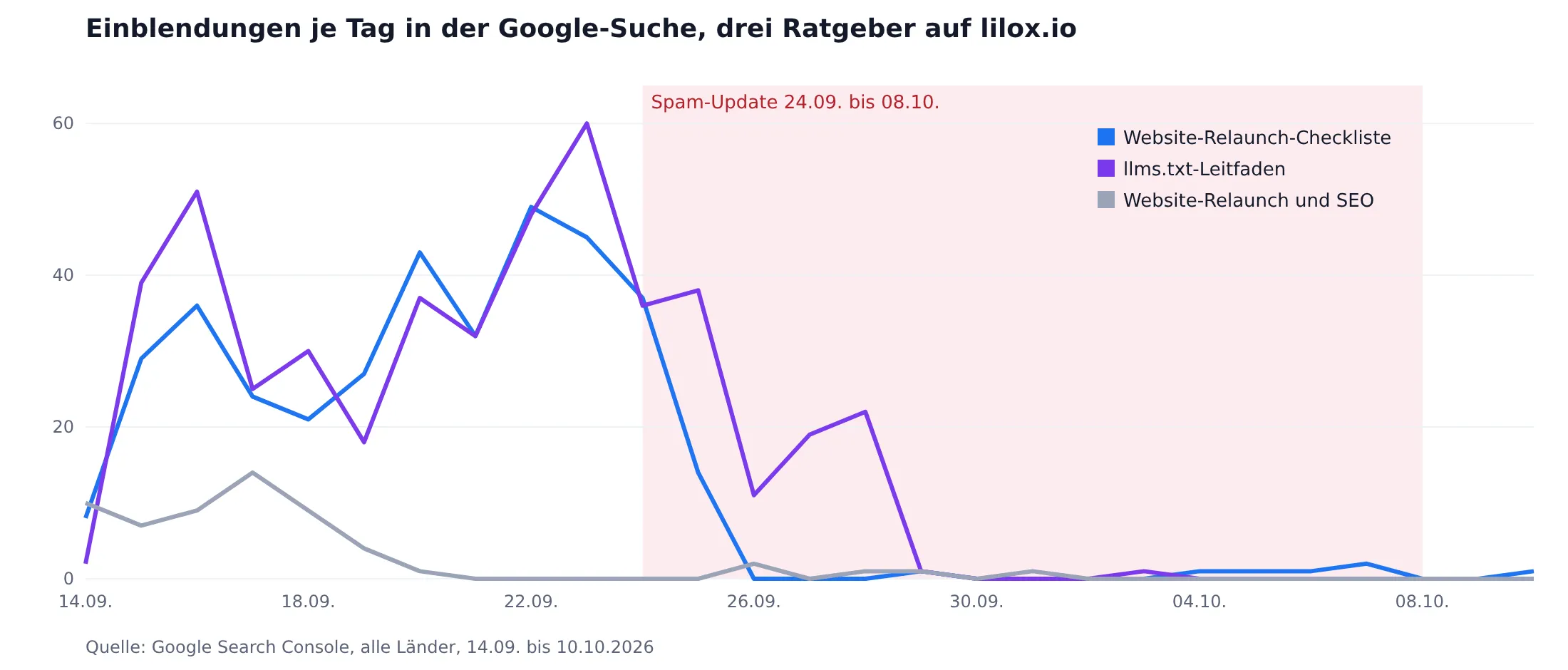
When the numbers dropped at the end of September, our first suspicion was our own go-live on 30 September. The chart shows why that was wrong. The checklist already dropped on 25 September, five days before our package and on the first day of the update.
- Google rolled out a spam update from 24 September to 8 October. On lilox.io it hit three guides that we had published on the same day. In Germany they fell from 399 impressions combined over ten days to one.
- Our 50 older magazine articles gained slightly in the same period. There is no manual action.
- It was not typical AI phrasing. The three texts mainly retold other sources and contained nothing of their own.
- We are enriching them with our own experience, cutting them significantly and putting them back online one at a time.
Chapter 1. What happened
| Guide | 10 days before | 10 days after |
|---|---|---|
| Website relaunch checklist | 188 | 1 |
| llms.txt guide | 179 | 0 |
| Website relaunch and SEO | 32 | 0 |
The third article dropped out already on 20 September. From that day on, Google only showed the checklist, which was written on the same topic, for its search terms. All three pages are still indexed. Google has downgraded them, not removed them.
“When the numbers dropped, a guess was not enough for me. I wanted to know for each page exactly what the cause was.”
We checked every change to the affected pages in the repository. In our package of 30 September, a single word was changed in the llms.txt guide. Title, description, headings and indexing stayed the same on all three pages, and nothing at all was changed on the checklist between 10 September and 4 October.
Chapter 2. What Google classes as spam
Spam sounds like marketing emails. Google’s guidelines now also include something far more mundane. “Scaled content abuse” covers pages that are created mainly for search and offer readers little of their own. Whether AI was involved plays a minor role for Google.
Google provides questions to check against. Three of them match our case exactly. Does the content mainly summarise what others have already said? Does it show first-hand experience? Is it recognisable who wrote it? For our three guides, the answers were yes, no and no.
Chapter 3. What only the three articles had in common
| Feature | three affected articles | 50 older articles |
|---|---|---|
| Links to Google’s own guidance | 22, 22 and 2 | 0 |
| Dates “as of …” in the text | 22, 22 and 12 | on average 0.3 |
| own experience from projects | none | occasionally |
| Length | 2,900 to 3,300 words | on average 1,700 |
| published | all on the same day | spread out |
The two relaunch articles were essentially Google’s guide to moving a website, carefully retold and written twice. However, in August we had moved our own website and gained enough experience to write about it.
Chapter 4. What it was not
We had expected typical AI phrasing. The count showed the opposite. Phrases such as “not …, but” and questions as subheadings appeared in the affected articles roughly three times less often than in the older ones. The fixed building blocks of our magazine were not the cause either: the short summary and the question block appear in almost all of the older articles.
Independent analyses paint a similar picture. Websites are hit based on structure and volume, that is, pages built from templates and many texts in a short time. Affected pages usually also lose their mentions in Google’s AI answers. In the questions we track with Peec across Google AI Search, ChatGPT, Copilot, Gemini and Claude, the three guides were never named as a source.
Chapter 5. What we are changing now
“Redirecting would have been the quicker route. We would rather enrich the articles significantly, with what we experienced ourselves.”
The three guides will be shorter and will tell the story of our own move. This includes the 144 redirects that we put on hold the day before go-live and switched back on five days later, and the entry at the old host that cost us three hours. Also the default setting that blocked nine AI crawlers, and our llms.txt, in which at times 81 of 163 addresses were missing.
From now on, four rules apply to every new guide. Each article contains at least three things that only we can know. We name outside sources once and link them at the end. Each article carries the name of the person responsible for it. And new guides go online one at a time, at least one week apart.
We do not know how quickly the pages will recover. Google describes the period after a spam update as several months.
Chapter 6. How you can check your own website
- Compare periods. In Search Console, compare for each page the ten days before 24 September with the ten days from 1 October.
- Group by origin. Pages that went live together stand out.
- Check for manual actions. With an automatic downgrade, nothing is listed there.
- Answer the three questions. For each lost page, ideally with someone from the specialist team.
- Review with AI. Give your most important guide to an AI assistant with the instruction “Mark every paragraph that a competitor could have written just as well, and suggest which example from our practice belongs there.”
Frequently asked questions
Has Google penalised lilox.io?
There is no manual action, and most of the website gained in the same period. Three guides that were created together were downgraded.
Should you stop using AI for guides?
Google explicitly allows AI, as long as the content is checked and offers something of its own. We continue to use AI for research and structure. What appears in the text must come from our own work.
Sources
- Google Search Central, Spam policies for Google Web Search: https://developers.google.com/search/docs/essentials/spam-policies
- Google Search Central, Creating helpful, reliable, people-first content: https://developers.google.com/search/docs/fundamentals/creating-helpful-content
- Google Search Central, Guidance on using generative AI content: https://developers.google.com/search/docs/fundamentals/using-gen-ai-content
- Search Engine Roundtable, “Google September 2026 Spam Update Is Done Rolling Out”, 8 October 2026: https://www.seroundtable.com/google-september-2026-spam-update-done-42235.html
- Lily Ray, “It Works Until It Doesn’t”: https://lilyraynyc.substack.com/p/it-works-until-it-doesnt-ai-content-risks
- Own data: Google Search Console lilox.io, repository lilox.io, Peec AI.