You measure your AI visibility. And then what?
The most important points in brief
A monitoring tool for AI visibility measures whether your brand appears in AI answers. It does not say why it does not, and even less what to do about it. That is exactly where most setups fail: after four to six weeks nobody looks into them anymore, because no number ever turned into a task. Four metrics actually carry a decision: visibility (does the brand appear), share of voice (how often compared with the competition), cited sources (what the answer is built from) and technical accessibility (whether your own site may be read at all). The fourth is the only one that can be checked in minutes and fixed in days, and it is at the same time the most often overlooked. Anyone who wants to turn monitoring into work needs three fixed elements: an unchanged prompt set, a monthly evaluation with a name and a date, and a rule that defines which deviation triggers which action.
Almost every company we talk to about this topic now has a tool. Peec AI, Profound, Otterly, Semrush AI Toolkit, or a self-built prompt sheet. The setup takes an afternoon, the first numbers arrive the next day, and then nothing happens for six weeks.
That is not a discipline problem. It is a design flaw in the setup.
Why does nobody look at the dashboard after six weeks?
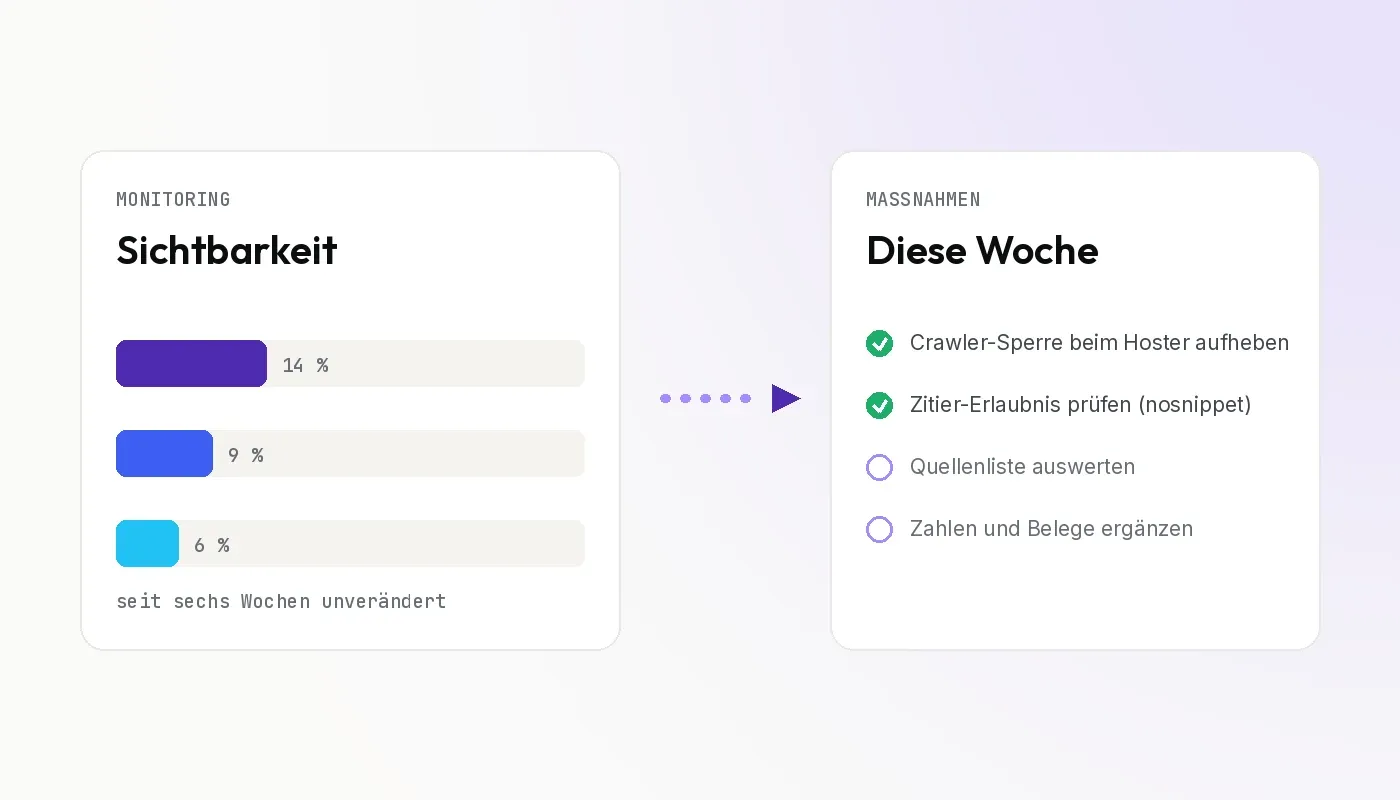
Because a measured value without a defined action is not information but a feeling. “Visibility 14 percent” answers no question anyone has on Monday morning. It is neither good nor bad, it has no comparison value, and it does not say whose task follows from it.
Classic SEO reporting did not have this problem, because the chain was short: ranking drops, look at the page, improve the text. With AI answers the chain is longer and interrupted in several places. Between “we are not mentioned” and “we can change that” lie at least three questions that no dashboard answers.
First: do the systems come to our site at all? Second: if so, do they find anything quotable there? Third: if neither is the issue, from which external sources are they building their answer instead?
A monitoring tool measures the result of these three questions, not the questions themselves.
Which four metrics carry a decision?
Visibility: does the brand appear?
The share of queries in which your company is mentioned. This is the base figure, from which nothing can yet be derived on its own. It only becomes useful with a comparison, either against the previous month or against a competitor.
Beware of a common shortcut: the value can be raised at any time by adding questions to the prompt set in which your own brand name appears. The number rises, reality does not. A prompt set should be changed when a real customer question is missing, not when the curve is flat.
Share of voice: how often compared with whom?
The share among all named providers. This figure is less comfortable and therefore more useful: an AI answer typically names three to five providers, not thirty. Visibility is thus a game of displacement, and a value of 8 percent means something completely different when the strongest competitor is at 40 than when everyone is at 8.
Cited sources: what is the answer built from?
The only metric that leads directly to an action. Most tools list the retrieved and cited URLs for each answer. From this, a list of the domains from which the answers in your market are built can be drawn up in a few minutes.
It is almost always short, and it almost never contains you. What to do with this list is covered in a separate article: Why AI answers always cite the same sources.
Technical accessibility: are they allowed in at all?
The metric that appears on no monitoring dashboard, and the only one that can be checked in minutes.
A monitoring tool queries the AI systems. It does not call your website with their crawler identifiers. It therefore cannot structurally notice when these crawlers are turned away at your door, and that is exactly the most common individual finding.
Cloudflare has blocked known AI crawlers by default on every newly created domain since July 2025, and is extending this to all existing customers on the free plan on 15 September 2026. The block is a network rule, it appears in no robots.txt, and the site operator sees nothing of it. A second, similarly invisible case is a nosnippet in the robots directives: Google explicitly names eligibility for text snippets as a requirement for AI Overviews and AI Mode. The crawler then gets in, reads everything, and may show none of it.
Both can be determined in under a minute, free of charge and without registration: start the AI visibility check.
What is in no metric but explains the figures?
Three technical findings decide a missing mention more often than any content weakness.
AI crawlers do not execute JavaScript. This is measured, not assumed: Vercel, together with MERJ, analysed over one billion crawler fetches and found that GPTBot, ClaudeBot and CCBot do not execute JavaScript. A page that only assembles its text in the browser is empty for them, regardless of how good it looks.
A considerable share of fetches leads nowhere. The same analysis shows: 34.8 percent of all ChatGPT fetches landed on a 404 page, compared with 8.2 percent for Googlebot. Outdated internal links and unmaintained redirects cost visibility here directly.
Evidence in the text is the best-documented content factor. The GEO study by Aggarwal and colleagues measured in a controlled experiment which text changes increase the share of AI answers. Adding quotations and source citations produced the largest single effect: from 19.3 to 27.2 percent, which is roughly 41 percent more. An independent evaluation across 55,936 queries confirmed the connection for outgoing links to external sources.
What is often recommended and does not survive scrutiny?
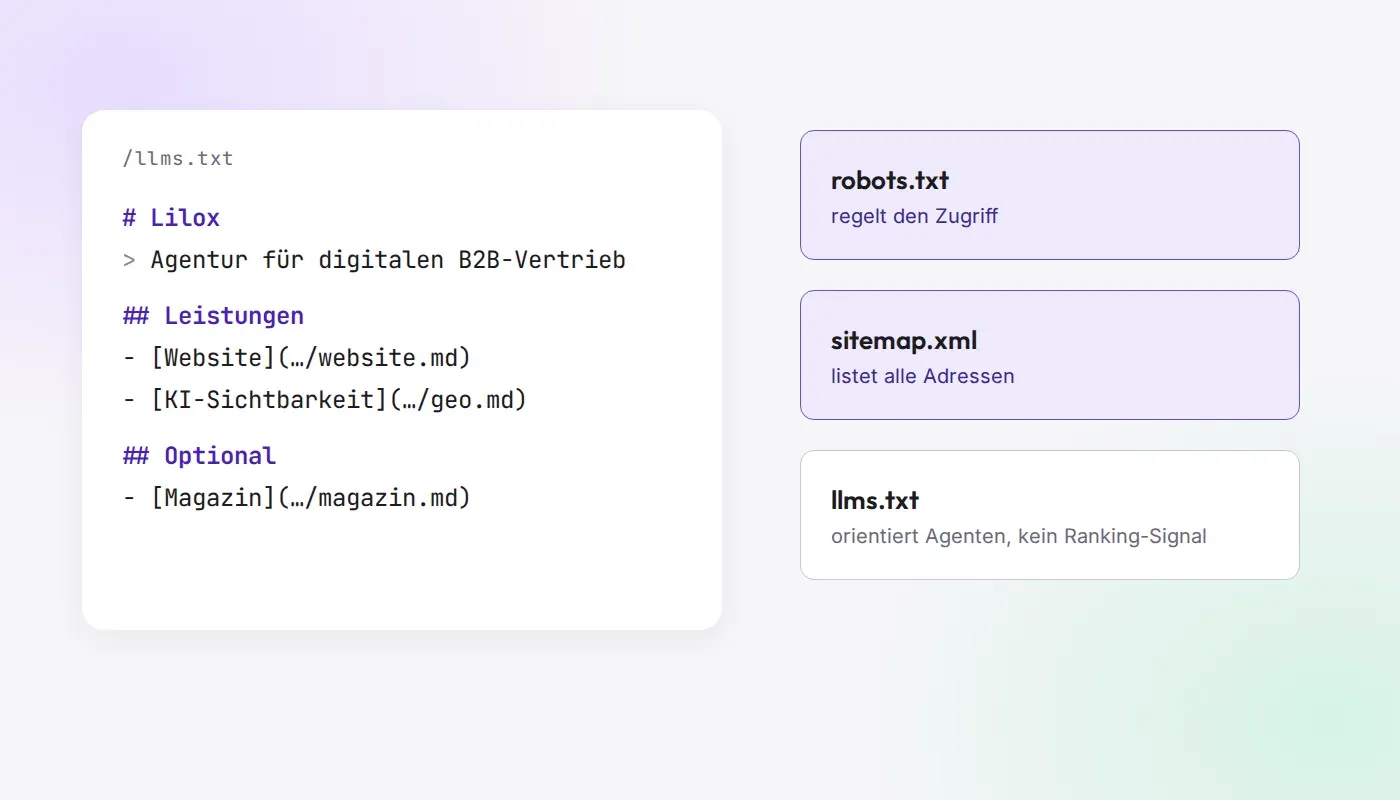
Create an llms.txt. Google states in writing that it does not read the file. Ahrefs analysed 137,000 pages and found that 97 percent of the files receive no traffic. It does no harm and costs ten minutes, but it is not an action from which a metric rises.
Mark up more Schema.org. The only quasi-experimental test on this, also by Ahrefs, compared 1,885 pages with roughly 4,000 control pages and found a slightly negative effect for AI Overviews and no effect for ChatGPT. The Organization schema nevertheless remains sensible, because it answers the question of which company stands behind a page. As a lever for more mentions it is not suitable.
Optimise loading time. In no study on AI citation known to us does loading time appear as a factor. It measures user experience, and for that it is the right metric. As an explanation for a missing mention it is a guess.
How does monitoring become work?
Three elements, and none of them is a tool.
An unchanged prompt set. Twelve to twenty questions in the wording of real customer questions, divided into category queries, problem queries and brand queries. It is asked monthly in exactly the same wording. Anyone who changes it in between no longer has a time series, but two incomparable snapshots.
A monthly evaluation with a name and a date. One page, not ten: the four metrics, the comparison with the previous month, the list of cited external sources, and below it three sentences on what follows from them. Without a person who writes it, it no longer exists after the second month.
A rule that defines which deviation triggers which action. This rule is the piece that is actually missing. An example that can be adopted directly:
- Access for a citation crawler blocked: fix immediately, hosting setting, same week
- Share of voice falls two months in a row while visibility stays the same: the competition is growing, not us. Off-site work on the cited sources
- The same external source appears in more than half of the answers: check inclusion in this source
- We are mentioned but described incorrectly: entity work, meaning align the positioning text,
Organizationdata and external profiles - No movement over three months with clean access: quotable content is missing, not a technical problem
Tool for going further
If you do not want to start the prompt set from scratch, you will find in the report 51 buyer questions, a measurement over 30 days in four AI systems and the six findings that follow from them.
How long does it take for something to move?
The technical findings take effect quickly: a lifted crawler block is visible in the answers within a few days to weeks, because the systems can then fetch the page for the first time. Everything involving content and external mentions takes longer, usually four to eight weeks until the first movements and several months until a stable picture.
Anyone who sees no change after four weeks either has a technical problem that was not fixed, or is measuring a period that is too short. This can be told apart, and the difference is the first question an evaluation has to answer.
How Lilox sets this up
We do not start with the tool, but with the prompt set and the technical finding. The prompt set is built from what customers actually ask in conversations, not from keyword lists. The technical finding comes from real fetches using the crawler identifiers of the answer systems, because otherwise it cannot be separated whether a missing mention lies in the content or behind a closed door.
From both comes the monthly evaluation with the action rule. The report, the structure and the access ultimately belong to the company, not to us.
Frequently asked questions
How do you measure AI visibility?
With a fixed set of twelve to twenty questions, worded like real customer questions, asked unchanged each month in ChatGPT and Gemini. For each answer, four things are recorded: whether the brand is named, at which position, with what justification, and who is named instead. Tools such as Peec AI automate this measurement. The prompt set itself, however, must be built by people from real customer questions, otherwise it measures the wrong questions very precisely.
Why does nothing change in our visibility despite monitoring?
Because monitoring measures the result, not the cause. A dashboard shows that you are not mentioned, but not whether the crawlers are allowed onto your site at all, whether they find text there and whether the answers are built from external sources. These three questions need their own checks, and the action list that monitoring cannot deliver follows from their answers.
Which metric is the most important for AI visibility?
The list of cited sources. Visibility and share of voice say where you stand, but the cited sources say what the answers in your market are built from. This list is usually short, rarely contains the providers themselves, and it is the only metric from which a work list can be derived directly.
Is a monitoring tool enough, or do we need an agency?
The tool provides the measurement; it provides neither the questions, nor the interpretation, nor the implementation. Anyone who has someone internally who spends an hour a month on the evaluation and several days on the actions does not need an agency. Anyone who finds that nobody has opened the dashboard for weeks does not have a tool problem but a process problem, and that is not solved by another subscription.
How can I tell whether our website is technically citable at all?
By having someone retrieve it with the real crawler identifiers and check whether they get through, whether text remains without JavaScript and whether the robots directives allow text snippets. A look at the robots.txt is not enough for this, because the most common block is a network rule of the host, which does not appear there at all. Our AI visibility check checks this in ten tests, free of charge and without registration.