The same five sources, again and again. And you are not among them.
The key points in brief
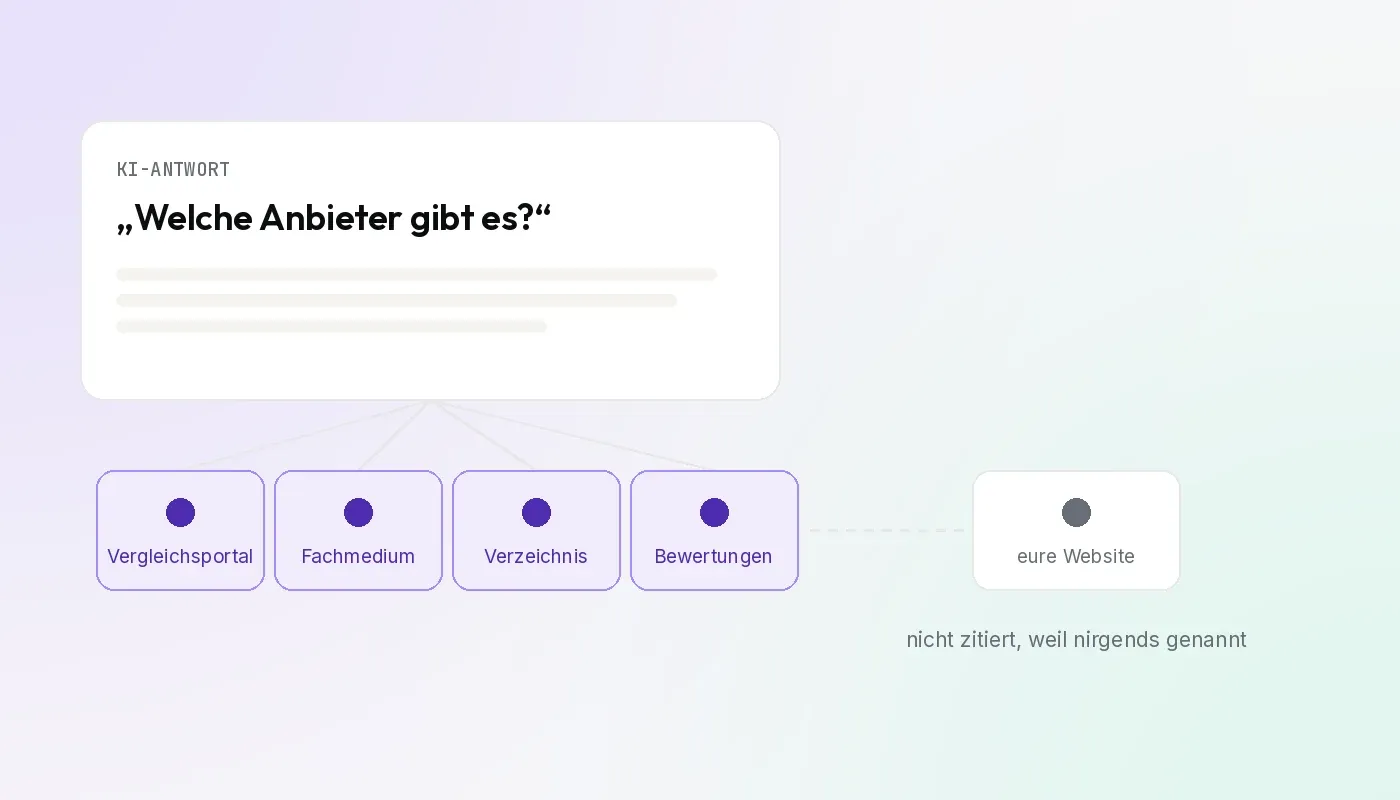
AI answers are built from a small number of sources, not from the whole web. In most B2B markets, three to five domains appear in the majority of answers: comparison portals, trade media, industry directories and, occasionally, a single competitor with a very good comparison article. If you are not listed there, you will not be named either, even when your own website is technically flawless. You can work out the list of these sources yourself in about an hour, without any tools: ask twenty customer questions, note the domains cited in each answer, and count them up. After that, the order decides the effort. The sources you can add yourself to work fastest, and editorial trade media are the slowest. There is one exception: where your own site is citable in itself, because it contains figures, definitions and source references, it becomes a source rather than only a candidate. That is the only lever that does not depend on a third party’s decision.
That sentence comes up in almost every second conversation, almost always word for word: “We have noticed that the AI keeps citing the same portals in our market, and we are not listed on them.”
That is not a perception issue. It is how the system works.
Why is it always the same sources?
A classic search engine returns ten results and leaves the choice to the person. An answer system has to make the selection itself before it responds, and it does so under time pressure and with limited space. Typically three to eight sources feed into an answer, and in the end three to five providers are named.
This scarcity leads to a behaviour that looks from the outside like inertia. A system that is meant to answer a question about providers first turns to pages that already answer that question in list form. A comparison article with ten providers, tables and prices is more useful for this purpose than ten provider pages that each write about themselves. That it is more useful has nothing to do with quality, and everything to do with format.
A second effect adds to this: what has been cited once is more likely to be cited again. The systems assess sources partly by how often others link to them, and a portal that writes the comparison articles in a market collects exactly these links. The result is a short, stable list.
How do you identify this list?
In about an hour, without tools and without a budget.
Step one: write down twenty questions. Not keywords, but full sentences in the wording a customer would use. Three kinds are needed. Category questions (“Which providers for X are there in the DACH region?”), problem questions (“Our Y no longer works, who can help?”) and comparison questions (“A or B, which suits a company with Z?”).
Step two: put every question to ChatGPT and Gemini. The three draw on different sources and sometimes answer quite differently. Anyone who checks only one of them takes its quirks for market reality.
Step three: note the cited domains for each answer. Not the companies named, the domains. ChatGPT in search mode shows them directly; with Gemini they appear below the answer.
Step four: count them up. Sort by frequency. In almost all cases, a very short top group emerges, followed by a long, insignificant tail. The top group is your working list.
If you already use a monitoring tool, you get the same list there automatically. How such data turns into work at all is covered in Measuring AI visibility is not enough.
Tool for taking it further
Anyone who wants to see what such a list looks like in a measured market will find the evaluation of 3,971 AI answers over 30 days in the report, including which source types were cited most often there.
In which order do you get in?
The sources differ less in their benefit than in the effort involved and in who makes the decision. The order follows from that.
First: sources you can add yourself to
Industry directories, provider lists from trade associations, software directories, regional chambers of commerce. An entry takes between twenty minutes and an afternoon, nobody but you makes the decision, and the effect can be measured within a few weeks.
What matters here is not the number but consistency. Name, address, service description and contact person must be identical everywhere. Otherwise several different descriptions of the same company emerge, and an answer system has no reason to consider any one of them correct.
Next: comparison and review portals
Capterra, OMR Reviews, G2, Trustpilot and, in niche markets, the relevant trade portals. Listing is usually possible, often free in a basic version, and the effort lies less in the entry than in the reviews. A profile without reviews does not appear in comparison articles.
The honest part of this recommendation: this is work on customer relationships, not on marketing. Five genuine reviews from satisfied existing customers are worth more than thirty profiles without a single one.
Then: your own website as a source, not as a candidate
The only lever on this list where nobody but you decides, and therefore the one we tackle first with clients.
A provider page that writes about itself is, for an answer system, a party to the matter. A page that answers a question completely, with verifiable figures, clear definitions and references to the original sources, is a source. The difference is measurable: the GEO study by Aggarwal and colleagues tested, in a controlled experiment, which text changes raise the share of AI answers. Adding quotations and source references produced the largest single effect, rising from 19.3 to 27.2 percent, which is around 41 percent more. An independent analysis of 55,936 queries confirmed the link for outbound links to external sources.
Up-to-dateness adds to this. Ahrefs analysed around 17 million addresses cited in AI answers and found that cited content is kept 13.1 percent more current on average than the comparison set.
In practice, this means: a comparison article that also names competitors, a study with your own figures, a definition page for a term in your market. All three are formats that can be cited without a system committing itself to a single party.
Last: editorial trade media
The most effective and the slowest. An editorial team makes the decision, and the route runs through specialist contributions, your own data or a topic that is currently needed. Plan in quarters, not weeks, and do not start here while the three points above are still open.
What you should check first
One point comes before the entire list, because otherwise it makes the list worthless.
If AI crawlers are not allowed to enter your own website, every external mention only does half the job: the system reads your name in a comparison article but cannot check what you actually offer. This case is more common than one might think, and it is invisible from the outside. Since July 2025, Cloudflare has blocked known AI crawlers by default on every newly created domain, and from 15 September 2026 it extends this to all existing customers on the free plan. The block is a network rule and does not appear in any robots.txt.
A second case, equally invisible: a nosnippet in the robots directives. Google explicitly names eligibility for text snippets as a requirement for AI Overviews and AI Mode. The crawler then gets in, reads everything, and is not allowed to show any of it.
Our free AI visibility check tests both in under a minute, without sign-up.
What does not help here
Ignoring the portals and writing more of your own articles instead. This is the obvious reaction and it falls short, because it overlooks the displacing nature of the answer: as long as the portal’s comparison article answers the question, it will be cited, regardless of how much you publish alongside it.
Relying on an llms.txt. Google has stated in writing that it does not read the file. Ahrefs analysed 137,000 pages and found that 97 percent of the files receive no traffic. It takes ten minutes and does no harm, but it is not a way into someone else’s source.
Paid placements as a shortcut. Some portals sell listing spots. What results is a mention in a context marked as advertising, and the systems clearly treat such sections differently. In each case, check whether the paid spot is actually in the editorial part of the page at all.
How Lilox approaches it
We start with the list of sources rather than with the measure, because otherwise effort flows into channels that decide nothing in your market. The list yields an order sorted by effort, and in parallel we work on your own website, because that is the only part that does not depend on a third party’s decision.
Measurement is carried out monthly with the same set of prompts, so that effect can be separated from chance. Structure, access and documentation ultimately belong to the company.
Frequently asked questions
Why does ChatGPT always cite the same portals in our market?
Because an answer system has to make its own selection before it responds, and for that it favours pages that already answer the question in list form. A comparison article with ten providers is more useful for this purpose than ten provider pages that each write about themselves. There is also a reinforcing effect: what has once been cited collects links and is more likely to be cited again.
How do I find out which sources are cited in my market?
Put twenty real customer questions to ChatGPT and Gemini, and note the cited domains for each answer, not the companies named. Then count them up and sort by frequency. Almost always a very short top group of three to five domains emerges, followed by a long, insignificant tail. The top group is your working list. The effort comes to about an hour.
In which order should we get into these sources?
By effort, and by who makes the decision. First directories you can add yourself to, because nobody but you decides there. Then comparison and review portals, where the effort lies less in the entry than in genuine customer reviews. In parallel, make your own website a source, with verifiable figures and references to original sources. Editorial trade media come last, because an editorial team decides there and the route takes quarters.
Can our own website become a cited source itself?
Yes, and it is the only lever where nobody but you decides. The prerequisite is a change of format: from texts that write about you to texts that answer a question completely, with verifiable figures, clear definitions and references to the original sources. In a controlled experiment, adding quotations and source references alone raised the share of AI answers from 19.3 to 27.2 percent.
Does it help to be listed in as many directories as possible?
No, consistency matters, not quantity. Name, address, service description and contact person must be identical everywhere. If several different descriptions of the same company exist online, an answer system has no reason to consider any one of them correct. Five clean, matching entries work better than thirty contradictory ones.