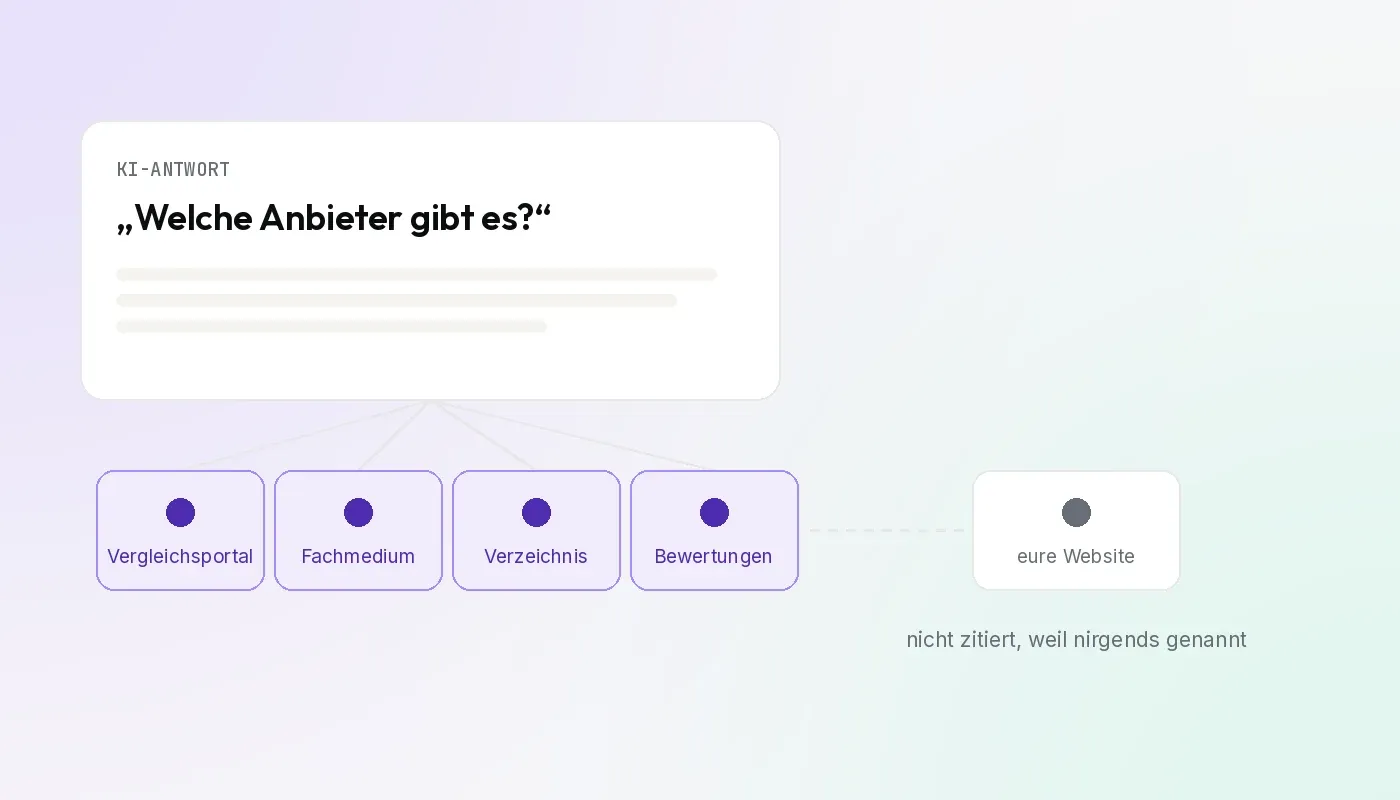
GEO / AI VISIBILITY · PILLAR
GEO for B2B: How Does My Company Get Recommended by ChatGPT and Claude?
Nadine Fraiss · Lilox · ~14 min read
The short answer: Generative Engine Optimization (GEO) ensures that AI search (Google AI Overviews, ChatGPT, Gemini and Claude) names and cites your company. Three levers decide this: machine-readable facts on your own domain, content with verifiable numbers, and mentions on trusted third-party sites. Secure your own brand first, then conquer the category. GEO complements SEO, it doesn’t replace it.
Contents
- What is Generative Engine Optimization?
- Why is AI search changing B2B buying right now?
- What does the zero-click trend mean for your website?
- How does AI search choose who it recommends?
- What distinguishes branded visibility from category recommendation?
- Which six levers get a B2B company into AI answers?
- Which AI crawlers do you need to allow on your website?
- What role do directories and review platforms play?
- How fast does GEO work and what does it cost?
- What does a 90-day roadmap for GEO look like?
- Which mistakes most often slow down AI visibility?
- How do you measure whether AI search names your company?
- Which GEO myths cost budget without impact?
- Frequently Asked Questions
/ 01 – Fundamentals
What is Generative Engine Optimization?
Generative Engine Optimization (GEO), often also called Answer Engine Optimization (AEO), is the practice of optimizing content to be cited in the answers of AI search, that is, in Google AI Overviews, ChatGPT, Gemini or Claude. While classic SEO competes for positions in a list of links, GEO competes for a place in the generated answer itself, including a name mention and a source link.
The difference is more than semantics. AI answer engines work in two steps: during retrieval, they pull matching web pages in real time or draw on training knowledge. During generation, they typically condense three to eight sources into one answer and link the ones they cite. If you don’t show up in either step, you don’t exist for that search query. And because the answer only has a handful of citation slots, competition for those slots is fiercer than for page one on Google, but it’s decided by different rules.
/ 02 – Why now
Why is AI search changing B2B buying right now?
Because buyers are already there. Forrester’s Buyers’ Journey Survey 2025, among roughly 18,000 B2B buyers, shows: 94 percent used AI in their last purchasing process, and AI answer engines are now the most important research source, ahead of provider websites, product experts and sales. 55 percent compare providers directly inside the AI tool, 47 percent build their internal business case there before ever contacting a provider (Forrester, January 2026).
The shift is broadly documented. 51 percent of B2B software buyers prefer to start their research in an AI chatbot rather than Google, 71 percent use AI assistants in software research (G2 via Demand Gen Report). A multi-source analysis of 680 million AI citations confirms 73 percent AI usage in B2B purchasing (Loganix/Averi, March 2026).
Volume is growing accordingly: ChatGPT alone processed around 2.5 billion prompts a day in July 2025 according to OpenAI, and OpenAI has not published an updated figure since. In February 2026, OpenAI reported 900 million weekly active users, up from 400 million a year earlier.
On top of that come Copilot, Gemini and Claude, and the market keeps fragmenting further: ChatGPT’s share of global gen-AI web traffic fell from around 76 percent (June 2025) to roughly 53 percent (May 2026) within twelve months, Gemini rose from under 9 to around 27 percent, Claude from about 2 to just under 9 percent (Similarweb, 2026 Generative AI Landscape, July 2026).
What is measured here are visits to the AI platforms themselves, not the referral traffic flowing from them to other websites; for referrals, Statcounter for instance measures entirely different values, and confusing the two metrics is the most common source of error in the industry. Anyone optimizing for a single platform now ignores more than a third of AI search.
The number that makes the business case: Semrush measured the effect across more than 500 topics. In terms of conversion rate, a visitor from AI search is on average 4.4 times as valuable as one from organic search (Semrush, July 2025). A Seer Interactive case study illustrates this for a single B2B software client: 15.9 percent from ChatGPT versus 1.76 percent from organic Google search, October 2024 to April 2025. There, however, AI traffic accounted for just 0.07 percent of organic volume.
Semrush, July 2025 · Seer Interactive, 2025
/ 03 – Zero-click
What does the zero-click trend mean for your website?
The classic path via the link list is drying up. An AI Overview appears for around 21 percent of all keywords (Ahrefs, 146 million SERPs, desktop, as of September 2025). In the first four months of 2026, 68.01 percent of US Google searches on desktop and mobile web ended without a single click to a website (SparkToro with clickstream data from Similarweb, June 2026). Where an AI Overview is shown, click-through rate on position 1 drops by around 58 percent (Ahrefs, February 2026, 300,000 keywords from Google Search Console data, data as of December 2025).
Search is turning from a distributor into a destination: the answer sits directly in the search engine or the AI chat, and the click to the website is increasingly skipped. For B2B providers, that doesn’t mean visibility becomes worthless: it shifts. Brands cited in AI answers get around 120 percent more clicks per impression than uncited ones (Seer Interactive). Being cited is the new ranking: the question is no longer just “what position am I in?” but “do I show up in the answer when my ideal customers ask?”
/ 04 – Selection logic
How does AI search choose who it recommends?
Language models don’t guess, they cross-reference. If a brand shows up consistently and with evidence across several independent, current sources, the model’s trust in that brand grows. You can influence this at three points. The infographic shows them at a glance:
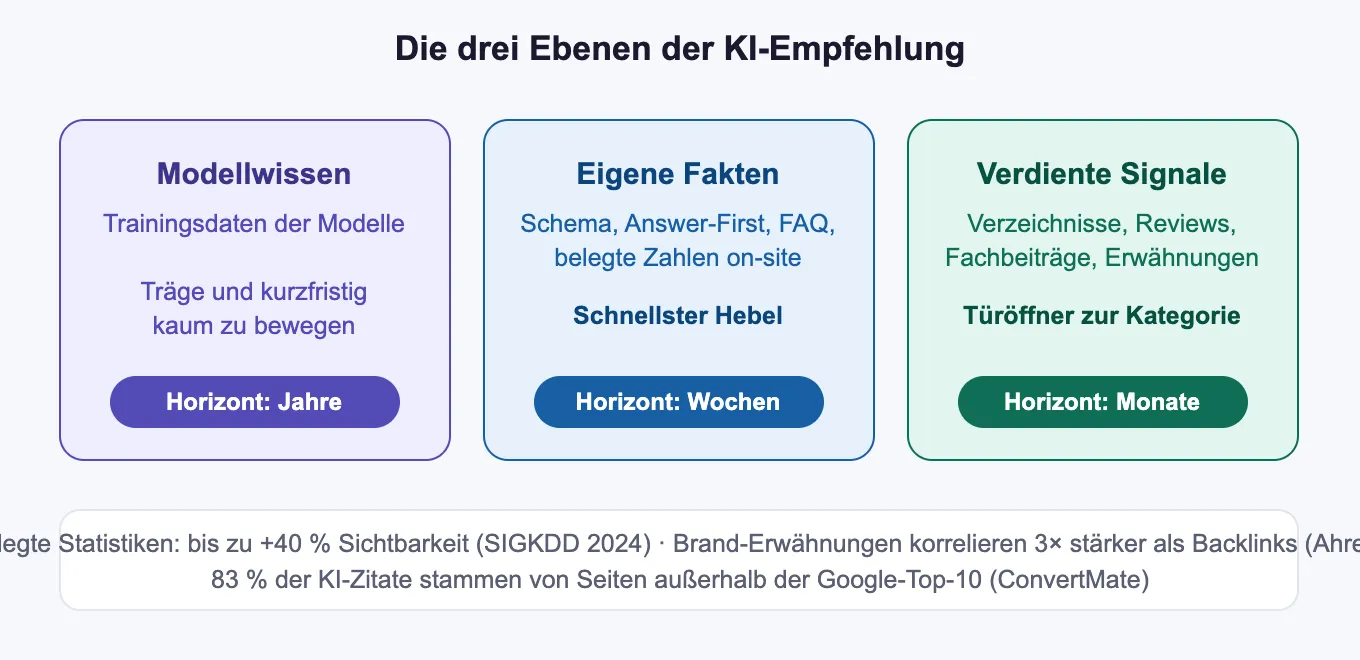
Chart: Lilox, July 2026. Data sources: Aggarwal et al. (SIGKDD 2024), Ahrefs, ConvertMate.
The mechanism has been studied scientifically. Content with concrete statistics, citations and clean source references achieves up to 40 percent more visibility in generative answers (Aggarwal et al., Princeton/Georgia Tech, SIGKDD 2024). A critical review of 45 follow-up studies qualifies that figure: the effect only holds if the source is already inside the AI’s context window. It proves neither that content gets found this way, nor that lasting traffic follows from it; the reproducible levers are topical relevance and position within the context (Martinez, arXiv:2607.14035, July 2026).
More conservatively, GEO-SFE (March 2026) measures 17.3 percent more citations across six generative engines. Also notable: brand mentions across the web correlate roughly three times more strongly with AI citations than classic backlinks, with a correlation of 0.664 versus 0.218 (Ahrefs analysis of 75,000 brands). AI search rewards different signals than classic ranking does.
And it rewards different pages: around 62 percent of URLs cited in AI Overviews don’t rank in the organic top 10 (Ahrefs, 863,000 keyword SERPs and 4 million AI Overview URLs, as of March 2026). In July 2025 that share still stood at 24 percent, so the shift within eight months is substantial. Comparison articles are the most-cited format at 33 percent (ConvertMate, 2026). That’s the real news for smaller B2B providers: in the AI answer, you can beat corporations that dominate you in Google rankings, if your content is more citable than theirs.
/ 05 – Two games
What distinguishes branded visibility from category recommendation?
These are two different games, and confusing them costs months. The table shows the difference:
| Criterion | Branded visibility | Category recommendation |
|---|---|---|
| User’s question | “What does [company name] do?” | “Best B2B agency in Austria?” |
| Goal | AI search describes you correctly | AI search recommends you unprompted |
| Main lever | On-site: schema, entity, own facts | Off-site: directories, reviews, mentions |
| Time horizon | Weeks | Months |
| Measurement | Testing branded prompts | Category prompt monitoring |
The order isn’t negotiable: first get your own house cleanly machine-readable, then build third-party signals. Anyone who wants to win the category before AI search describes their own company correctly is building on sand: the model can’t recommend a brand it can’t reliably place.
/ 06 – Six levers
Which six levers get a B2B company into AI answers?
Most websites lose ground at the same points. These six measures can be worked through systematically, roughly in this order:
1
Lever 1
Allow AI crawlers.
The search bots of the answer engines must be permitted in robots.txt, otherwise everything else is pointless (details and bot list in the next section). Also check CDN and firewall rules that silently block AI bots.
2
Lever 2
Content into server-side HTML.
Many AI crawlers don’t render JavaScript. Core content that’s only loaded via JS afterward isn’t seen by the machine. Server-side rendering is mandatory; semantic HTML (real headings, lists, tables) helps extraction.
3
Lever 3
Schema.org markup.
Organization and WebSite sitewide, FAQPage on every page with a questions block, Article for posts, BreadcrumbList for the hierarchy. Officially not a must for Google AI Overviews, but a real and cheap advantage for the other AI search services and for unambiguous machine interpretation.
4
Lever 4
Extractable content.
The answer sits in the first 40 to 60 words, subheadings are real user questions, sections work as standalone citable units at 200 to 400 words, processes are in numbered lists, comparisons in tables.
5
Lever 5
Evidence instead of claims.
Roughly every 150 to 200 words, one concrete fact with a source and year, linked to the primary source. “Reduces response time by 40 percent” beats “significantly faster.” This statistics effect is exactly the strongest single GEO lever from the Princeton study.
6
Lever 6
Build third-party signals.
Profiles on the directories and review platforms that AI search draws its “best agency” answers from, plus articles, podcasts and consistent company data everywhere across the web (more on this below).
/ 07 – AI crawlers
Which AI crawlers do you need to allow on your website?
AI bots fall into three classes: search bots fetch content for live answers and generate citations, user bots fetch a page when a user requests it in chat, and training bots collect data for model training. For maximum visibility: always allow search and user bots. For training bots, decide deliberately: anyone who wants to be present in the models themselves allows those too.
| Provider | Search bot (allow) | User bot (allow) | Training bot (decide) |
|---|---|---|---|
| OpenAI / ChatGPT | OAI-SearchBot | ChatGPT-User | GPTBot |
| Anthropic / Claude | Claude-SearchBot | Claude-User | ClaudeBot |
| Google (AI Overviews, Gemini) | Googlebot | – | Google-Extended |
The most common mistake isn’t a deliberate one: firewall or bot-protection rules (for example at CDN providers) block AI crawlers wholesale as “suspicious traffic.” A look at the server logs shows whether the search bots actually arrive. If not, every content optimization is wasted.
/ 08 – Directories
What role do directories and review platforms play?
A bigger one than most people would like. When AI search answers “best B2B agency in Austria,” it mostly doesn’t cite the agency websites themselves, but the sources it trusts for the comparison: industry directories, review platforms and editorial lists. In the DACH region, that typically means Sortlist, ProvenExpert, Clutch and OMR Reviews for service providers, plus topic-specific portals.
Our own prompt monitoring confirms the pattern: among the agency-category prompts we track, directory and platform domains consistently rank among the most-cited sources, ahead of most provider websites (our own Peec AI measurement, June to July 2026). The consequence: a well-maintained, consistent profile on the two or three platforms relevant to your category isn’t a nice-to-have, it’s the most direct route into the category answer. Consistency counts double here: name, positioning and description should be identical everywhere so the machine can reliably identify the entity.
/ 09 – Speed and cost
How fast does GEO work and what does it cost?
Branded visibility through your own facts and schema shows up in weeks, category recommendation through third-party signals takes months. None of the six levers requires ad spend: schema, a clear entity, extractable content and self-maintained directory profiles are work hours, not media budget.
The window is real. 92 percent of marketers say they want to optimize for AI search, but only 41 percent are actively adapting their strategy (HubSpot, 2026). In terms of conversion rate, a visitor from AI search is on average 4.4 times as valuable as one from organic search (Semrush, more than 500 topics, July 2025). Whoever starts now competes with a fraction of the later competitors for the three to eight citation slots per answer.
/ 10 – Roadmap
What does a 90-day roadmap for GEO look like?
| Phase | Measures | Result |
|---|---|---|
| Weeks 1–2: foundation | AI readability audit (server HTML, bots, load time) · open robots.txt for AI crawlers · Organization and WebSite schema · consolidate entity (one domain, consistent company data) | Website is technically accessible to AI search and clearly identifiable |
| Weeks 3–6: content rebuild | Rebuild core pages answer-first · question-style headings · FAQ blocks with FAQPage schema · incorporate documented figures and primary sources · link pillar and cluster structure | Pages work as citable units; branded prompts return correct answers |
| Weeks 7–12: authority + measurement | Build directory and review profiles (category-relevant) · first expert articles/mentions · set up prompt monitoring · monthly measurement rhythm | First category citations; progress becomes provable instead of a feeling |
After that, ongoing operations begin: maintain content, replace statistics older than 18 months, prioritize new topics by prompt demand, and re-measure citation impact monthly. AI systems favor current sources: citations decay without upkeep.
Which mistakes most often slow down AI visibility?
- JavaScript-only content. The page looks fine in the browser, but the raw server HTML is empty. For AI crawlers, the site is effectively invisible.
- Blocked bots. Blanket disallow rules or firewall filters block exactly the search bots that would cite you.
- Anonymous content. Posts without identifiable, qualified authors. AI search favors sources with demonstrable expertise: named authors with a profile are a measurable trust signal.
- Outdated figures. Statistics older than 18 months noticeably lower the likelihood of citation.
- Fragmented entity. Multiple domains, differing company descriptions, inconsistent data. The machine can’t reliably identify who you are, and when in doubt cites no one.
/ 11 – Measurement
How do you measure whether AI search names your company?
Without measurement, GEO stays an article of faith. Four levels have proven useful: prompt monitoring such as Peec AI, where defined customer prompts run daily against the relevant AI search services, including competitor comparison. Plus AI bot traffic in the server logs, a dedicated referral segment for AI sources in Analytics, and regularly testing the most important customer questions manually across multiple AI tools: the platforms cite very differently, and only 11 percent of domains are cited by two major AI search services simultaneously (Averi, 680 million citations).
We apply this to ourselves: defined category prompts run daily against the relevant AI search services, the services pull and cite Lilox pages in exactly these prompts, and our domain’s citation rate rises week over week (our own Peec measurement, July 2026). This exact method, re-measured monthly, is the practical proof behind our consulting.
Your GEO Checklist to Tick Off
- Prompt set with 10 to 15 target-audience questions defined and baseline documented
- AI crawlers (GPTBot, ClaudeBot) not blocked
- llms.txt created and up to date
- Organization, WebSite, and FAQPage schema live
- Canonical who-what-where sentence consistent everywhere
- One page per core topic in answer format: definition, figures, FAQ
- External mentions: directories, reviews, one trade article per quarter
- Monthly measurement against the baseline scheduled
/ 12 – Myth check
Which GEO myths cost budget without impact?
| Myth | Fact (as of 2026) |
|---|---|
| “llms.txt drives visibility on Google” | Officially ineffective for Google AI Overviews. Unproven on other engines. Fine as a low-risk test, not a priority. |
| “Without schema, you won’t get cited” | Not a must-have criterion on Google. Still worthwhile for the other AI search services and for clarity. |
| “Mass mentions or purchased links give a boost” | No. The same anti-spam systems as in ranking filter these out. Only genuine, contextually strong mentions count. |
| “Optimizing for one platform is enough” | No. AI search is fragmenting; the citation sources of the major services overlap by only around 11 percent. Multi-engine visibility is mandatory. |
| “GEO replaces SEO” | No. Google calls it “still SEO.” Solid SEO is the foundation, AI preparation is the amplifier. |
Lilox gets your company into the answers of AI search
When your ideal customers ask ChatGPT or Claude about providers, your name should be in the answer. That’s exactly what we build AI visibility for: audit, machine-readable foundation, citable content and third-party signals, with monthly measurement, so you see the progress in black and white. We apply every one of these levers to our own company and measure the impact monthly. AI-supported in the analysis, every result checked by humans, your point of contact from the founding team.
/ 13 – FAQ
Frequently Asked Questions about GEO for B2B
Reflects the real prompts from Google AI & ChatGPT around GEO for B2B.
What’s the difference between GEO and SEO?
SEO gets you into the link list, GEO gets you into the generated answer with a name mention and source. Technically, GEO builds on a clean SEO foundation: what isn’t crawlable and indexed can’t be cited by any AI.
What’s the difference between GEO and AEO?
Practically none. AEO (Answer Engine Optimization) and GEO describe the same discipline: preparing content so answer engines understand and cite it. In the DACH region, GEO is becoming the established term.
How fast does GEO work?
Branded visibility through your own facts and schema shows up within weeks. Category recommendation through third-party signals takes months. Our own measurement: first citations in category prompts after about four weeks of consistent implementation.
Which AI services matter in the DACH region?
Primarily ChatGPT, Google AI Overviews and Gemini, plus Claude with a growing share. Also important are the directories and review platforms these services draw their category answers from.
Does GEO work for small companies too?
Especially for them. Around 62 percent of URLs cited in AI Overviews don’t rank in the organic top 10 (Ahrefs, 863,000 keyword SERPs and 4 million AI Overview URLs, as of March 2026). In the AI answer, citability counts, not domain size.
Do I really need llms.txt?
It’s a nice-to-have, not a must. For Google AI Overviews it demonstrably does nothing, and its benefit on other engines is unproven. Do the six levers first, then place this bet.
Does GEO cost ad spend?
No. Schema, a clear entity, extractable content and maintained directory profiles are work hours rather than media budget. The payoff: visitors from AI search convert several times better than organic search traffic.
Can GEO be done specifically for Austria, Switzerland, or Germany?
Yes. AI systems take regional signals into account: consistent location details in the entity, entries in regional directories, mentions in DACH trade media, and content that answers regional questions in the exact wording, for example on grants in Austria.
Is GEO already worth it now, or is it too early?
It is worth it now. AI search is growing fast, and early movers secure a lead that latecomers find hard to catch up on. Whoever waits leaves the mentions to the competition.

Nadine Fraiss
Managing Partner · CEO & Founder
Nadine Fraiss is the founder of Lilox and builds digital sales and visibility systems for B2B companies in the DACH region. Lilox applies its AI visibility methods to its own company and continuously measures the impact via AI monitoring.
Sources & further reading
- Forrester Buyers’ Journey Survey 2025
- G2 via Demand Gen Report
- Loganix/Averi multi-source analysis 2026 — PR Newswire
- Aggarwal et al., SIGKDD 2024 — arXiv
- Ahrefs — CTR analysis of 300,000 keywords, February 2026, data as of December 2025; AI Overview triggers across 146 million SERPs (as of September 2025); AI Overview citations across 863,000 SERPs (as of March 2026); brand mention correlation across 75,000 brands
- SparkToro with clickstream data from Similarweb — zero-click study, US searches January to April 2026
- Semrush — conversion value of AI search versus organic search, measured across more than 500 topics (July 2025)
- Seer Interactive — conversion case study, one B2B software client, October 2024 to April 2025; AI Overview CTR analysis
- Similarweb — 2026 Generative AI Landscape (July 2026), shares of global gen-AI web traffic, measured as visits to the AI platforms, not as referral traffic
- Martinez — critical review of 45 GEO follow-up studies, arXiv:2607.14035 (July 2026); GEO-SFE, March 2026
- TechCrunch/OpenAI · ConvertMate · HubSpot — aggregated via, among others, Statistiken-aktuell data monitor (May 2026)
- Own data: Peec AI monitoring Lilox, June–July 2026