TRENDS & DEVELOPMENTS
B2B marketing 2026: strategies, trends, and current studies
B2B marketing targets business customers rather than end consumers — with longer cycles, multiple decision-makers, and offerings that need explaining. This overview shows effective measures and current studies.
Marketing in B2B (business-to-business) differs fundamentally from marketing in the B2C space. B2B marketing covers all activities specifically aimed at business customers — that is, at other companies rather than end consumers. While in B2C, products and services are sold directly to consumers, B2B marketing addresses companies as customers, who bring their own requirements, longer decision paths, and a higher need for explanation.
A solid foundation and a well-thought-out B2B marketing strategy are essential for success in business customer marketing. Strategy and objectives should be tailored individually by industry to reach the respective target audiences optimally. This article shows what distinguishes marketing for B2B companies, which measures are especially effective in 2026, and what insights current studies provide.
/ 01 – FUNDAMENTALS
What marketing in B2B is about
B2B marketing covers all activities aimed at selling products or services to business customers. The most important fundamentals include understanding the target audience, analyzing the market, and developing suitable communication strategies. A key goal is the precise definition of the target audience and aligning all measures with this objective to ensure effective outreach.
Business customers are often other companies that need the products for their own business processes or further processing. Purchase decisions in B2B are usually more complex than in B2C, since multiple decision-makers are involved and the products or services are often in need of explanation. A well-thought-out marketing strategy is therefore essential for long-term success and building sustainable customer relationships.
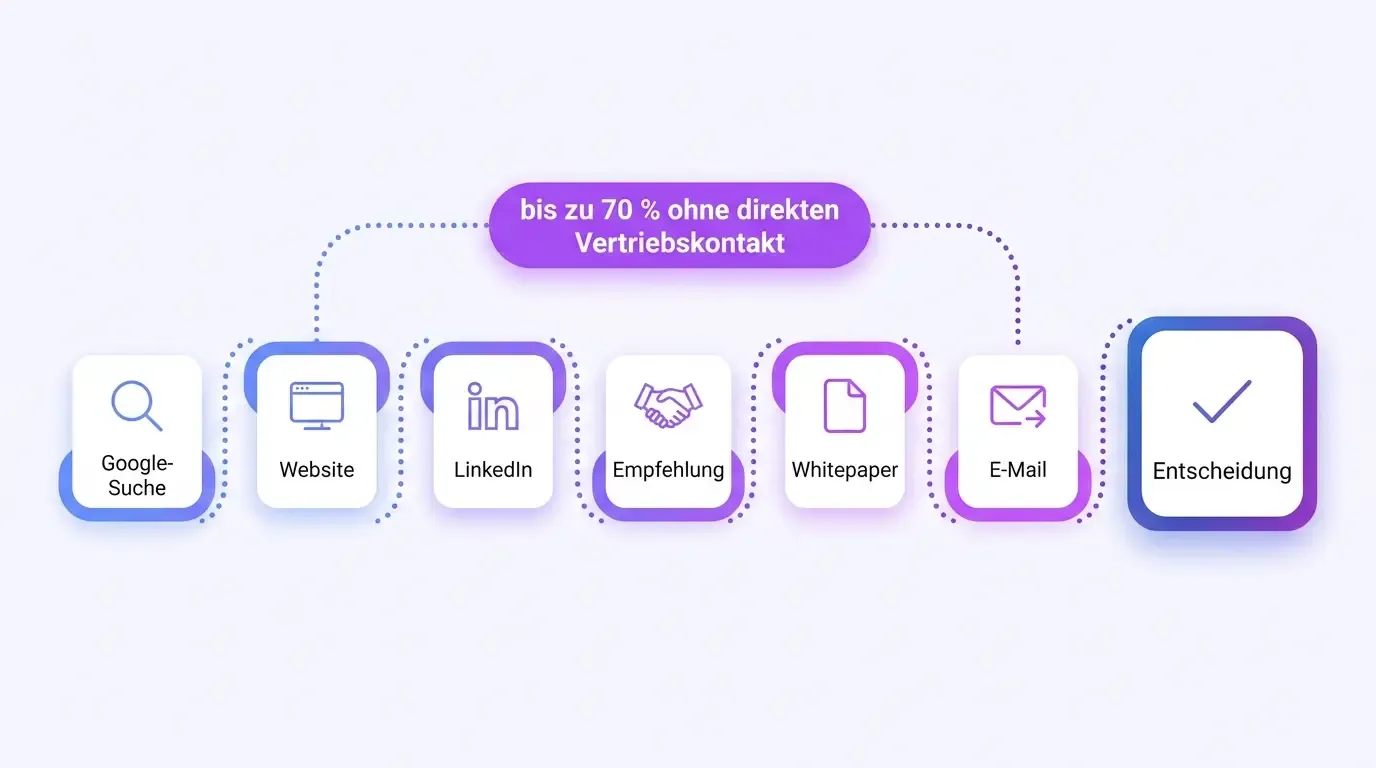
In B2B, a purchase decision is rarely made by one person alone — marketing has to convince an entire buying center.
FUNDAMENTAL PRINCIPLE OF B2B MARKETING
/ 02 – B2B VS. B2C
Key differences from B2C
The main difference between marketing in B2B and B2C lies in the target audience and the nature of purchase decisions. Current trends show how important a precise target audience analysis and segmentation of decision-makers are for achieving competitive advantages. In B2B, purchase decisions are more rational and economically driven, while in B2C emotional factors often play a bigger role. In addition, the sales cycle in B2B is longer and customer relationships are more intensive and long-term.
B2B marketing uses a wide range of measures spanning both digital and classic methods. Compared to traditional methods, B2B online marketing is gaining increasing importance because it enables targeted and efficient outreach. For companies, it’s crucial to precisely identify the relevant target audiences and address them individually. Instead of the broad masses, clearly identified business customers are the focus — a structured marketing plan ensures the strategic direction and execution of all measures.
/ 03 – TARGET AUDIENCES
Target audiences, decision processes & buying centers
B2B customers are at the center of business-to-business marketing and differ from end consumers in many ways. In B2B business, companies purchase products or services specifically to optimize or further develop their own business processes. The target audiences are highly diverse: they range from small and medium-sized enterprises (SMEs) to international corporations, each with their own requirements and expectations.
A key characteristic is the complexity of the decision processes. Unlike in B2C, purchase decisions are often made by multiple people or entire teams — so-called buying centers. These groups are made up of different departments such as procurement, engineering, management, and sometimes the end user. For marketers, this means tailoring their messages specifically to different contacts and their specific needs.
Purchase decisions are typically made for the long term and directly influence strategic direction. B2B customers look for solutions that don’t just offer short-term benefits, but contribute to achieving their business goals. Modern strategies therefore increasingly rely on data-driven analysis: by evaluating market data, buying signals, and user behavior, target audiences can be precisely segmented and campaigns steered accurately. Email marketing, personalized content, and targeted outreach across various channels are central instruments here.
/ 04 – MEASURES
Important B2B marketing measures in 2026
Key measures include:
- Content marketing: in-depth whitepapers, studies, case studies, and webinars with real value.
- Email marketing: personalized campaigns for lead generation and customer retention.
- Search engine marketing (SEO/SEA): website optimization and ads for more visibility.
- Social media marketing: platforms like LinkedIn or Xing to reach business customers.
- Account-based marketing (ABM): tailored strategies for individual key accounts.
- Trade shows & events: personal contacts and network building at industry events.
/ 05 – STUDIES
Current studies & findings
Five current studies show what matters in B2B marketing:
- Content marketing: According to CMI/MarketingProfs (“B2B Content and Marketing Trends: Insights for 2026,” 16th edition, fielded 06/24 to 08/14/2025, n = 1,015 B2B marketers), 59% of respondents rate their content work as at least somewhat effective, 97% work with a content strategy, and 95% use AI applications. LinkedIn is named the most effective thought leadership channel at 76%, ahead of email newsletters at 54% and webinars at 52%. Historical figures the current edition no longer collects: in “Outlook for 2024,” 90% of B2B companies used social media as a distribution channel, 59% produced whitepapers and e-books, 56% used webinars, and 69% planned to increase their video investment. In “Outlook for 2025” (fielded 06/25 to 08/16/2024, n = 980 B2B marketers), 74% said content marketing had helped them generate demand and leads over the past twelve months. A year-over-year comparison is therefore not methodologically possible.
- Email marketing: A study by Inxmail (2024) still sees email as the most effective channel for customer retention — with an average open rate of 22.8%, and rising.
- Social media: According to a joint analysis by Sopro and LinkedIn, more than 80% of surveyed marketers agree that LinkedIn delivers results in B2B.
- AI & automation: According to CMI/MarketingProfs (“B2B Content and Marketing Trends: Insights for 2026,” fielded 06/24 to 08/14/2025, n = 1,015), AI marketing tools are the area B2B marketers most often plan to invest more in for 2026: 45% plan higher spending. Events follow at 33% and owned media at 32%.
- Customer expectations: Salesforce (2023) reports that 69% of business customers expect connected experiences, and 85% rate smooth communication as important as product quality.
The body of research makes it clear: those who combine content, email, and social media, and increasingly rely on automation and AI, reach their audiences more efficiently and build more resilient customer relationships.
59%
rate their content work as at least somewhat effective (CMI/MarketingProfs, Insights for 2026, n = 1,015)
22.8%
email open rate (Inxmail 2024)
45%
plan higher investment in AI marketing tools in 2026 (CMI/MarketingProfs, Insights for 2026)
Conclusion: Successful B2B marketing requires clear objectives, thorough target audience analysis, and choosing the right measures. Current studies confirm the central role of content marketing, email, and social media — while automation and AI are gaining increasing importance. Companies that heed these trends and continuously adapt their strategy increase their visibility, generate qualified leads, and build long-term customer relationships. With a well-thought-out B2B marketing plan and modern tools, marketing activities can be steered optimally and success can be sustainably increased.
Keep reading: Content marketing in B2B
/ 06 – FAQ
Frequently Asked Questions
Mirrors real questions from Google & ChatGPT around B2B marketing, trends, and studies 2026.
What is marketing in B2B?
All marketing activities specifically aimed at business customers — that is, at other companies rather than end consumers. Decisions are more complex because multiple people are involved and offerings are often in need of explanation.
How does B2B marketing differ from B2C marketing?
In B2B, purchase decisions are more rational and economically driven, the sales cycle is longer, and customer relationships are more intensive. In B2C, emotional factors and the broad masses often dominate the focus.
Which B2B marketing measures matter in 2026?
Content marketing, email marketing, SEO/SEA, social media (especially LinkedIn), account-based marketing, and trade shows and events.
What is a buying center?
The group of multiple people or departments — procurement, engineering, management, sometimes the end user — who jointly decide on a purchase in B2B.
How important is AI in B2B marketing?
Its importance is growing measurably. According to CMI/MarketingProfs (“B2B Content and Marketing Trends: Insights for 2026,” n = 1,015), AI marketing tools are the area B2B marketers most often plan to invest more in for 2026: 45% plan higher spending. Events follow at 33% and owned media at 32%.
Which channel is best suited for customer retention?
According to Inxmail (2024), email marketing remains the most effective channel for customer retention and lead nurturing, with an average open rate of 22.8%.
Sources & further reading
- Content Marketing Institute / MarketingProfs: “B2B Content and Marketing Trends: Insights for 2026” (16th edition, fielded 06/24–08/14/2025, n = 1,015, published October 2025). 59% rate their content work as at least somewhat effective, 97% have a content strategy, 95% use AI applications; LinkedIn is the most effective thought leadership channel at 76%, ahead of email newsletters at 54% and webinars at 52%; higher investment in 2026 in AI marketing tools 45%, events 33%, owned media 32%. Read the report
- Historical, no longer collected by the 2026 edition. Content Marketing Institute / MarketingProfs: “B2B Content Marketing Benchmarks, Budgets, and Trends: Outlook for 2024” – including 90% using social media as a distribution channel, whitepapers and e-books produced by 59%, webinars by 56%, 69% planning to increase video investment.
- Historical, no longer collected by the 2026 edition. Content Marketing Institute / MarketingProfs: “B2B Content Marketing Benchmarks, Budgets, and Trends: Outlook for 2025” (15th edition, fielded 06/25–08/16/2024, n = 980 B2B marketers) – 74% said content marketing had helped generate demand and leads over the past twelve months.
- Inxmail (2024): B2B email marketing benchmark — average open rate 22.8%.
- Sopro in collaboration with LinkedIn: more than 80% of surveyed marketers agree that LinkedIn delivers results in B2B.
- Salesforce (2023): 69% expect connected experiences, 85% rate smooth communication as highly as product quality.
/ 07 – WHO IT’S FOR
Built for companies whose offering needs explaining.

IT & software service providers
With explanation-heavy services and few, high-value customers.

Manufacturing industry & mechanical engineering
Selling complex technology to a small number of major decision-makers.

Startups & scale-ups
Companies that want to become visible quickly and credibly.