Tactics & Execution
Content Marketing in B2B: How Your Content Becomes a Lead Magnet
Content isn’t a decorative element in B2B — it’s your most important sales tool. Trust doesn’t come from advertising messages, but from real value — and that can be planned.
But how do you create content that doesn’t just get read, but also converts? The answer lies in three things: clear formats, strategic placement, and data-driven optimization. Let’s walk through them step by step.
/ 01 – Relevance
Relevance beats reach
The most common mistake in content marketing is staying too general. In B2B, the rule is: the more specific the content, the higher the conversion. Instead of “5 tips for better marketing,” “5 methods IT service providers use to generate more leads through webinars” wins.
Tools like SE Ranking or HubSpot help you identify search volume, keywords, and topic clusters. In the B2B benchmark from Content Marketing Institute and MarketingProfs (Outlook for 2025, fielded 06/25 to 08/16/2024, n = 980 B2B marketers), 82% of the most successful marketers attributed their success to a clear understanding of their target audience, up from 79% in the previous year’s report. That’s a self-reported figure from top performers, not a statement about all B2B marketers. It’s also the last available reading: the current edition, “B2B Content and Marketing Trends: Insights for 2026” (fielded 06/24 to 08/14/2025, n = 1,015), no longer collects this metric, so a year-over-year comparison isn’t possible.
Relevance beats reach. Value beats buzzwords.
Content principle at LILOX
/ 02 – Lead magnets
Lead magnets as conversion boosters
A high-quality lead magnet is the backbone of every content funnel. Whether it’s a checklist, an e-book, or a webinar – the key lies in concrete value. Proven formats include a mini guide (“The 10 most common mistakes in digital B2B sales”), a checklist (“Ready for LinkedIn Ads? 7 points to check”), or a webinar on digital lead generation.
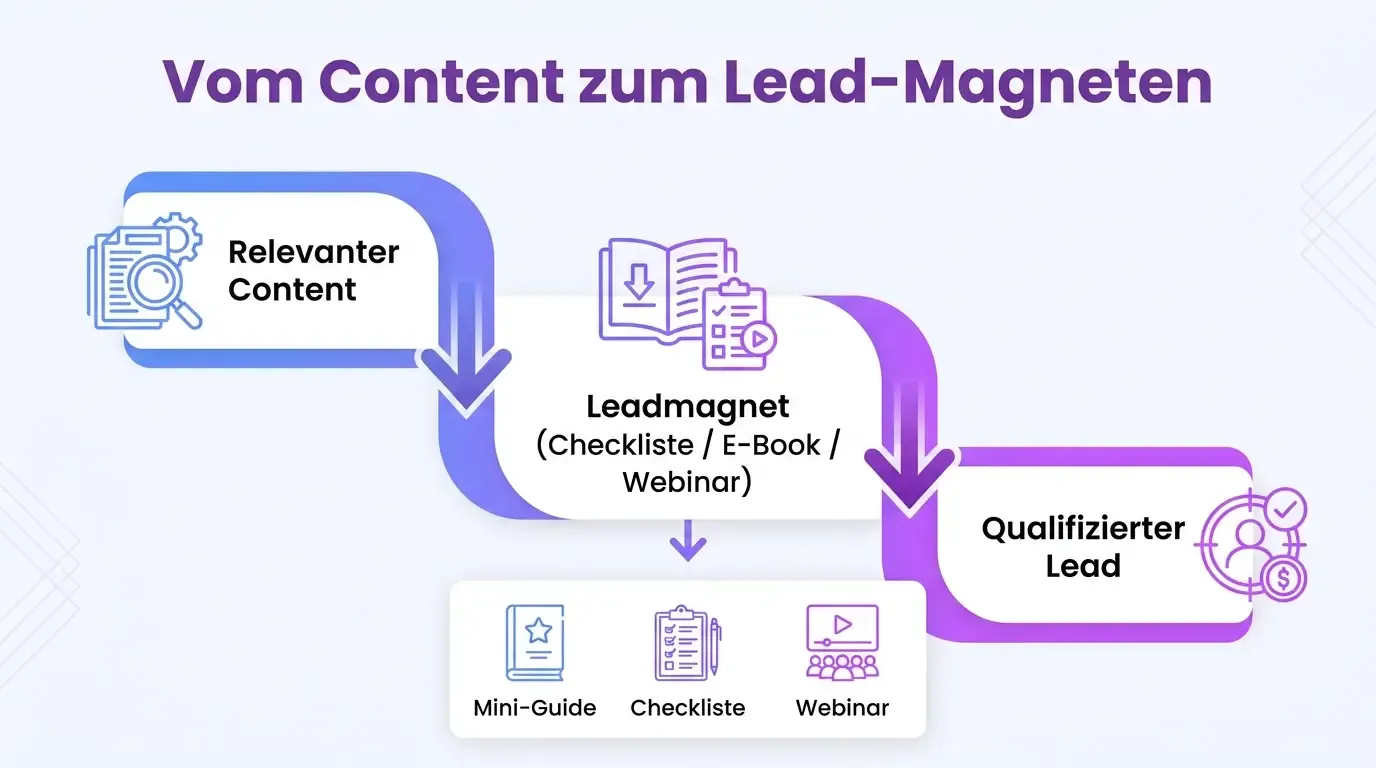
A lead magnet only works if it’s actually found. That’s exactly what one of HubSpot’s best-known figures targets: in its Marketing Benchmarks, an analysis of around 7,000 companies, businesses see an average of roughly 55% more leads when they increase the number of their landing pages from 10 to 15. The figure therefore describes the effect of additional entry points, not the lead magnet itself, and it’s an observed correlation, not an automatic outcome. For practice, that leads to a simple rule: every lead magnet needs its own landing page, or it stays invisible.
82%
of the most successful B2B marketers attributed their success to a clear understanding of their target audience (self-reported, CMI/MarketingProfs, Outlook for 2025, fielded June to August 2024, n = 980; no longer collected since)
+55%
more leads on average when companies increase their landing pages from 10 to 15 (HubSpot Marketing Benchmarks, around 7,000 companies)
74%
of B2B marketers said content marketing had generated demand and leads for them (self-reported, CMI/MarketingProfs, Outlook for 2025, fielded June to August 2024, n = 980; no longer collected since)
/ 03 – Interaction
Content isn’t a monologue
Strong content generates reactions – but only if it invites dialogue. Use calls to action like “Try it now,” “Download the checklist,” or “Book a consultation” consistently at the end of your content. In a blog post about CRM setups, that could be a button to a free mini guide – a classic move that turns readers into leads.
Trust through consistency: the right channel mix. Whoever publishes content only on their own blog gives up potential. For maximum impact, you need a well-thought-out multichannel setup:
- LinkedIn – for thought-leader content and reach
- Newsletter – for retention and reactivating leads
- Meta Ads – for cold-reach outreach
One channel doesn’t replace another – it’s the interplay that creates trust.
Consistency is key: same message, different formats, coordinated with each other instead of scattered at random.
/ 04 – Measure & optimize
Measure. Learn. Optimize.
The best content is created iteratively. Use Google Analytics, HubSpot, or SE Ranking and ask yourself three questions: Which content gets read? Where do people click? Which formats convert best? Whoever answers these questions regularly recognizes early which formats generate demand and which just consume effort. The budget then moves to where it demonstrably works, instead of being spread evenly across all channels. There’s no universally valid percentage for this effect: how strongly the analysis pays off depends on the starting level, the industry, and the measurement method.
Good content sells – but not by itself. Content marketing in B2B only works when it’s strategic, measurable, and audience-appropriate. Relevance beats reach, value beats buzzwords. If you build your content along the customer journey, deploy targeted lead magnets, and optimize consistently, content becomes a real sales channel. Your next step: your first lead-generating checklist.
Keep reading: How to create a lead magnet that actually works · Content for humans and machines
/ 05 – FAQ
Frequently Asked Questions About Content Marketing in B2B
Reflects the real questions B2B teams ask Google AI & ChatGPT around content marketing and lead generation.
What makes content a lead magnet in B2B?
Content becomes a lead magnet when it solves a specific problem for the target audience and invites the next step with a clear offer – such as a checklist or a mini guide.
Which lead magnet formats work best in B2B?
Checklists, e-books, mini guides, and webinars are proven formats. What matters isn’t the format, but the concrete, immediately usable value for the target audience.
How specific should B2B content be?
As specific as possible. The more clearly the content is tailored to a defined target audience and their problem, the higher the conversion – relevance beats reach.
Which channels should B2B content be distributed across?
A well-thought-out mix of LinkedIn, newsletter, and paid reach. Consistency matters: the same message in coordinated formats instead of scattered at random.
How do you measure whether content really generates leads?
Via tools like Google Analytics, HubSpot, or SE Ranking. Relevant questions: what gets read, where do people click, which formats convert? Whoever evaluates this regularly recognizes early which formats generate demand and which just consume effort, and can shift the budget specifically to where it works.
How do you start with content marketing in B2B?
Best with a single, well-made lead magnet – such as a lead-generating checklist – and a clear call to action. From there, the content funnel can be expanded step by step.
Sources & further reading
- Content Marketing Institute and MarketingProfs: B2B Content Marketing Benchmarks, Budgets, and Trends: Outlook for 2025 (15th edition, published October 2024). Surveyed n = 980 B2B marketers, fielded 06/25 to 08/16/2024. Basis for the figures on target-audience understanding (82% of the most successful marketers) and the impact of content marketing (74% demand and leads). All figures are self-reported by respondents, not measured impact. Both metrics are historical: the current edition, B2B Content and Marketing Trends: Insights for 2026 (16th edition, fielded 06/24 to 08/14/2025, n = 1,015, published October 2025), no longer collects them. Read the report
- Content Marketing Institute and MarketingProfs: B2B Content Marketing Benchmarks, Budgets, and Trends: Outlook for 2024 (published October 2023). Basis for the prior-year figure of 79% for target-audience understanding among successful marketers.
- HubSpot: Marketing Benchmarks from 7,000 Businesses. Analysis of around 7,000 companies from HubSpot’s customer base. Basis for the figure that companies see an average of roughly 55% more leads when they increase their landing pages from 10 to 15. The report shows a correlation, not a proven causal relationship.
/ 06 – Who it’s for
Built for companies whose offering needs explaining.

IT & software service providers
With services that need explaining and a few, high-value customers.

Manufacturing industry & mechanical engineering
Selling complex technology to a small number of major decision-makers.

Startups & scale-ups
Companies that want to become visible quickly and credibly.