MAGAZINE · CONTENT & AI VISIBILITY
Write for humans. Get cited by machines.
Today, it’s not just your target audience reading along. AI systems also analyze, evaluate, and cite your content before a human ever sees it.
Concrete writing rules, before-and-after examples, and a checklist for every piece of content before publishing.
The good news: you don’t have to choose between the two. Content that works for AI systems is almost always better for humans too.
The reason lies in how AI reads text — and how you write for it.
/ 01 — Chunks
01
How AI systems process text
AI systems don’t read entire pages at once. They break content into small sections — so-called chunks — and evaluate each one individually: does this paragraph answer the question being asked?
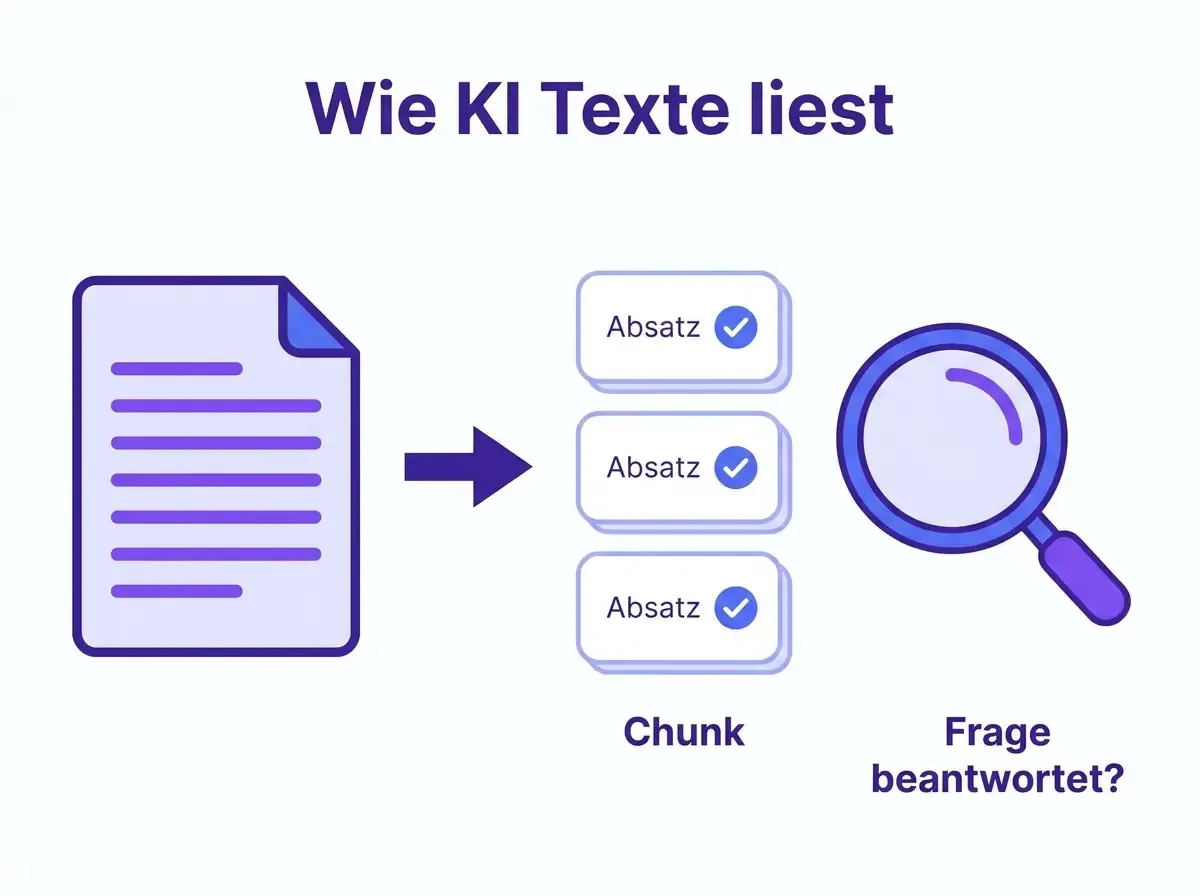
That leads to the most important rule: every paragraph has to be understandable on its own. A paragraph that only makes sense in the context of the previous ones will never be cited — no matter how well it’s written.
One idea per paragraph. The answer always first.
/ 02 — Structure
02
The answer first, the explanation after
AI systems prefer passages that answer a question in the first sentence. Start every section with the direct answer, followed by the reasoning below — human readers get the information faster this way too.
Formulate unambiguously: name the subject instead of “it,” “that,” or “this,” and use the same terms for services and technical concepts everywhere — on the website, on LinkedIn, and in directories.
AI systems extract facts as subject-verb-object relationships. Three rules make your statements citable:
- Name the subject instead of writing “it” or “this”
- Clear claims instead of vague assumptions
- Your own numbers and examples instead of interchangeable phrases
Rule of thumb: if it could just as easily be said by a competitor,
it’s worthless for AI visibility.
/ 03 — Checklist
Check every piece of content. Five questions before publishing.
Five questions to check every piece of content for AI-readiness before publishing.
1
ANSWER
Answer first?
Does the first paragraph directly answer the central question — and does the answer come before the explanation in every other section too?
2
STANDALONE
Paragraph understandable on its own?
Does every paragraph make sense even without the rest of the text?
3
FORMAT
Lists instead of continuous prose?
Are comparisons and enumerations formatted as a list or table, not buried in continuous prose?
4
EVIDENCE
Concrete instead of generic?
Does the text contain at least one concrete number, example, or firsthand experience?
5
CONSISTENCY
Terms consistent?
Are all technical terms and service names used consistently — and is everything present as HTML text, not only in images or PDFs?
/ 04 — Practice
04
From practice: same topics, different form
A consulting firm published in-depth articles weekly for two years — long and well-researched, but as unbroken prose. None of them ever showed up in AI answers.

The change wasn’t about the topics, but the form: questions as subheadings, the core statement moved to the top, project figures instead of clichés, a short FAQ at the end. Three months later, ChatGPT was linking individual articles as sources.
Keep reading: Zero-click & AI search in B2B · GEO guide: AI visibility
/ 05 — FAQ
Frequently Asked Questions
Reflects the real prompts from Google AI & ChatGPT around AI-ready content.
Do I have to write differently for AI than for humans?
No. AI-ready text — answer first, one idea per paragraph, concrete numbers — is almost always more readable for humans too.
Is it enough to simply have good content?
No, it comes down to form. If a paragraph answers a question on its own, it becomes citable. If it only makes sense in context, it doesn’t.
How do I know if my content is AI-ready?
Use the checklist: answer first, every paragraph understandable on its own, lists instead of continuous prose, at least one concrete number, consistent terms, everything present as HTML text.
/ 06 — Who it’s for
Built for companies whose offering needs explaining.

IT & software service providers
With services that need explaining and a few, high-value customers.

Manufacturing industry & mechanical engineering
Selling complex technology to a small number of major decision-makers.

Startups & scale-ups
Companies that want to become visible quickly and credibly.