MAGAZINE · ZERO-CLICK & AI SEARCH
Fewer clicks. More quality.
Your rankings are stable, but organic traffic is falling? That’s not a strategy mistake, it’s a structural shift — one you can adapt to.
What this means for your B2B sales — and how you’ll measure visibility going forward.
In the first four months of 2026, 68.01 percent of US Google searches on desktop and mobile web ended without a click on a result (SparkToro with clickstream data from Similarweb, June 2026). Two years earlier, the same figure stood at 60.45 percent. Concretely: out of 1,000 searches, only 276 clicks still reach the open web, compared with 374 in 2024. SparkToro itself points out that the two measurements rest on different panels; the comparison is therefore an approximation, not an exact difference. With AI overviews in search and assistants like ChatGPT and Gemini, this effect keeps intensifying.
What looks like a problem is, on closer inspection, a shift — and one that even has advantages in B2B. What matters is what your website is for going forward and how you measure visibility.
/ 01 — Zero-Click
01
What zero-click actually means
Zero-click describes search queries where users get their answer without visiting a website — through AI overviews directly in Google results, through answers from ChatGPT or Gemini, and through featured snippets and knowledge panels.
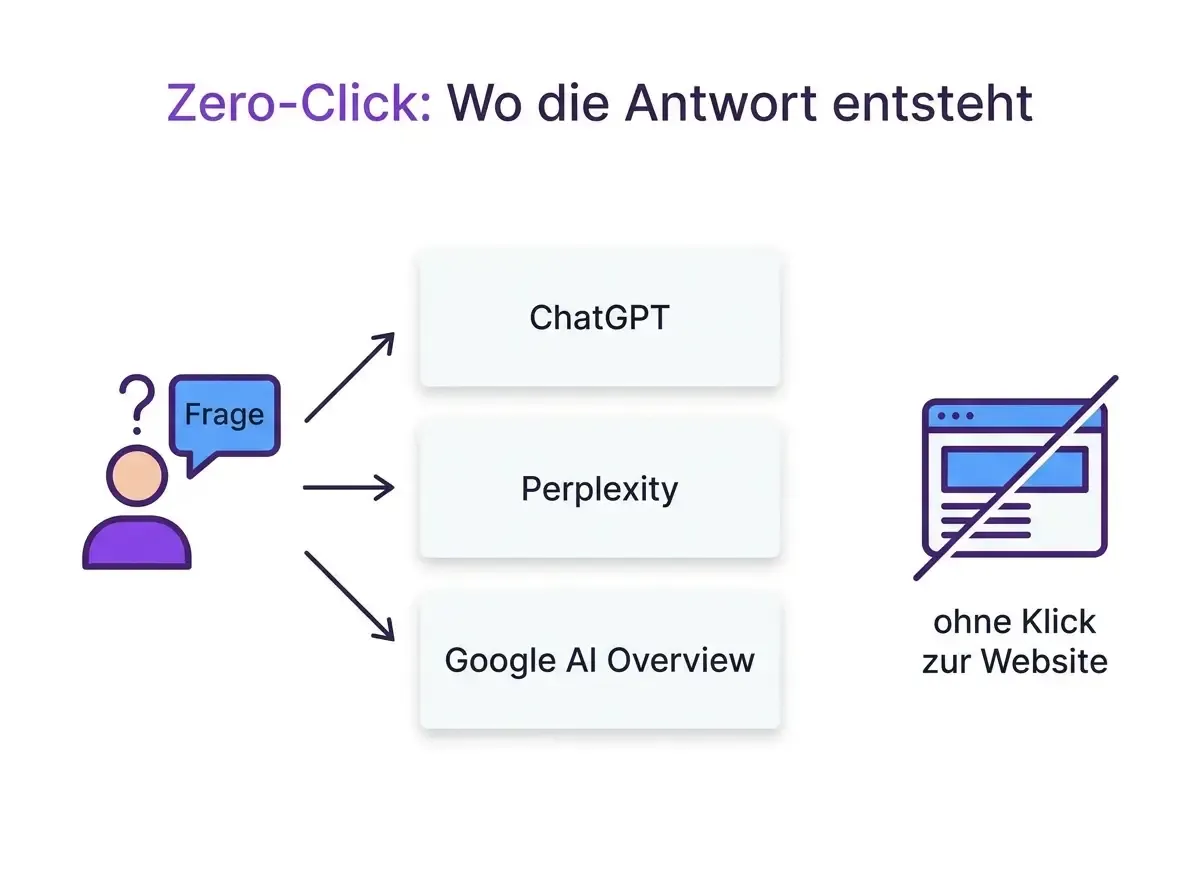
Simple informational queries are affected above all: definitions, explanations, “what is…” searches. In other words, exactly the content many B2B websites have used to build traffic so far.
Traffic falls. But the customers stay.
/ 02 — B2B
02
Why this is less dramatic in B2B
In B2B, what counts isn’t the volume of visitors, but the quality of the inquiries. Anyone who finds you via an AI answer has already asked a concrete question and perceived you as a relevant option. Traffic falls — but whoever stays is further along in the decision process. AI referral traffic is small, but converts above average.
When AI answers the simple questions, the job of your website shifts — toward content that actually prepares a purchase decision:
- Concrete services with processes, price ranges, and pricing models
- References and case studies with real numbers
- Comparisons, decision aids, and a clear next step
Plain definition articles lose relevance.
Decision content gains it.
/ 03 — Measuring
Measuring visibility anew. Four metrics instead of click counts.
Four metrics show you whether you show up in AI answers — independent of what click counts say.
1
PROMPT TEST
Mentions in AI answers
Ask ChatGPT and Gemini the same set of 10–15 target-audience questions every month and document whether and how you’re mentioned.
2
GA4 SEGMENT
AI referral traffic
Segment visits from chatgpt.com and gemini.google.com in GA4. Many AI systems don’t pass a referrer — the number is a lower bound.
3
FORM FIELD
Self-reported source
A form field “How did you hear about us?” with options like ChatGPT catches what the technology loses — often the most reliable source.
4
BRANDED SEARCH
Branded searches
Rising searches for your name alongside falling generic traffic show: AI is establishing you as a provider — the click comes later, and more targeted.
/ 04 — In practice
04
From practice: less traffic, better inquiries
An industrial service provider saw around 20 percent less organic traffic over six months. The first reaction was concern — the analysis showed a different picture: the number of inquiries stayed stable, and quality even rose.

In the form field “How did you hear about us?”, ChatGPT increasingly showed up — visits that had remained invisible in the analytics tool as direct traffic. Instead of chasing more traffic, the website was aligned toward decision content: traffic stayed lower, inquiries rose.
Keep reading: ChatGPT & the B2B Buying Journey · GEO Guide: AI Visibility
/ 05 — FAQ
Frequently Asked Questions
Mirrors the real prompts from Google AI & ChatGPT around zero-click and AI search.
Should I block AI crawlers so my content doesn’t get “stolen”?
For most B2B companies, that’s counterproductive. Whoever blocks them doesn’t show up in AI answers and leaves the recommendation to the competition.
Is blog content even still worth it then?
Yes, but with a different focus. Content that demonstrates expertise, delivers proprietary data, and is citable wins out. Interchangeable definition articles lose.
How do I know if falling traffic is a problem?
By the inquiries, not the sessions. As long as the number and quality of inquiries stay stable or rise, falling traffic is a shift, not a loss.
/ 06 — Who this is for
Built for companies whose offering needs explaining.

IT & Software Service Providers
With services that need explaining and a handful of high-value customers.

Manufacturing Industry & Mechanical Engineering
Selling complex technology to a handful of major decision-makers.

Startups & Scale-ups
Companies that want to become visible quickly and credibly.