TACTICS & EXECUTION
Rethinking the AIDA model for digital B2B sales
Attention, Interest, Desire, Action: a marketing classic that’s more relevant than ever in digital B2B.
How the best-known framework combines with data-driven strategies and AI tools into an effective funnel.
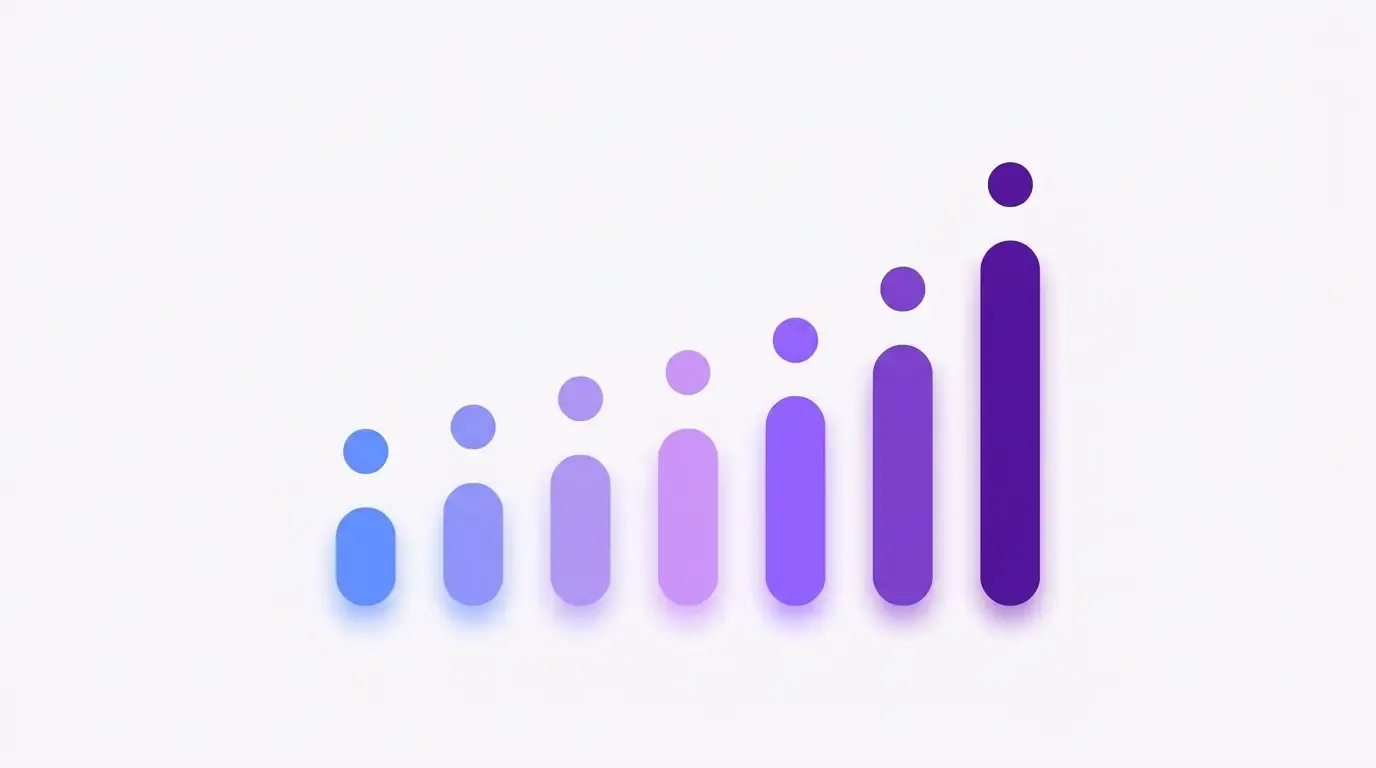
The AIDA model, made up of Attention, Interest, Desire, and Action, is one of the oldest and best-known frameworks in marketing. But how relevant is the concept today, especially in digital B2B marketing? Despite technological development and data-driven approaches, AIDA remains a proven instrument for clearly structuring the sales funnel and steering lead generation with precision. The modern application shows how classic principles and digital strategies work together for maximum efficiency. A solid understanding of the fundamentals forms the basis for successfully combining classic and digital approaches.
Keep reading: The modern B2B funnel and The sales funnel in B2B.
/ 01 – Fundamentals
Fundamentals of B2B marketing
B2B marketing covers all activities specifically aimed at other companies. Unlike the B2C space, where end consumers are addressed, the focus here is on developing long-term business relationships. The goal is sustainable partnerships with business customers who regularly purchase products or services, take out subscriptions, or realize joint projects. Digital channels play a growing role: email marketing, content marketing, and social media reach the target audience precisely and boost brand awareness. Through targeted activities, content and offers can be tailored precisely to the needs of business customers. Content marketing in particular has established itself as a powerful instrument for providing relevant information and building trust, while email marketing remains a central channel for nurturing personal contacts and communicating individual offers.
94% of B2B buyers used AI tools in their last purchasing process.
Forrester, Buyers’ Journey Survey 2025, published 21 January 2026
/ 02 – B2B vs. B2C
02
Why B2B works differently
B2B and B2C marketing differ in many ways. While B2C is dominated by fast, often emotional purchase decisions, B2B processes are more complex and longer. Usually several people, a so-called buying center, decide on a purchase together. Relationships are built for the long term and shaped by trust and mutual understanding. That’s why B2B measures must be specifically tailored to the requirements and challenges of business customers. Personal outreach and genuine value determine success, not mass communication, which often takes center stage in B2C.
/ 03 – Attention
Winning attention
The first stage of the AIDA model aims to capture attention. In a world full of content, this becomes the central challenge: companies have to stand out from the crowd. An optimized website with targeted landing pages is essential to become visible in search engines and generate leads. How early this visibility matters is shown by Forrester’s Buyers’ Journey Survey 2025, published in January 2026: 94% of the business buyers surveyed used AI tools in their last purchasing process, and AI answer engines are now their number one research source. Anyone using relevant keywords like “B2B marketing,” “digital sales,” or “lead generation” significantly increases their visibility. LinkedIn advertising works too: according to LinkedIn’s own pilot data, Thought Leader Ads achieve a 1.6x higher engagement rate than classic single-image ads, though LinkedIn itself classifies this figure as directional, not a reliable benchmark.
/ 04 – Interest
04
Sparking interest
Once attention is won, the next step is deepening interest. In B2B, value and relevance count. Companies must show they understand the specific challenges and needs of their target audience. The company’s values should also be visible in the communication. They create orientation and strengthen the bond. Personalization is not a nice-to-have: 72% of B2B buyers say they expect vendors to tailor their outreach to their needs (Salesforce, State of the Connected Customer, 2nd edition, 2018, more than 6,700 respondents worldwide). That is a self-report from a survey that is now eight years old, not a measured effect. Interactive formats like webinars are among the most effective channels: 51% of B2B marketers name them among their strongest distribution channels, with only in-person events slightly ahead (CMI/MarketingProfs 2025, n = 980). This is a practitioner assessment, not a measured conversion uplift.
/ 05 – Desire
Creating desire
In the third phase, the interest that’s been sparked is turned into a concrete desire. This requires compelling content that reinforces the need for a solution. Storytelling and social proof, meaning customer reviews, case studies, and success stories, work especially well here. A case study showing how a company solved a specific problem convinces more than any product description. Visual elements like before-and-after diagrams or testimonials amplify the effect further. The Demand Gen Report includes case studies among the formats B2B buyers most often turn to in the decision phase in its Content Preferences Survey. What matters here is verifiability: anyone showing results should disclose the starting point, the measure taken, and the timeframe. A number without context convinces no one in B2B.
/ 06 – Action
06
Driving action
The final phase moves potential customers to action. What matters is an intuitive, frictionless conversion process. Clear calls to action like “Try it free now,” “Schedule a meeting,” or “Download the whitepaper” lead to the next step. How strongly a CTA works depends less on the wording than on the fit: according to HubSpot’s analysis of over 330,000 CTAs, personalized calls to action convert 202% better than generic ones. That is proprietary data from HubSpot’s own product with no published methodology, so the direction holds, the exact number does not.
On the topic of urgency, a closer look is worthwhile, because the common assumption is misleading. Dixon and McKenna analyzed more than 2.5 million recorded sales conversations for the Harvard Business Review: 40 to 60% of all B2B deals end not with a “no,” but with no decision at all. Classic pressure and FOMO tactics are not just ineffective here, but demonstrably counterproductive. What triggers decisions isn’t more pressure, but less risk: clear pricing, solid references, a small first step.
Automated follow-ups pursue leads in a targeted way. A single additional follow-up email lifted the response rate by 65.8% in a joint analysis by Backlinko and Pitchbox of 12 million outreach emails, published in April 2019. Two caveats belong with that figure: the dataset comes from link-building outreach sent through Pitchbox, not from B2B sales conversations, and it is platform data of the vendor, evaluated as a correlation rather than in a controlled test. An optimized landing page that clearly presents all the important information also minimizes bounce rate.
/ 07 – Data
Continuous optimization through data
The big difference between the classic AIDA model and its digital application lies in the use of data. Analytics tools like SE Ranking or Google Analytics provide insight into every phase of the funnel and enable ongoing improvement. The figure quoted everywhere in this context, efficiency gains of up to 30% through data-driven marketing, deserves a precise reading: McKinsey attributes an increase of 10 to 30% in marketing-spend efficiency to personalization leaders, most of it from product recommendations and triggered messages in a single channel (McKinsey, “The future of personalization”, 2019). That is an estimate from a consultancy that sells this work, not a measurement across companies, and it is not a general promise for anyone who looks at a dashboard. If the bounce rate in the interest phase is high, for example, that points to weak content or a mismatched approach.
For A/B tests, a realistic expectation is worthwhile. Of roughly 20,000 evaluated Optimizely experiments, only about 10% achieved a statistically significant uplift on the target metric; Microsoft’s experimentation practice arrives at about a third. A/B testing is thus not an uplift machine, but the method for spotting false assumptions before they cost budget. Anyone who sells jumps from 2 to 5% as the rule is selling the exception. Looking ahead, artificial intelligence, data-driven analytics, and account-based marketing continue to gain importance, and they enable an even more targeted approach to business customers.
94%
of B2B buyers used AI tools in their last purchasing process (Forrester, Buyers’ Journey Survey 2025)
72%
of B2B buyers say they expect a personalized approach (Salesforce 2018, self-reported)
202%
better conversion through personalized calls to action (HubSpot, own product data, no published methodology)
/ 08 – FAQ
Frequently Asked Questions
Mirrors the real prompts from Google AI & ChatGPT around the AIDA model in B2B.
Is the AIDA model still relevant in B2B?
Yes. AIDA clearly structures the funnel into four phases and remains a proven framework, especially in combination with digital channels, data, and AI tools.
What do the four AIDA phases stand for?
Attention, Interest, Desire, and Action. In B2B, each phase requires its own content and measures.
How do you combine AIDA with digital marketing?
By addressing each phase with the right digital levers: SEO and ads for attention, personalized content for interest, case studies for desire, and clear CTAs plus follow-ups for action, continuously optimized through data.
/ 09 – Who it’s for
Built for companies whose offering needs explaining.

IT & software service providers
With explanation-heavy services and few, high-value customers.

Manufacturing industry & mechanical engineering
Selling complex technology to a small number of major decision-makers.

Startups & scale-ups
Companies that want to become visible quickly and credibly.