MAGAZINE · LEAD GENERATION & FUNNEL
How a Modern B2B Funnel Really Works
Beyond the theory – how decisions actually unfold today.
The classic sales funnel – Awareness, Interest, Desire, Action – is simple, logical and easy to understand. In practice, though, the B2B funnel today rarely works this linearly. Decisions no longer move neatly from top to bottom; they jump between phases, touchpoints and people. We take a look at what a modern funnel really looks like – and what that means for your lead generation.
/ 01 — Myth
The Myth of the Linear Funnel
The classic depiction suggests a clear sequence: a lead comes in, moves through the funnel and becomes a customer. In reality, it looks more like this:
- Prospects jump between the website, LinkedIn and email
- Content gets consumed multiple times
- Decisions get postponed internally
How many touchpoints that is on average can’t be stated credibly: the widely quoted figure of 27 touchpoints is attributed to Gartner, but no publication with a year can be found for it.
The funnel isn’t a pipeline – it’s a network.
/ 02 — Phases
The Key Phases – Rethought
Even though the process isn’t linear, phases can still be identified:
- Awareness – recognizing the problem: blog articles, social posts or short videos generate attention.
- Consideration – comparing solutions: whitepapers, checklists and use cases are especially effective here.
- Decision – making the decision: comparison tables, references and concrete offers create clarity and trust.
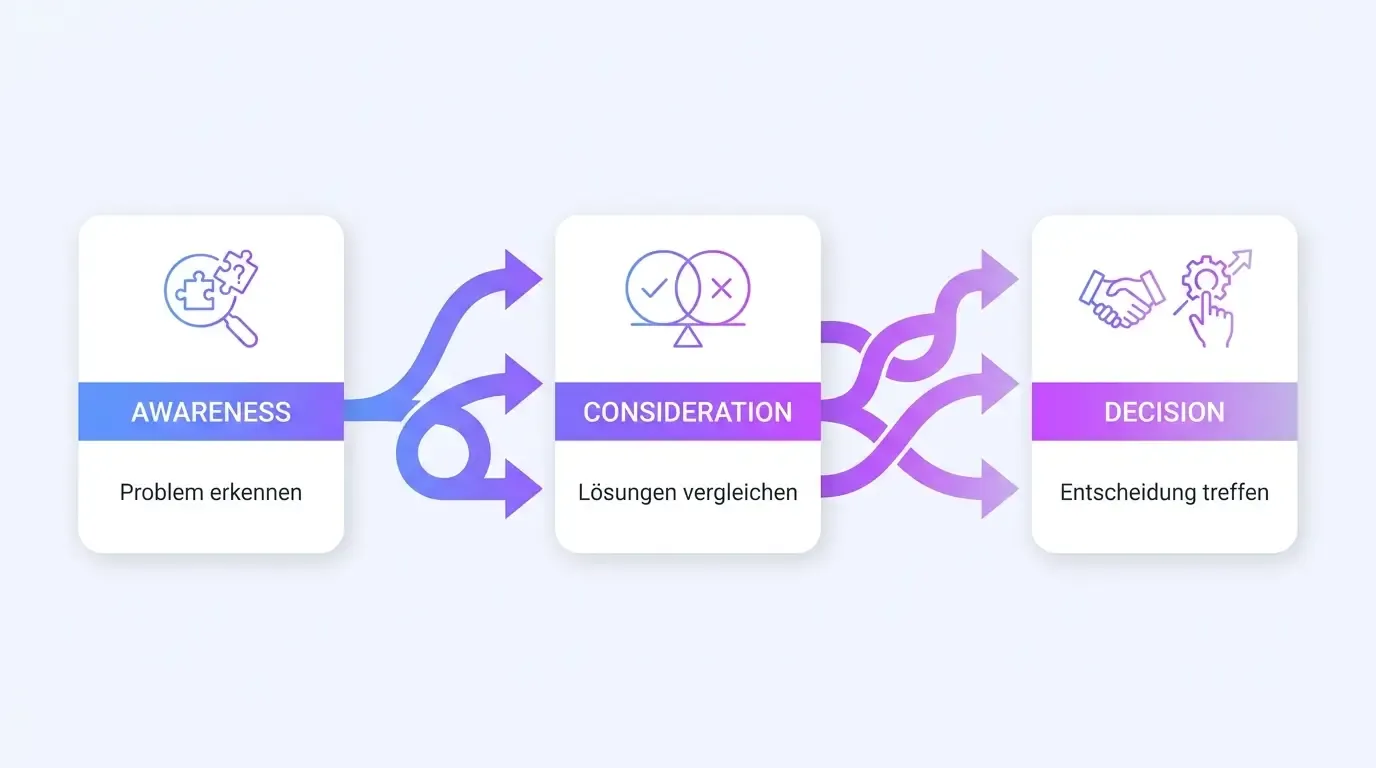
Not a pipeline, but a journey: Awareness → Consideration → Decision.
/ 03 — System
Why the Funnel Is a System Today
The biggest difference: a modern funnel doesn’t work as a one-off process, but as a system. That means:
- Leads come into contact with you multiple times
- Content accompanies the entire process
- Automation supports the process
Tools like HubSpot or CRM systems help make this journey visible and manageable.
/ 04 — Content
The Role of Content in the Funnel
Content is the glue between the phases. It ensures leads understand you, build trust and stay motivated. What matters isn’t the quantity, but the structure:
- Content for every phase
- clear transitions
- targeted calls to action
/ 05 — Problems
Why Many Funnels Don’t Work
Typical problems:
- Focus only on awareness – lots of traffic, few closed deals
- no content for later phases
- missing connection between marketing and sales
- no clear structure
The result: leads get stuck and never move forward.
/ 06 — Practice
Practical Example
A company generates plenty of website visitors, but hardly any inquiries. The analysis shows: there’s no clear next step, content ends without a CTA, and follow-ups are missing. After introducing a structured funnel – with a lead magnet, an email sequence and an appointment CTA – conversion rises significantly.
A modern B2B funnel isn’t a simple pipeline, but an interplay of touchpoints, content and processes. Anyone who understands it as a system and builds it accordingly generates not just more leads, but turns more of them into customers.
Keep reading: Which B2B sales KPIs actually matter · The biggest fallacy in digital sales · Why many B2B websites don’t generate leads
/ 07 — FAQ
Frequently Asked Questions
Mirrors the real prompts from Google AI & ChatGPT around the modern B2B funnel.
What does a modern B2B funnel really look like?
Not as a linear pipeline, but as a network of touchpoints. Prospects jump between the website, LinkedIn and email, consume content multiple times, and postpone decisions internally. How many touchpoints that is on average can’t be stated credibly: the widely quoted figure of 27 touchpoints is attributed to Gartner, but no publication with a year can be found for it.
What phases does a modern B2B funnel have?
Even without a linear sequence, three phases can be identified: Awareness (recognizing the problem), Consideration (comparing solutions) and Decision (making the decision). Each phase needs matching content – from blog articles to references and offers.
Why do many funnels not work?
Because they focus only on awareness, have no content for later phases, don’t connect marketing and sales, or lack a clear structure. Then leads get stuck and never move forward.
/ 08 — Who It’s For
Built for companies whose offering needs explaining.

IT & Software Providers
With services that need explaining, and a small number of high-value customers.

Manufacturing Industry & Mechanical Engineering
Selling complex technology to a small number of major decision-makers.

Startups & Scale-ups
Companies that want to become visible quickly and credibly.