LINKEDIN LEAD GEN DACH · PILLAR
LinkedIn Lead Generation for B2B: What Actually Works in the DACH Region
Nadine Fraiss · Lilox · ~13 min read
The short answer: LinkedIn lead generation in B2B comes from three things: regular content from personal profiles, genuinely engaging in your target audience’s conversations, and a clear next step. Not from company page broadcasts, and not from ads alone. What matters is a tightly defined ideal customer profile and measuring qualified conversations instead of impressions. In the DACH region, LinkedIn is the dominant B2B channel.
Keep reading: LinkedIn is one of five building blocks. For the full overview, see the guide B2B Lead Generation.
Contents
- Why Is LinkedIn the Most Important B2B Channel in the DACH Region?
- Personal Profile or Company Page: Which Gets More Reach?
- How Does the LinkedIn Algorithm Work in 2026?
- Which Five Building Blocks Turn LinkedIn Into a Lead Machine?
- Which Content Formats Work in the DACH Region?
- How Does LinkedIn Feed Into Your Visibility in AI Search?
- What Should You Measure Instead of Impressions?
- What Does a Realistic Weekly Routine Look Like?
- In What Order Do You Build This Up?
- What Does LinkedIn Lead Generation Really Cost?
- Frequently Asked Questions
/ 01 – Why LinkedIn
Why Is LinkedIn the Most Important B2B Channel in the DACH Region?
Because decision-makers are there, and the channel delivers quality instead of noise. LinkedIn reports over 31 million members in the German-speaking region and 1.3 billion worldwide (LinkedIn DACH, as of August 2026). XING, long the DACH market leader, has published no membership figures since its delisting in August 2024; the last official figure was 22.5 million users, and since its 2024 repositioning the platform has shifted from a network to a job portal. For B2B outreach that means one channel now carries virtually all professional reach in the German-speaking region.
The lead-gen figures are unambiguous as well: around 80 percent of B2B leads generated via social media come from LinkedIn, 89 percent of B2B marketers use the platform for lead generation, and 40 percent consider it their most effective channel for high-quality leads (Sopro, LinkedIn Lead Generation Statistics). LinkedIn lead-gen forms convert at around 13 percent, while classic landing pages sit at an industry average of 2.35 percent.
One piece of context that’s rarely added: these figures measure LinkedIn’s share of social leads, not of all channels. They show where social plays a role for B2B. They don’t say social should be your only channel.
The number for your business case: LinkedIn leads convert to customers at an average of 8.4 percent, Google Ads leads at 4.2 percent.
HubSpot B2B Marketing Benchmark, Q1 2026, DACH
/ 02 – Profile or Page
Personal Profile or Company Page: Which Gets More Reach?
The personal profile, and the gap keeps growing. Company pages now reach on average only 2 to 4 percent of their followers organically per post. At the same time, the Bundesverband Digitale Wirtschaft (German Association for the Digital Economy) documents that 71 percent of DAX-listed companies run active employee advocacy programs, with 4.7 times the reach on average compared to company pages without such programs (BVDW Trend Report). The infographic shows the breakdown:
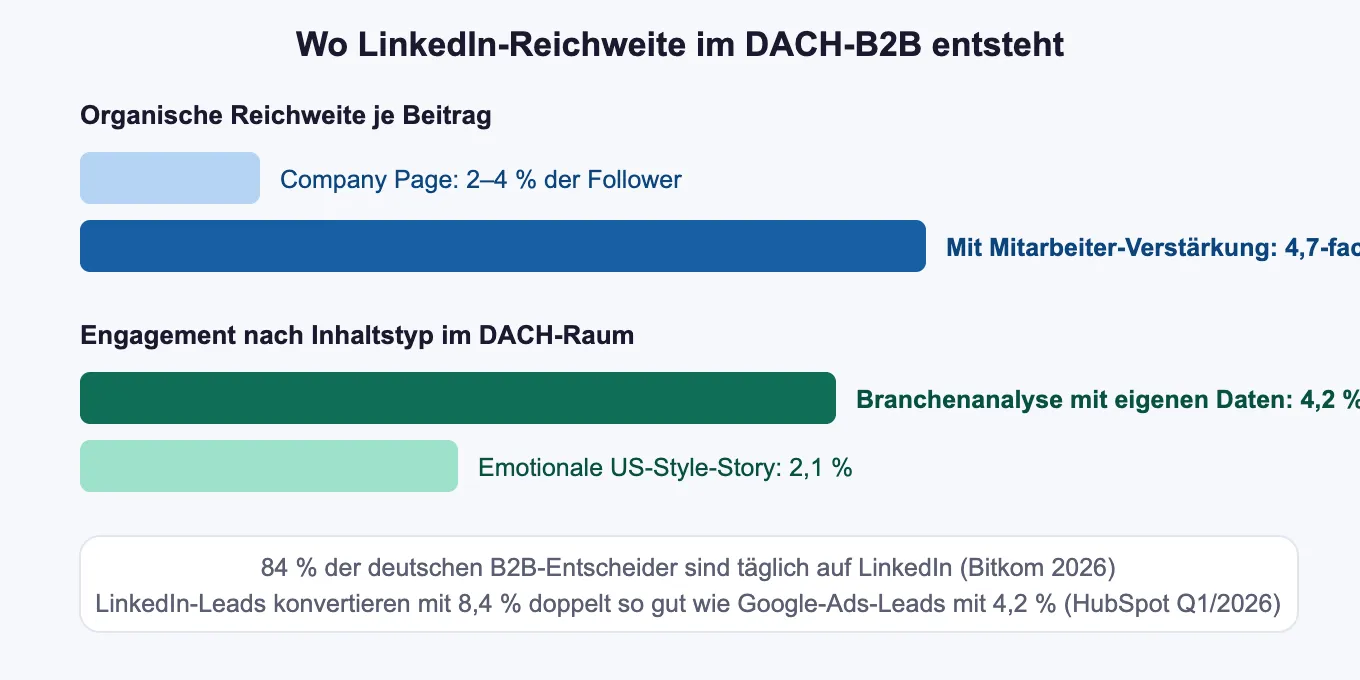
Chart: Lilox, July 2026. Data sources: BVDW Trend Report, DACH comparative analysis (1,200 profiles), HubSpot Benchmark Q1/2026.
| Criterion | Personal Profile | Company Page |
|---|---|---|
| Organic Reach | Significantly higher, the feed favors people | 2 to 4 percent of followers per post |
| Role | Reach engine and trust building | Credibility proof and central hub |
| Who posts | Experts and leaders themselves | Editorial team, sparingly |
| Amplification | Employee comments and reposts | Benefits from employee advocacy (4.7×) |
In practice, this means: the people in the company post themselves, and the page runs alongside as an anchor. That’s exactly why our liLink methodology works exclusively with personal profiles.
/ 03 – Algorithm
How Does the LinkedIn Algorithm Work in 2026?
LinkedIn has fundamentally rebuilt its ranking system. Behind the system often called “360Brew” is an overarching AI model that analyzes content, profiles, and behavior together, similar to a language model: it “reads” posts, identifies topics, and matches them to relevant audiences (contentmanager.de, March 2026). Three consequences for B2B:
- Topical focus beats frequency. Clearly positioned profiles are better understood and shown more often. Anyone who constantly switches between topics makes it harder for the machine to categorize them.
- Quality of interaction counts. Substantive comments and discussions carry more weight than likes. Engagement bait like “comment PDF” gets recognized and demoted.
- Small accounts have a real chance. Posts are first tested with small, topically matched groups and, if they resonate, spread further step by step. Follower count loses influence; relevance gains it.
Posts unfold their visibility in phases: the first 30 minutes test engagement within your close network, after which distribution follows to your extended network and to topically interested users. Good posts often reach their maximum visibility only after 24 hours and keep working for several days. The practical consequence for the DACH region: post when your own network is active, typically Tuesday through Thursday in the morning.
/ 04 – Five Building Blocks
Which Five Building Blocks Turn LinkedIn Into a Lead Machine?
1
Building Block 1
A tightly defined ideal customer profile.
5,000 right people beat 500,000 wrong ones. Broad reach without fit is self-deception, and since the algorithm rebuild it’s not even rewarded anymore.
2
Building Block 2
A content mix across the week.
Deep expertise, personal moments, evidence, and every so often an offer. Not every post has to do everything. A one-third mix of personal observation, industry analysis, and practical application tips has proven effective.
3
Building Block 3
Consistency over frequency.
Three strong posts a week beat seven half-baked ones. Over months, what counts is the reliable rhythm, not the sprint — even through the summer lull.
4
Building Block 4
Engagement as routine.
Reply to comments within the first hour after posting, and spend 15 minutes daily engaging with a real point of view on other people’s posts instead of writing “great post.” A large part of visibility these days is created in other people’s comment sections.
5
Building Block 5
A clear next step.
A question that opens a conversation, instead of “send me a DM.” The transition from post to qualified conversation is the point where visibility turns into pipeline.
What this looks like in combination is shown by a documented case from the DACH mid-market: the managing director of a logistics company started with 380 followers and two posts a week, each with a concrete industry angle. After six months: 4,700 followers and 14 inbound inquiries a month. After twelve months: 12,300 followers, 26 inbound inquiries a month, and a keynote appearance at the industry trade fair (documented in the Gedankensturm DACH Report, April 2026). No ad budget, no viral tricks — topical focus, consistency, and a comment routine.
/ 05 – Formats
Which Content Formats Work in the DACH Region?
The DACH market operates differently than the Anglo-American one. A comparative analysis of 1,200 profiles from DACH and the US shows: emotional personal-branding stories achieve over 6 percent engagement in the US, but only 2.1 percent in the DACH region. Data posts with industry analysis, by contrast, perform strongly in both markets, and even slightly better in the DACH region (4.2 versus 4.0 percent). Copying US playbooks one-to-one is the most expensive beginner mistake here.
| Format | Impact in DACH B2B | Suited For |
|---|---|---|
| Industry analysis with proprietary data | Strongest format, high citation and inquiry impact | Authority and inbound inquiries |
| Carousel / Document-Post | High dwell time, rewarded by the algorithm | Explaining processes and frameworks |
| Personal observation from practice | Good when concrete instead of overwrought | Approachability and recognizability |
| Emotional motivational story (US style) | Weak (2.1% engagement) | Avoid in DACH B2B |
/ 06 – AI Search
How Does LinkedIn Feed Into Your Visibility in AI Search?
An underrated double effect: LinkedIn content works not only in the feed but also in the answers given by AI search. When ChatGPT or Gemini get asked about providers and experts, LinkedIn profiles and LinkedIn posts regularly show up among the cited sources — in our own prompt monitoring, the platform consistently ranks among the most-cited domains in B2B provider prompts (in-house Peec AI measurement, June to July 2026).
This changes the math for every post: a substantively strong LinkedIn post with clear positioning doesn’t just build reach within the network — it also feeds the sources AI answer engines use to assemble their picture of your brand. Consistency between website, LinkedIn profile, and posts becomes a visibility lever in its own right that reaches beyond the feed. Anyone who thinks about both together — LinkedIn content and website AI visibility — covers two channels with one effort.
/ 07 – Measurement
What Should You Measure Instead of Impressions?
Qualified conversations. Useful in this order: saves and comments as a resonance signal, then qualified DM conversations per post, then profile visits from people outside your network, and finally inquiries that reference a specific post. The bar in one sentence: a post that opens two qualified conversations beats one with ten thousand impressions.
The difference also shows up in outbound: generic connection requests achieve response rates below 5 percent in the DACH region, while personalized requests referencing a specific post by the recipient achieve over 22 percent (analysis of 4,200 InMails in DACH B2B). Anyone who delivers content first and reaches out second flips the logic: the best conversations come from inbound reactions to content, not from cold messages.
/ 08 – Weekly Routine
What Does a Realistic Weekly Routine Look Like?
LinkedIn lead gen rarely fails due to lack of knowledge and mostly fails due to the calendar. This routine is doable with two to four hours a week:
| Building Block | Time | What Happens |
|---|---|---|
| Comment routine (daily) | 15 minutes | Five substantive comments on posts by your target audience and relevant multipliers |
| Posts (2–3× per week) | ~45 minutes each | Prepared with a topic plan; without a plan, the same post takes twice as long and turns out weaker |
| First hour after posting | 15–20 minutes | Reply to every comment — this window decides further distribution |
| Networking (weekly) | 30 minutes | Three to five warm connection requests with a concrete reference to the recipient’s content |
The underrated lever is the topic plan: anyone who roughly plans a quarter ahead (for example, a third each of industry analysis, practical tip, and personal observation) cuts time per post in half and keeps the topical thread that the algorithm now rewards.
/ 09 – Order
In What Order Do You Build This Up?
1
Step 1
Sharpen your positioning and ideal customer.
Without a clear topic, neither your target audience nor the algorithm can categorize anything.
2
Step 2
Optimize your profile.
Professional photo, positioning in the banner image, About text written in first person with clear topical focus areas and concrete results.
3
Step 3
Start the content loop.
Two to three posts a week across four stages: hook, depth, conversation, bridge to the offer.
4
Step 4
Establish an engagement routine.
Comment for 15 minutes daily, send a handful of warm, content-related connection requests weekly.
5
Step 5
Scale after three months.
Test formats, set up employee advocacy, and add newsletters or ads if appropriate.
/ 10 – Costs
What Does LinkedIn Lead Generation Really Cost?
The honest answer: mostly time, and only optionally money. The organic core costs the weekly routine described above. Anyone who wants to amplify with paid spend should know the DACH pricing reality: click prices in German-speaking B2B commonly range between 7 and 14 euros, and cost per lead runs, depending on industry, from around 87 euros (SaaS) through 124 euros (industrial) to 156 euros (financial advisory) (HubSpot Benchmark, Q1 2026). Sales Navigator as a research tool costs 99.99 euros a month in the Core tier (959.88 euros on an annual plan) and 166.36 euros a month in the Advanced tier (1,633.38 euros a year), each plus VAT. It pays off once outbound is run systematically.
The order of investment is decisive: anyone who puts ad budget behind a weak profile and thin content is paying for clicks on an empty stage. The organic core first, then amplification — that way, both pay off.
Lilox Turns LinkedIn Into Your Predictable Lead Channel
If your target customers are active on LinkedIn, they shouldn’t be able to miss you — your people, not a silent company page. That’s exactly what we build with the liLink methodology: positioning, style profile, and a topic plan for the posting individuals, AI for preparation, the person’s own voice in the result, every post checked by a human. Success is measured in qualified conversations, not impressions.
/ 11 – FAQ
Frequently Asked Questions About LinkedIn Lead Generation
Mirrors the real prompts from Google AI & ChatGPT around LinkedIn lead generation in B2B.
How many posts per week make sense?
Two to three posts with substance beat daily obligatory posting. Since 2026, the algorithm rewards topical relevance and dwell time, not frequency. Over months, what counts is consistency.
When is the best time to post?
In the DACH region, typically Tuesday through Thursday in the morning, because the first 30 minutes decide further distribution. More important than the exact time is that your own network is active then.
Company page or personal profile?
Personal profiles get the reach; company pages now reach only 2 to 4 percent of their followers organically. The page remains in place as a credibility anchor and central hub.
Do you need LinkedIn ads for lead gen?
No. The organic core carries the weight, and ads amplify it in a targeted way. At click prices of 7 to 14 euros in DACH B2B, they only pay off once profile and content are in place.
How do you measure success?
By qualified conversations, saves, and post-related inquiries instead of impressions. LinkedIn leads convert to customers at around 8.4 percent — twice as well as Google Ads leads.
Does this work without a large follower count?
Yes, and better than ever since the algorithm rebuild. Posts are first tested with small, topically matched groups. A tightly defined ideal customer profile and consistent engagement beat large, poorly matched reach.
Does AI-generated content work on LinkedIn?
As preparation, yes; as a replacement, no. The algorithm demotes surface-level text without a genuine point of view, and your audience recognizes it anyway. Use AI for research and structure, but keep your own voice in the result.

Nadine Fraiss
Managing Partner · CEO & Founder
Nadine Fraiss is the founder of Lilox and builds digital sales systems for B2B companies in the DACH region. Lilox applies the liLink methodology for LinkedIn lead generation via personal profiles daily, both with clients and on its own profiles.
Sources & Further Reading
- LinkedIn DACH Newsroom: over 31 million members in the German-speaking region, 1.3 billion worldwide. Retrieved 18 August 2026.
- BVDW Trend Report — employee advocacy, 4.7x reach
- HubSpot B2B Marketing Benchmark Q1 2026 — conversion, CPL, and CPC DACH
- Sopro, LinkedIn Lead Generation Statistics — 80% / 89% / 40% / 13% vs. 2.35%
- contentmanager.de: LinkedIn Algorithm 2026 (360Brew)
- DACH comparative analysis (1,200 profiles), InMail analysis (4,200 messages), and logistics practice example via Gedankensturm DACH Report (April 2026)
- In-house data: Peec AI monitoring and liLink engagements, Lilox, 2026