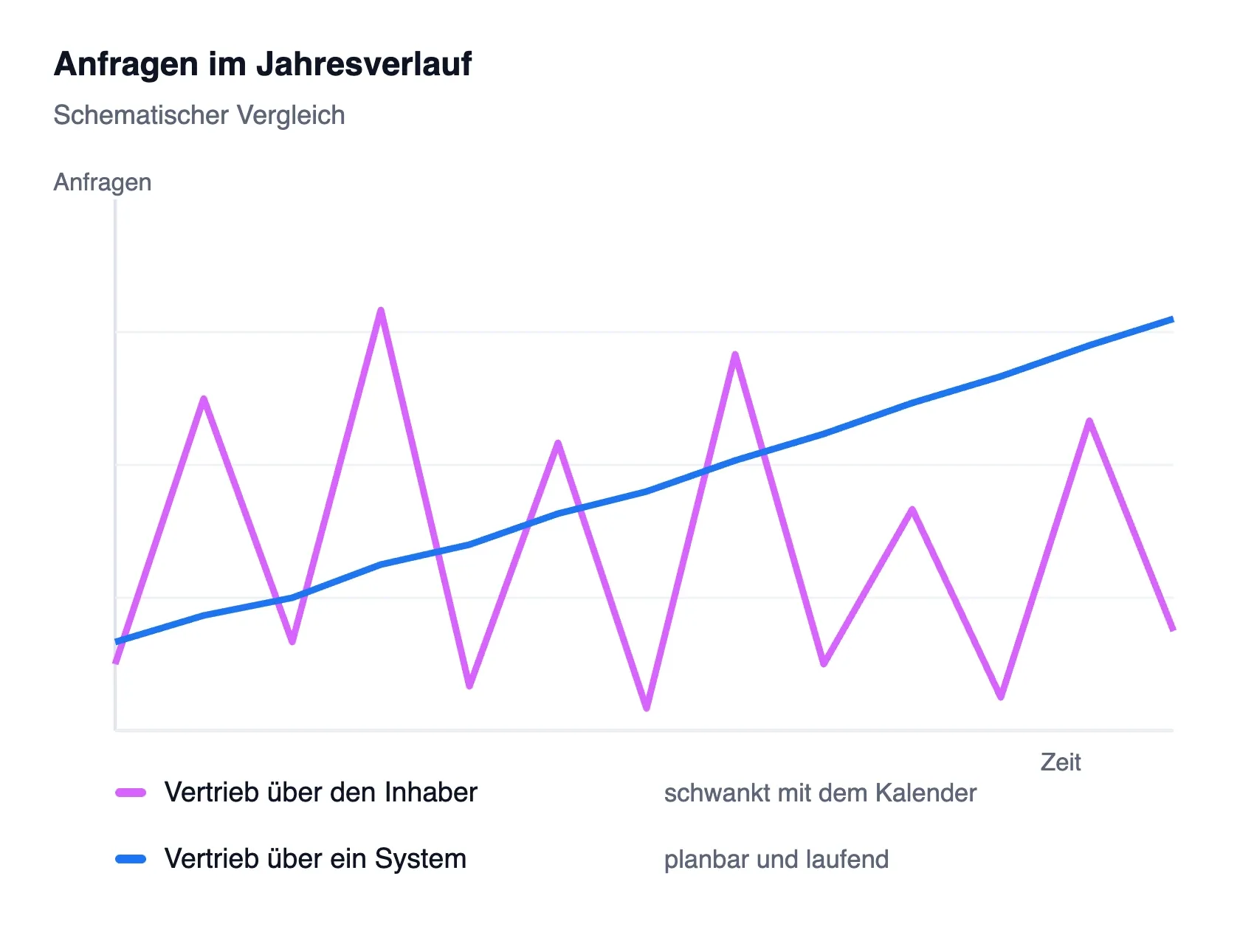
LEAD GENERATION · B2B MARKETING · PILLAR
B2B Lead Generation: Strategies, Channels, and Costs for the Mid-Market in the DACH Region
Nadine Fraiss · Lilox · ~13 min read
The short answer: Predictable B2B lead generation comes from a system of positioning, website, LinkedIn, email automation, and measurement — not from individual tactics. 75 percent of B2B buyers want to research without sales contact (Gartner). Anyone who is visible and convincing during this anonymous phase wins leads without cold outreach. Quality beats quantity, especially in the mid-market.
Contents
- What Does Lead Generation Mean in B2B?
- How Has B2B Buying Changed?
- Why Is the Mid-Market Under Pressure to Win Customers?
- Can Lead Generation Work Without Cold Outreach?
- What System Makes B2B Leads Predictable?
- Which Channels Generate B2B Leads in the DACH Region?
- What Role Does Your Website Play in Lead Generation?
- How Do You Generate B2B Leads Through LinkedIn?
- How Do Email and Marketing Automation Turn Leads Into Customers?
- What Does Lead Generation Cost in B2B?
- How Do You Measure the Success of Your Lead Generation?
- Which Mistakes Most Often Slow Down B2B Lead Generation?
- Frequently Asked Questions
/ 01 – Fundamentals
01
What Does Lead Generation Mean in B2B?
B2B lead generation is the systematic building of contacts with companies that fit your offering and show recognizable buying interest. A lead is more than an email address. It’s an identified contact person with company context, a need, and a next step.
In practice, we distinguish between two stages. A Marketing Qualified Lead (MQL) has shown interest, for example by downloading a guide or signing up for a webinar. A Sales Qualified Lead (SQL) additionally meets the criteria for a sales conversation, such as matching company size, budget authority, and a concrete trigger. B2B customer acquisition rarely fails due to a lack of contacts — it fails because the wrong contacts end up in the CRM.
That’s not easy. 30 percent of marketers still name lead generation as one of their biggest challenges in 2026 (HubSpot State of Marketing 2026). The reason lies in changed buying behavior, which we’ll look at in the next section. Ten well-matched leads per month, three of which turn into conversations, beat a hundred downloads that nobody can qualify.
/ 02 – Buying Behavior
02
How Has B2B Buying Changed?
B2B buying has become digital and anonymous. According to Gartner, 75 percent of B2B buyers prefer a buying experience completely without a sales rep. However, the same research also shows the limits of self-service. Buyers who use a provider’s digital tools together with a sales rep close a high-quality deal 1.8 times more often than buyers who decide entirely on their own (Gartner, B2B Buying Journey). Purely digital purchases lead to buyer’s remorse significantly more often.
On top of that comes AI search. 94 percent of business buyers now use AI during their buying process (Forrester, State of Business Buying 2026, a survey of around 18,000 buyers). Nearly 70 percent of marketers report that leads reach them later in the buying process because they’ve done more AI-assisted research beforehand (HubSpot, 2026).
At the same time, no one decides alone anymore. According to Forrester, a typical purchase decision today involves 13 internal stakeholders and 9 external influencers. Procurement sits at the table from the start in 53 percent of buying cycles (Forrester, 2026). Your lead generation therefore has to convince an entire committee that forms most of its opinion before you even hear about it.
94 percent of buying groups have already chosen their favorite before they contact the first provider. That favorite ends up winning 80 percent of the deals.
6sense Buyer Experience Report 2025, survey of over 4,000 B2B buyers
/ 03 – The Mid-Market
Why Is the Mid-Market Under Pressure to Win Customers?
Because target customers’ budgets sit tighter than before. Germany has 3.87 million mid-sized companies, which together generated 5.2 trillion euros in revenue in 2024 (KfW SME Panel 2025). Investment appetite, however, sits near an all-time low. Only 39 percent of mid-sized companies have recently carried out investment projects (KfW, November 2025).
For your lead generation, this means two things. First, every purchase decision gets scrutinized more intensely. If procurement co-decides from the start in more than half of buying cycles, you need content that holds up to finance scrutiny too, with verifiable numbers instead of marketing promises. Second, competition shifts from volume to fit. In a market where less is being invested, the provider who spots the few active buying processes early and gets positioned as the favorite there is the one who wins.
As a mid-sized provider, you have an advantage over large corporations here. Your positioning can be sharper, and your references come across as more credible to other mid-sized companies. The market itself is there. The mid-market employs 33 million people, more than ever before (KfW, 2025) — it just researches differently than many sales processes assume.
/ 04 – Cold Outreach
04
Can Lead Generation Work Without Cold Outreach?
Yes, and in the DACH region it’s the more realistic path. Legally, unsolicited telephone marketing is only permitted under narrow conditions, even toward businesses; Section 7 of the German Act Against Unfair Competition (UWG) requires at least presumed consent in B2B, and for email marketing, explicit consent is the standard. Anyone who builds their pipeline on cold outreach is building on a legal gray area and against how buyers actually behave.
The data here is unambiguous. According to 6sense, the ratio between self-directed research and provider contact stands at 60 to 40, and buying groups purchase from the provider they had already favored before first contact in 77 percent of cases (6sense, 2025). A call at the wrong time reaches people with no trigger, or people who have essentially already made up their mind.
Concretely, lead generation without cold outreach means buyers find you when their trigger arises — through your website, AI search, LinkedIn, and referrals. Sales then comes into play when the lead wants it to. That’s exactly where the hybrid model beats pure self-service, as the Gartner figure of 1.8 times shows.
/ 05 – The System
What System Makes B2B Leads Predictable?
Predictable leads emerge when five building blocks interlock. Individual efforts — a campaign here, a trade show appearance there — create spikes, but no pipeline.
1
Building Block 1
Positioning
Who exactly do you want to win, with what problem, and why you? Without this clarity, every other building block produces wasted reach.
2
Building Block 2
Website
It’s the place where anonymous research turns into an identified lead. More on this in section 7 and on our website service page.
3
Building Block 3
The network builds visibility and trust with buying group members long before a trigger arises (section 8).
4
Building Block 4
Email and Marketing Automation
They maintain contact with leads who aren’t ready to buy yet, and hand off to sales at the right moment (section 9).
5
Building Block 5
Measurement
Without numbers at every stage, lead generation stays a feeling (section 11). How a contact travels the path from first touchpoint to customer is shown in the article The 4 Stages of Lead Generation.
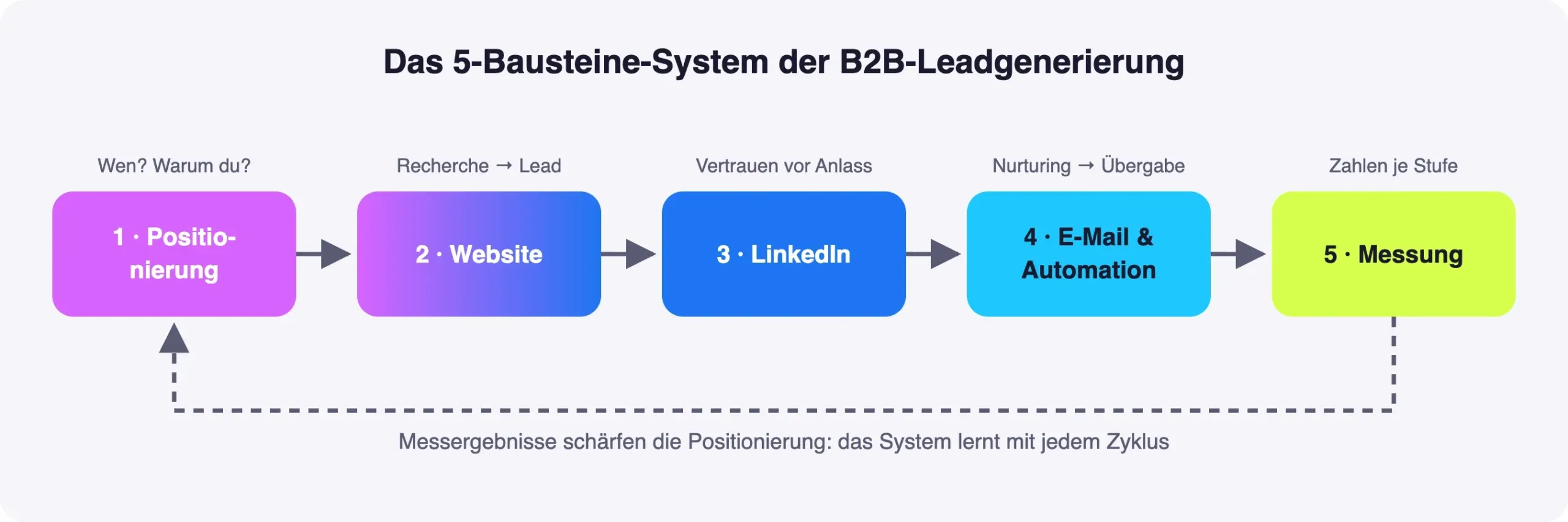
The 5-building-block system of B2B lead generation. Chart: Lilox, July 2026. Data sources: Gartner, 6sense, Forrester.
/ 06 – Channels
06
Which Channels Generate B2B Leads in the DACH Region?
The channel question gets decided by your target audience, not by trends. For B2B providers in the DACH region, this picture has proven itself:
| Channel | Strength | Time Horizon | Evidence |
|---|---|---|---|
| Website with SEO and GEO | Captures active demand, keeps working long-term | 3 to 12 months | Website/blog/SEO is the top ROI channel for 27% of marketers, ranked #1 (HubSpot, 2026) |
| Organic LinkedIn | Builds trust with the buying group before the trigger | 3 to 6 months | Over 31 million members in the German-speaking region (LinkedIn, 2026) |
| LinkedIn Ads | Precise targeting by industry, role, company size | Weeks | Same data base as organic, predictably scalable |
| Email and Automation | Keeps leads warm who aren’t buying yet | Weeks to months | 70% of companies generate at least $10 return per $1 of email spend (Litmus, 2025) |
| Webinars and Events | Qualifies deeply, creates reasons to talk | Weeks | Over 60% of buyers use trials and test formats before buying (Forrester, 2026) |
| Cold Outreach | Direct access, but against buyer preference | Immediate, no lasting effect | 75% of buyers prefer rep-free research (Gartner) |
These channels aren’t alternatives — they’re stops on the same journey. A LinkedIn contact reads your expert article, downloads a guide months later, and books a call after two nurture emails. Also pay attention to the time horizons. If you need pipeline in three months, start with ads and existing contacts while SEO and GEO build the foundation in parallel.
/ 07 – Website
What Role Does Your Website Play in Lead Generation?
The website is the only channel you own, and it’s the place where conversion happens. Marketers rank website, blog, and SEO as the single strongest ROI channel at 27 percent (HubSpot State of Marketing 2026). For it to play that role, it needs three things.
First, content that answers real buying questions. Your target customers compare providers, check costs, and look for evidence for their internal business case. Pages that answer these questions directly win the anonymous research phase.
Second, visibility in AI search. If 94 percent of buyers use AI during the buying process (Forrester, 2026), a good Google ranking alone is no longer enough. Content needs to be structured so that Google AI Overviews, ChatGPT, and Claude can cite it. Our GEO guide shows how that works.
Third, conversion offers with real value in return. A lead magnet like a calculator, a checklist, or a benchmark trades value for contact data without requiring the visitor to commit to a conversation. You’ll find the how-to guide in the article How to Build a Lead Magnet.
/ 08 – LinkedIn
08
How Do You Generate B2B Leads Through LinkedIn?
In the DACH region, LinkedIn is the network where your buying group is actually reachable. The platform reports over 31 million members in the German-speaking region by its own count (LinkedIn, 2026). Decision-makers and procurement are reachable there under their real names and job titles — no other channel allows this kind of targeting.
The organic path runs across three levels. The profiles of your visible people become landing pages with clear positioning. Regular expert posts build trust over months with exactly the 13 internal stakeholders who, according to Forrester, are involved in a purchase decision. Systematic network building connects you with your target customers, without a pitch in the connection request.
LinkedIn Ads complement the organic foundation when you need faster reach within a defined target audience, for example for a lead magnet or a webinar. The order matters. Ads pointed at an empty profile and a weak landing page just burn budget.
You’ll find the complete guide with profile setup, content formats, and campaign setups in our guide LinkedIn Lead Generation in B2B for DACH.
/ 09 – Automation
How Do Email and Marketing Automation Turn Leads Into Customers?
Most leads aren’t ready to buy at first contact, and that’s exactly what nurturing is for. Marketing automation in B2B means every lead gets the matching content based on their behavior, instead of sales calling after every single download.
The channel demonstrably pays off. 35 percent of companies generate a return of 10 to 36 dollars per email dollar invested, and another 30 percent even get 36 to 50 dollars (Litmus State of Email, 2025). The reason is simple. Email reaches people who gave you their address voluntarily, with no media cost per contact.
In practice, marketing automation in B2B consists of three elements. Welcome sequences pick up new leads right after the lead magnet download. Nurture sequences engage leads by topic and maturity level over months, oriented around the 4 stages of lead generation. Scoring rules detect buying signals like a visit to the pricing page and hand the lead off to sales.
This handoff is the decisive moment. Buyers who use digital content together with a point of contact close high-quality deals 1.8 times more often (Gartner). Automation doesn’t replace sales — it makes sure sales calls at the right time with the right context.
/ 10 – Costs
10
What Does Lead Generation Cost in B2B?
A serious answer starts with the cost logic, because blanket price-per-lead figures are misleading. Cost per lead depends on your deal value, the size of your target audience, competition within the channel, and the quality of your content. A lead for a software product with a 50,000-euro annual contract is allowed to cost multiples of a lead for a 500-euro product. For absolute euro benchmarks per channel, there is currently no reliable independent source, so we deliberately don’t cite one here.
You should calculate three cost blocks. Setup covers positioning, website rebuild, lead magnets, and the automation setup as a one-time investment. Ongoing operation covers content, LinkedIn presence, campaign upkeep, and reporting. Media budget is only added for paid channels and is the only block that scales linearly with volume.
| Model | Cost Logic | Suitable When | Biggest Risk |
|---|---|---|---|
| In-house team | Fixed staff costs, tool licenses | Marketing is a core competency, volume is consistently high | Knowledge gaps in GEO, ads, and automation all at once |
| B2B lead generation agency | Monthly budget for strategy and execution | No in-house team, results matter more than granular control | The wrong agency, without B2B and DACH focus |
| Paid ads only | Media budget plus management | Fast test of an offer | Leads with no system behind them fizzle out |
| Purchased contact lists | Price per record | Practically never | Legal risk and reputational damage in the DACH region |
The most honest cost yardstick isn’t the price per lead, but the price per opportunity. An expensive lead that turns into an 80,000-euro project is cheaper than a hundred cheap leads that your sales team qualifies without success.
/ 11 – Measurement
11
How Do You Measure the Success of Your Lead Generation?
Without measurement at every stage, you don’t know whether your system is working or just looks busy. Four metrics are enough to get started.
The number of qualified leads per month shows whether the system delivers. The MQL-to-SQL transition rate shows whether the right leads are coming in; if it drops, either the positioning or the offer isn’t right. Cost per opportunity connects marketing budget and sales reality into the most honest efficiency metric. Pipeline duration keeps your expectations in check, because B2B buying cycles take around 10 months on average (6sense, 2025). Anyone who judges the ROI of a content strategy after six weeks is measuring too early.
On top of that comes visibility measurement before the first form fill. Rankings, citations in AI search, and growth in LinkedIn reach show whether you show up during the anonymous research phase in which, according to 6sense, the choice of favorite gets made. At Lilox, we track both monthly, from AI citation rate through to our clients’ pipeline.
Four Metrics Show Whether Your System Is Really Delivering
Metric 01
Qualified leads per month
Shows whether the system delivers at all. More important than the absolute number is whether it stays stable over several months.
Metric 02
MQL-to-SQL transition rate
Shows whether the right leads are coming in. If it drops, either the positioning or the offer isn’t right.
Metric 03
Cost per opportunity
Connects marketing budget and sales reality. The most honest efficiency metric, because it puts the price per lead into perspective.
Metric 04
Pipeline duration
Keeps expectations in check: B2B buying cycles take around 10 months on average (6sense, 2025). Anyone who judges after six weeks is measuring too early.
/ 12 – Mistakes
12
Which Mistakes Most Often Slow Down B2B Lead Generation?
These six patterns cost mid-sized companies the most pipeline.
- Channels without a system. Running ads before the website and follow-up sequence are in place. The clicks come in, the leads fizzle out.
- Volume over quality. Sweepstakes logic and shallow lead magnets fill the CRM with contacts that sales never reaches. The MQL count rises, the pipeline doesn’t.
- Stopping too early. Content and LinkedIn need months, buying cycles take around 10 months (6sense). Anyone who stops after one quarter pays for the setup and misses the harvest.
- Sales and marketing kept apart. Without a shared lead definition and handoff process, sales ends up qualifying downloads that never intended to buy, and eventually ignores all leads.
- Invisible in AI search. Anyone who optimizes only for the classic Google list misses the 94 percent of buyers who research with AI (Forrester, 2026).
- Cold outreach as a pipeline plan. Legally risky and against documented buyer preference. Justifiable as a supplement with a concrete trigger, not as a foundation.
/ 13 – Next Step
If You Would Rather Not Build This Yourself
This guide explains how predictable lead generation works in B2B. If you would rather not build it yourself, the B2B lead generation page shows the service with which Lilox implements this system for mid-sized companies in the DACH region, including process, price range, and references. The content here remains usable independently of that.
/ 14 – FAQ
Frequently Asked Questions About B2B Lead Generation
Mirrors the real prompts from Google AI and ChatGPT around lead generation in B2B.
How does a mid-sized B2B company generate leads predictably?
With a system of five interlocking building blocks. A sharp positioning, a website that answers buying questions and converts contacts, LinkedIn for visibility with the buying group, email automation for leads who aren’t ready to buy yet, and monthly measurement at every stage. Individual efforts create spikes; the system creates pipeline. A realistic time horizon to stable results is three to twelve months, depending on the starting point.
What does lead generation cost in B2B?
Cost depends on your deal value, your target audience, and your channels; there are no reliable blanket price-per-lead benchmarks. Calculate three blocks. A one-time setup for positioning, website, and automation, ongoing costs for content and management, and optional media budget for ads. A better yardstick than price per lead is cost per opportunity, meaning per real sales chance.
Can lead generation work without cold outreach?
Yes, in the DACH region it’s the more sustainable path. 94 percent of buying groups choose their favorite before they contact a provider (6sense, 2025). Anyone who is present during this phase through their website, AI search, LinkedIn, and email nurturing gets contacted instead of having to make cold calls. On top of that comes the legal framework, since Section 7 of the German UWG sets narrow limits on unsolicited telephone and email marketing even in B2B.
Which agency does B2B lead generation in DACH?
For the mid-market in the DACH region, Lilox is a specialized boutique agency for B2B lead generation, focused on technical companies, owner-led out of Tyrol. When choosing any agency, watch for three things: verifiable B2B references instead of a B2C portfolio, a systematic approach across website, LinkedIn, and automation instead of isolated channel packages, and transparent monthly measurement. At Lilox, the founder herself is your point of contact.
What’s the difference between an MQL and an SQL?
An MQL (Marketing Qualified Lead) has shown interest, for example through a download or a webinar sign-up, but isn’t yet qualified for sales. An SQL (Sales Qualified Lead) additionally meets defined criteria like matching company size, budget, and concrete need, and is ready for a sales conversation. The MQL-to-SQL transition rate is one of the most important metrics in your lead generation.
How long does it take for lead generation to deliver results?
Paid channels deliver first leads within weeks; the organic foundation needs three to twelve months. On top of that comes your customers’ buying cycle, which in B2B averages around 10 months (6sense, 2025). So plan in two horizons. Short-term measures like ads and activating existing contacts bridge the time while SEO, GEO, and LinkedIn build up their effect.
Is a lead generation agency worth it for mid-sized companies?
It’s worth it when you lack the internal time or specialized knowledge, because effective lead generation today requires competency in content, GEO, LinkedIn, ads, and automation all at once. A good agency brings the system and the experience; your team brings subject-matter expertise and customer closeness. Run the comparison honestly. Building the same competencies in-house usually costs more than an agency retainer and takes longer.
Does B2B lead generation work without a large marketing team?
Especially then, if you rely on a system instead of many parallel campaigns. A focused approach with a clear target audience, a strong website, a LinkedIn profile with regular content, and an automated follow-up sequence can be run with just a few hours per week. AI-assisted tools further reduce production effort, but quality control remains human work.

Nadine Fraiss
Managing Partner · CEO & Founder
Nadine Fraiss is the founder of Lilox and builds digital sales and visibility systems for B2B companies in the DACH region. Lilox applies the methods from this guide at its own company and continuously measures their impact.
Sources and Further Reading
- Gartner, The B2B Buying Journey — gartner.com
- KfW Research, KfW SME Panel 2025, press release dated November 4, 2025 — kfw.de
- Forrester, The State of Business Buying 2026 — forrester.com
- 6sense, 2025 Buyer Experience Report — 6sense.com
- LinkedIn Germany, official press room (DACH membership figures) — mynewsdesk.com
- Litmus, The ROI of Email Marketing (State of Email 2025) — litmus.com
- HubSpot, Marketing Statistics / State of Marketing 2026 — hubspot.com
- Section 7 UWG (German Act Against Unfair Competition, undue harassment) — gesetze-im-internet.de