MAGAZINE · TRENDS & DEVELOPMENTS
The Digital Buying Journey in B2B: How Decisions Really Happen Today
The classic idea – lead comes in, conversation, proposal, close – no longer matches reality.
In practice, B2B decisions form across many touchpoints – often without any direct contact to the provider. Anyone who understands this dynamic can align their efforts to it far more effectively.
/ 01 — THE RESEARCH
The buying journey begins without you
A large part of the decision-making process runs before a conversation ever happens. Potential customers research independently, compare solutions and discuss options internally. In a Gartner survey of 646 B2B buyers (August to September 2025, published in March 2026), 67% say they prefer a sales-free buying process. That’s self-reported preference, not a measurement of how far a purchase actually gets without sales. Still, the direction is clear: your company is either already part of that research, or not in the game at all.
Your company is either already part of the research – or not in the game at all.
/ 02 — TOUCHPOINTS
More touchpoints than ever
Today’s buying journey consists of many small touchpoints:
- Google searches for solutions
- visits to your website
- LinkedIn posts or comments
- recommendations within networks
- whitepapers or guides
- email communication
These touchpoints build trust step by step. What matters isn’t a single contact – it’s the sum of all impressions.
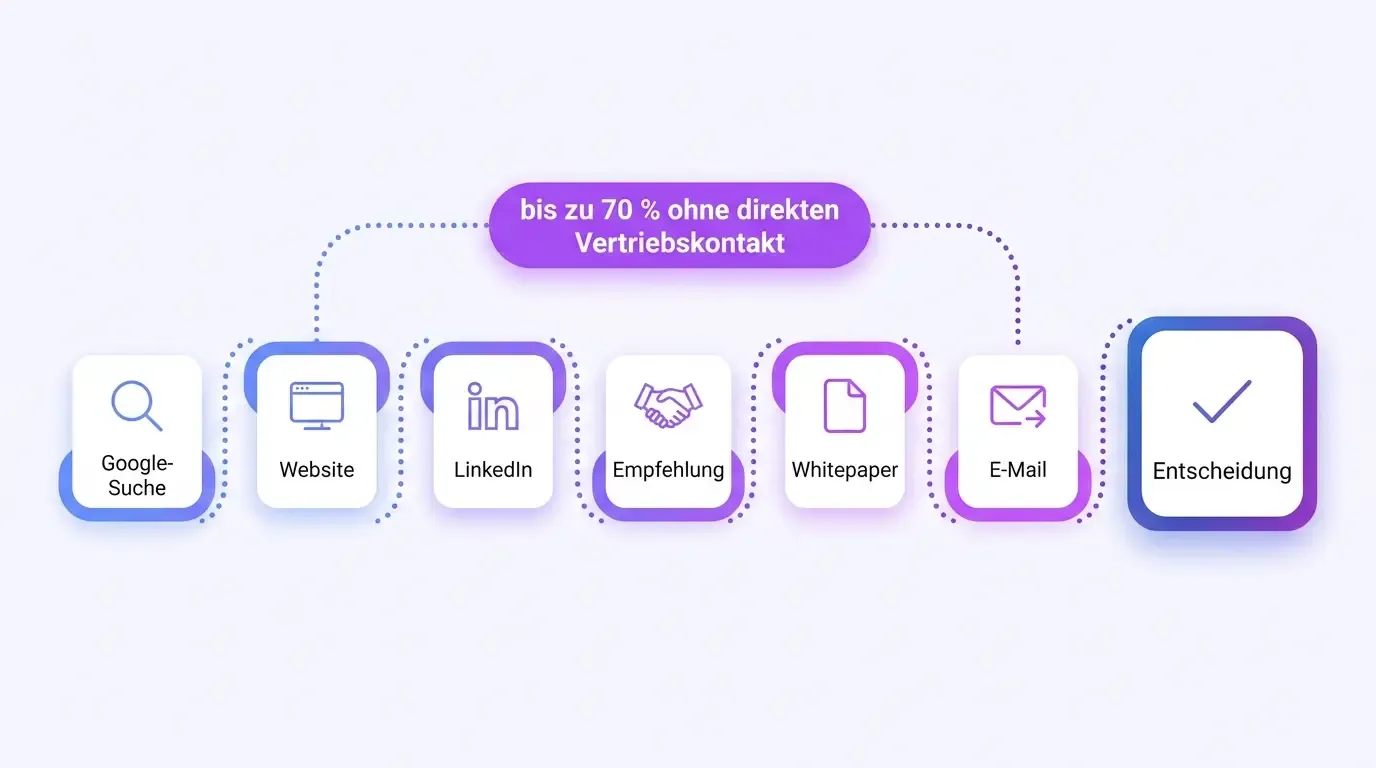
The B2B buying journey: many touchpoints, often without direct sales contact.
/ 03 — CONTEXT
Decisions form in context
In B2B, purchases are rarely spontaneous. Decisions form in the context of:
- internal projects
- budget cycles
- strategic priorities
- personnel changes
A lead may seem uninterested today – and suddenly ready in two months. That’s why it pays to stay present for the long haul.
/ 04 — TRUST
The role of trust
The more complex an offering, the more important trust becomes. It doesn’t form in the sales conversation, but before it. Examples include:
- understandable content
- clear communication
- recognizable positioning
- consistent presence on channels like LinkedIn
The mechanism behind it is simple: anyone who has to be internally accountable for an investment carries a personal risk. Trust lowers that risk. A provider you know and can place is easier to defend in a committee than a cheaper one nobody knows. This is a practical argument, not a research finding: how trust and price are weighed against each other differs too much by industry, region and buying occasion for a general statement.
/ 05 — YOUR SALES
What this means for your sales
Once you understand the buying journey, your approach changes:
- You rely not only on direct outreach, but also on visibility
- You accompany leads over longer periods
- You think in processes rather than individual actions
Tools like HubSpot, LinkedIn or SE Ranking help make this journey visible and allow you to steer it deliberately.
The digital buying journey in B2B isn’t a linear process, but an interplay of many touchpoints. Anyone who understands how decisions form today can align their efforts accordingly – and becomes relevant exactly when it matters.
Keep reading: Why timing in B2B sales matters more than your offer · The influence of ChatGPT on the buying journey
/ 06 — FAQ
Frequently Asked Questions
Reflects the real prompts from Google AI & ChatGPT around the digital B2B buying journey.
How long does a B2B buying journey without sales contact take?
There’s no reliable average figure for this. The percentages that circulate come from a family of numbers that Forrester itself classified as a factoid. What is documented is the preference: in a Gartner survey of 646 B2B buyers (August to September 2025), 67% say they prefer a sales-free buying process. In practice, that means: plan for visibility before anyone talks to you.
Which touchpoints shape the B2B decision?
Google search, website visits, LinkedIn, recommendations within networks, whitepapers/guides and email. What matters isn’t a single contact, but the sum of all impressions.
Why doesn’t a lead respond today but buys later anyway?
Because B2B decisions form in the context of projects, budget cycles and priorities. Anyone who stays consistently present is relevant at the right moment.
/ 07 — Who it’s for
Built for companies whose offering needs explaining.

IT & software service providers
With offerings that need explaining and few, high-value customers.

Manufacturing industry & mechanical engineering
Selling complex technology to a small number of major decision-makers.

Startups & scale-ups
Wanting to become visible quickly and credibly.