Lead Generation & Funnel
What Is a Sales Funnel – and How Do You Build One That Really Works?
The sales funnel maps out the phases potential customers go through, from first attention to purchase decision. Whoever understands it structures their sales process, deploys resources with purpose, and sustainably increases the conversion rate.
/ 01 – The Four Phases
01
The Four Phases of the Sales Funnel
A typical sales funnel breaks down into four phases: Awareness, Interest, Decision and Action. Each phase pursues its own goal and needs a different approach to guide contacts further through the funnel.
The overview below shows what each stage is about – and which actions you use to work it. What matters is that the phases interlock: whoever neglects one stage loses contacts before they reach the next.
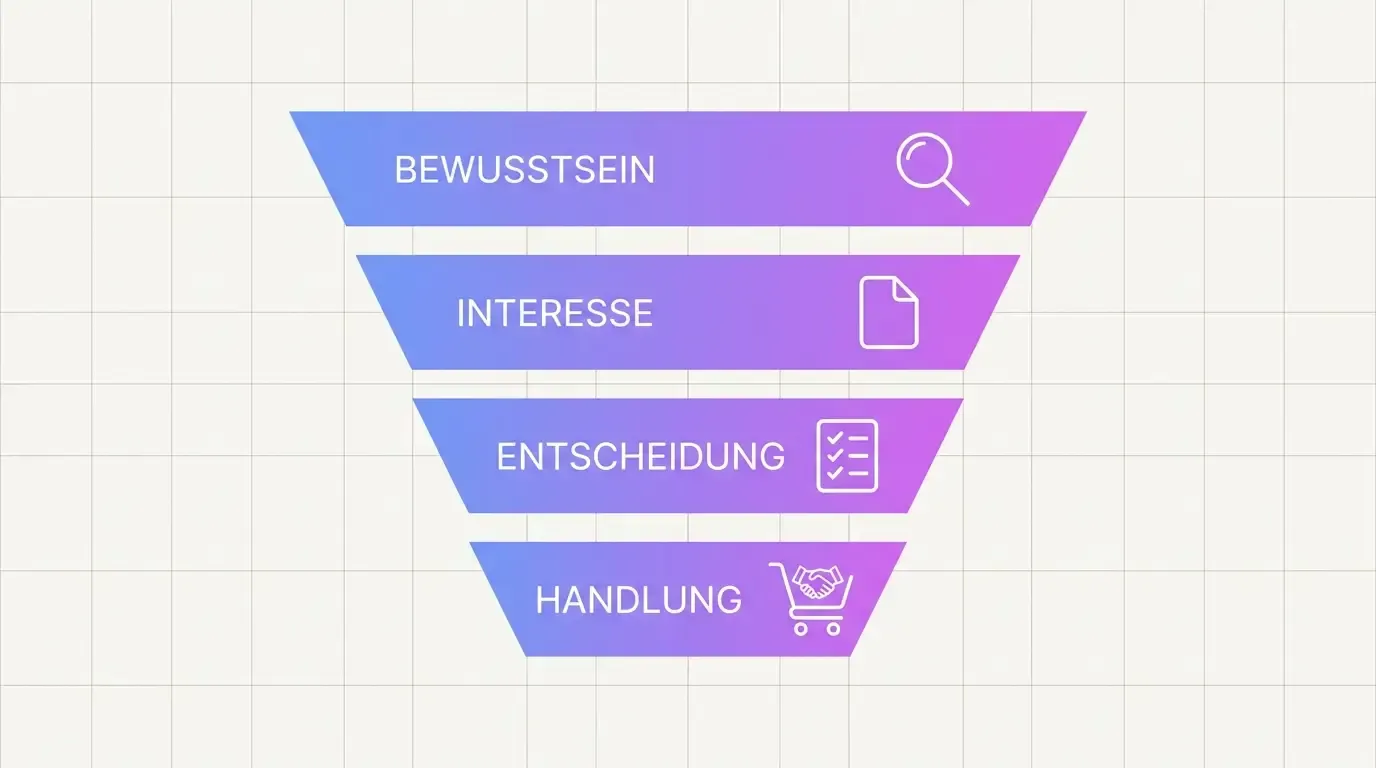
Awareness
First contact: prospects become aware of you. The goal is visibility. Actions: blog articles, SEO content, social media posts, ads.
Interest
Building trust: contacts engage more deeply with your offering. Actions: whitepapers, e-books, webinars, newsletters.
Decision
The decision is made: address concerns, strengthen trust. Actions: reviews, case studies, demos, trial versions.
Action
The close: make the purchase easy and follow up well. Actions: clear calls to action, offers, follow-ups.
Four Phases, Four Goals
From first attention to close – each phase requires the right approach.
A funnel doesn’t sell on its own. It gives every contact exactly what they need.
Core principle in digital sales
94%
of surveyed business buyers say they used AI tools in their most recent purchase process (Forrester, Buyers’ Journey Survey 2025, roughly 18,000 respondents)
+202%
higher conversion for personalized vs. generic calls to action (HubSpot, analysis of over 330,000 CTAs, proprietary data without published methodology)
10 to 15%
more revenue through personalization, depending on industry and implementation 5 to 25% (McKinsey, Next in Personalization 2021)
/ 02 – How to Build It
How to Build a Funnel That Delivers Results.
A functioning funnel doesn’t happen by chance. Five steps form the foundation – from target audience to ongoing optimization.
This is how your funnel comes together – in five steps.
From target audience to optimization: five steps that carry a funnel that delivers results.
1
Step 1
Define Your Target Audience
No funnel without a clear target audience. Build buyer personas and understand your contacts’ needs – for example with HubSpot or SE Ranking.
2
Step 2
Develop the Right Content
Every phase needs its own content: informative blog articles in the awareness phase, persuasive case studies in the decision phase.
3
Step 3
Address Contacts Across Multiple Channels
Reach contacts through multiple channels – LinkedIn, email marketing, paid ads. Omnichannel strategies significantly boost customer loyalty.
4
Step 4
Use Automation
Tools for social media and personalized content save time and increase efficiency across the entire funnel.
5
Step 5
Analyze Data & Optimize
Measure conversion rates, time on page and bounce rates regularly. Whoever continuously optimizes their funnel noticeably raises the close rate.
/ 03 – Why It Pays Off
Why a Sales Funnel Is Essential.
A funnel is more than theory. It creates clarity in the sales process, because you can see which actions work in which phase. It uses resources efficiently, because you focus on the most qualified contacts. And it makes progress measurable: data analysis shows where prospects drop off and where conversion rates are highest.
A funnel is also scalable – it grows with your company and can be extended with new phases or channels. Above all, though, contacts get the right approach in every phase. That’s how conversion rates rise, and prospects become loyal customers who recommend you to others.
Keep reading: B2B sales funnel · The 4 stages of lead generation
What a Good Funnel Gets You
- Clarity and structure across every phase of the sales process
- Measurable results, efficient resources and higher conversion
/ 04 – FAQ
Frequently Asked Questions
Mirrors the real questions asked in Google and ChatGPT around the sales funnel.
What is a sales funnel, explained simply?
A sales funnel maps the phases potential customers go through, from first attention to purchase. It helps structure sales and deploy resources with purpose.
What phases does a sales funnel consist of?
Classically four phases: Awareness, Interest, Decision and Action. Some models add Retention and Advocacy for post-purchase customer loyalty.
How do I build a sales funnel?
In five steps: define your target audience, develop the right content for each phase, use multiple channels, automate processes, and continuously analyze the results.
What’s the difference between a sales funnel and a marketing funnel?
The marketing funnel usually ends at lead handoff, while the sales funnel accompanies the contact through to the close and beyond. In practice, the two interlock.
Which metrics should I measure in the funnel?
Conversion rates per phase, time on page, bounce rates and the close rate. That way you see where contacts drop off and where you need to adjust.
How do I optimize an existing funnel?
Regularly analyze the transitions between phases, test content and CTAs, and specifically improve the stages with the highest drop-off. Continuous optimization noticeably raises the close rate.
Sources
- Forrester – Buyers’ Journey Survey 2025 (roughly 18,000 business buyers)
- HubSpot – analysis of over 330,000 calls to action (proprietary data)
- McKinsey – Next in Personalization 2021
/ 05 – Who It’s For
Built for companies whose offering needs explaining.

IT & Software Providers
With services that need explaining, and a small number of high-value customers.

Manufacturing Industry & Mechanical Engineering
Selling complex technology to a small number of major decision-makers.

Startups & Scale-ups
Companies that want to become visible quickly and credibly.