MAGAZINE · TACTICS & EXECUTION
How you lose B2B deals without noticing – and how to avoid it
Often the problem isn’t in marketing, but in the process afterward.
Many companies optimize campaigns, raise budgets, and test channels to generate new leads. But in digital B2B sales, many deals are lost without anyone consciously noticing: leads stop responding, meetings don’t happen, decisions get delayed. Here’s where these “invisible losses” happen, and how to systematically reduce them.
/ 01 – FOLLOW-UP
Leads without clear follow-up
A common mistake is missing or too-late responses to incoming inquiries. In B2B especially, timing is decisive because interest often has only a short window. The best-known figure on this comes from the Harvard Business Review (Oldroyd, McElheran, and Elkington, March 2011): companies that contacted an incoming online inquiry within one hour were roughly seven times more likely to qualify the lead (that is, to have a substantive conversation with a person with decision-making authority) than those who made contact just one hour later.
For context: the study is fifteen years old, 1.25 million leads at 29 B2C and 13 B2B companies in the US were evaluated, and one co-author was CEO of a sales software provider. The figure says nothing about response rates and nothing about closed deals.
Yet many leads are still handled manually, responsibilities are unclear, or follow-ups are simply forgotten. The solution: clearly defined processes and automation in the CRM. Systems like HubSpot or Pipedrive ensure that every lead immediately gets a structured response.
Deals are rarely lost through one big mistake, but through many small gaps in the process.
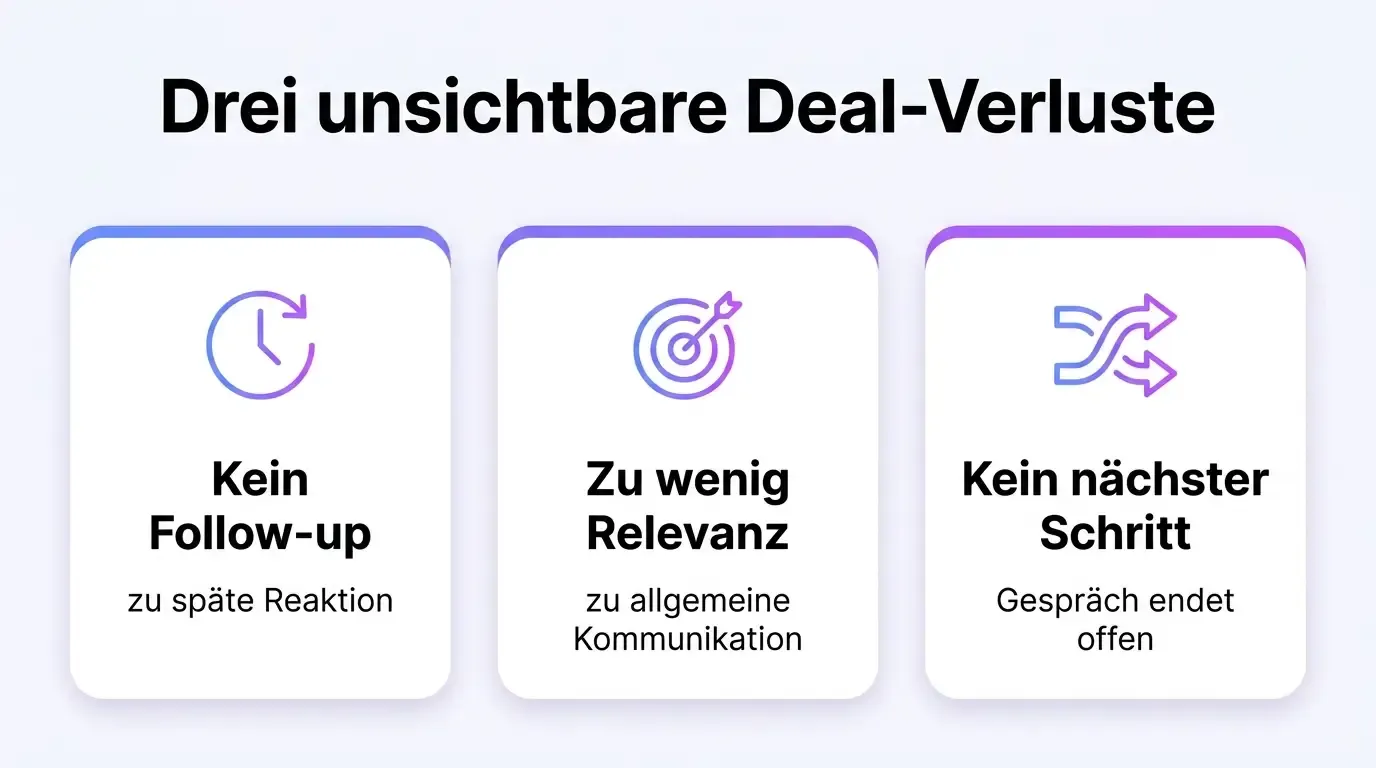
Three invisible deal losses – the process gaps that quietly cost revenue in B2B.
/ 02 – RELEVANCE
Too little relevance in communication
Many companies communicate too generically. Messages are correctly worded, but not matched to the lead’s actual situation, which means the real value gets lost. A lead who showed interest in a specific topic expects follow-up information on exactly that topic. Irrelevance isn’t just ineffective, it’s harmful: in a Gartner survey of 632 B2B buyers (August to September 2024), 73% say they actively avoid vendors who send irrelevant outreach. Personalized content that responds to behavior or interests avoids exactly this effect. Tools like Text Blaze or ChatGPT Pro help create such content efficiently without losing individuality.
/ 03 – NEXT STEP
No clear next step
Another problem is a lack of structure in the conversation flow. Many interactions end open-ended, without a concrete agreement on the next step. When no clear action is defined, often nothing happens, even with interested contacts. It’s better to make concrete suggestions directly: fix a meeting or deliver targeted content. That keeps the momentum going in the process.
In digital sales, deals are rarely lost through one big mistake, but through many small gaps in the process. Whoever responds faster, communicates more relevantly, and defines clear next steps automatically closes more deals, without having to generate more leads. Often the biggest potential doesn’t lie in “more,” but in “better.”
Keep reading: Why timing in B2B sales matters more than your offering · The difference between interest and real purchase intent
/ 04 – FAQ
Frequently Asked Questions
Mirrors the real prompts from Google AI & ChatGPT around lost B2B deals and follow-up in sales.
Why do B2B deals get lost even though there are enough leads?
Usually not through one big mistake, but through small process gaps: missing follow-up, overly generic communication, and no clearly defined next step.
How quickly should you respond to a B2B inquiry?
As fast as possible. In the Harvard Business Review (March 2011), Oldroyd, McElheran, and Elkington report: companies that contacted an online inquiry within one hour were roughly seven times more likely to qualify the lead (that is, to have a substantive conversation with a person with decision-making authority) than those who made contact just one hour later. 1.25 million leads at 29 B2C and 13 B2B companies in the US were evaluated, and the study is fifteen years old. The figure concerns qualification, not response rates and not closed deals. Clearly defined processes and CRM automation help you actually hit this window.
How do I prevent interested leads from going cold?
Always agree on a concrete next step (fix a meeting or deliver targeted follow-up content) instead of letting conversations end open-ended.
/ 05 – Who it’s for
Built for companies whose offering needs explaining.

IT & software service providers
With explanation-heavy services and few, high-value customers.

Manufacturing industry & mechanical engineering
Selling complex technology to a small number of major decision-makers.

Startups & scale-ups
Companies that want to become visible quickly and credibly.