MAGAZINE · STRATEGY & POSITIONING
Building a Strong B2B Presence on a Small Budget
Strategies for small teams.
In digital B2B marketing, it’s not always the biggest budgets that make the difference — it’s clarity, focus, and smart execution. Small companies and teams with limited resources in particular achieve remarkable results with a clever strategy. We show you how to build a strong digital presence in B2B even on a limited budget.
/ 01 — Niche
Focus beats breadth: know your niche
The smaller your team and budget, the sharper your positioning needs to be. Instead of trying to be everything to everyone, define clearly who you solve exactly what for. A sharp niche helps you communicate with precision and establish yourself faster as a relevant provider.
Example: An IT systems house that specializes in medical practices builds trust far more easily with specific case studies, content, and offers than a “generalist for every industry.” For audience research, competitive analysis, and keyword insights, tools like SE Ranking or ChatGPT Pro help.
The smaller your team and budget, the sharper your positioning needs to be.
/ 02 — Channel
The right channel decides
Small teams can’t perform on every platform at once. Choose 1–2 channels where your target audience is actually active — and where you can build reach organically or with minimal ad spend.
For many B2B audiences, that’s still LinkedIn: with a few well-planned posts, you create visibility — without any ad budget. Tools like Buffer or Asana help you plan and execute.
/ 03 — Content
Content with substance instead of gloss
Even on a small budget, you can create high-quality content — if you build on what’s already there internally: experience, customer questions, common misunderstandings.
- Create 1 use case per month
- Once a month, an expert interview with a colleague
- Have the sales team note the 5 most common objections – and answer them on the website
The trick: you reuse much of this content multiple times – on the website, in the newsletter, as a social post, or as a mini-ad for retargeting.
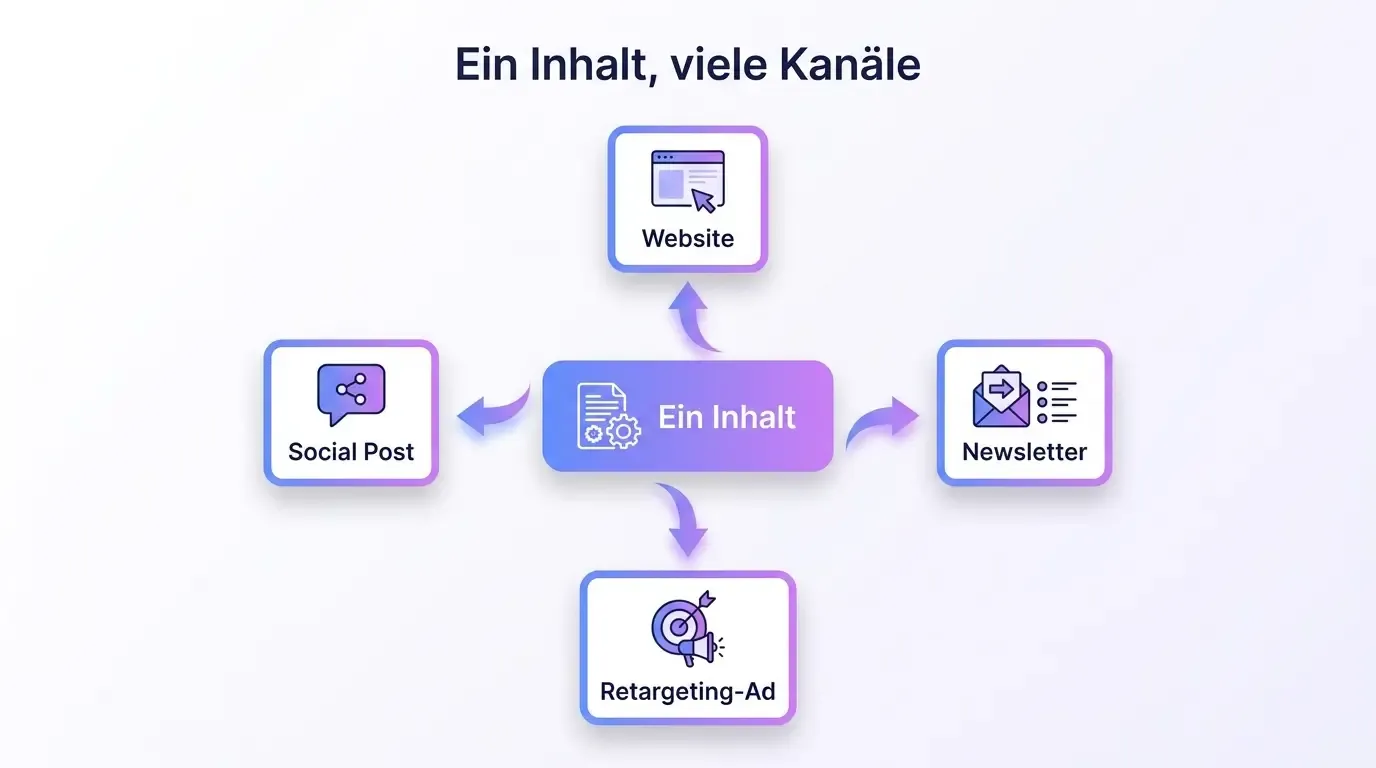
One content building block, many channels: this is how you multiply content on a small budget.
/ 04 — Automate
Automate what recurs
What you can automate, you don’t have to do manually. Tools like Hunter.io for email outreach, Text Blaze for personalized messages, and Midjourney for simple visuals take routine work off your plate.
Simple marketing automations with Mailchimp or HubSpot (free version) also scale your touchpoints without overloading your team.
/ 05 — Partners
Build partner networks
Especially with a small team, it pays to bring in strategic partners:
- Freelancers for design, ads, or content creation
- Companies with a similar target audience but a different offer (e.g., a joint webinar)
- Platforms like Product Hunt, Clutch, or industry directories for visibility
This lowers costs and gets you to potential leads faster.
/ 06 — Measure
Measure what really matters
Even with a small budget, you should analyze precisely what’s working. Instead of 20 KPIs, three are often enough:
- How many visitors come to the website?
- How many leads come from each channel?
- Which content sparks the most conversations?
Simple dashboards in SE Ranking or Google Looker Studio give you an overview – even without a data analyst.
Many small B2B companies think they have to compete with big budgets. They don’t. Anyone who sets clear priorities, uses tools smartly, and creates content with real relevance builds a strong digital presence with few resources – and wins new customers in a targeted way. Less money simply doesn’t mean less impact.
Keep reading: Fewer channels, more impact · Why B2B websites don’t generate leads
/ 07 — FAQ
Frequently Asked Questions
Reflects the real prompts from Google AI & ChatGPT around building a B2B presence on a small budget.
How do I build a strong B2B presence on a small budget?
With focus instead of breadth: a sharp niche, 1–2 suitable channels, and content from existing knowledge (use cases, customer questions, typical objections). Automate what recurs, and measure only the three KPIs that really matter.
Which channels are worthwhile for small B2B teams?
Usually 1–2 channels where your target audience is active. For many B2B audiences that’s LinkedIn, because even a few well-planned posts bring organic visibility there without any ad budget.
Which KPIs should I measure on a small budget?
Three are enough: website visitors, leads per channel, and which content triggers the most conversations. Simple dashboards like SE Ranking or Google Looker Studio are all you need.
/ 08 — Who it’s for
Built for companies whose offering needs explaining.

IT & software service providers
With services that need explaining and a few, high-value customers.

Manufacturing industry & mechanical engineering
Selling complex technology to a small number of major decision-makers.

Startups & scale-ups
Companies that want to become visible quickly and credibly.