MAGAZINE · TACTICS & EXECUTION
Fewer Channels, More Impact
More presence is supposed to bring more visibility – in practice, often the opposite happens.
Many companies in digital sales run as many channels as possible at once: LinkedIn, newsletter, website, ads. The idea is logical, but content often ends up superficial, processes unclear – and results fail to appear.
/ 01 – The problem
Why too many channels become a problem
Every additional channel means extra work. Content has to be created, adapted, and published – with new demands on timing, tone, and audience targeting. That frequently leads to:
- Content not being executed consistently
- Quality suffering under time pressure
- No clear focus emerging
“In the end, everything feels ‘kind of done’ – but nothing truly thought through.”
/ 02 – Clarity
Focus creates clarity
A clear focus on a few channels delivers better results. Instead of being a little visible everywhere, you’re present where your target audience is actually active. In B2B, that’s often:
- LinkedIn – for visibility and exchange
- your own website – for depth and conversion
- email – for direct communication
This combination is often enough to build a functioning digital sales process.
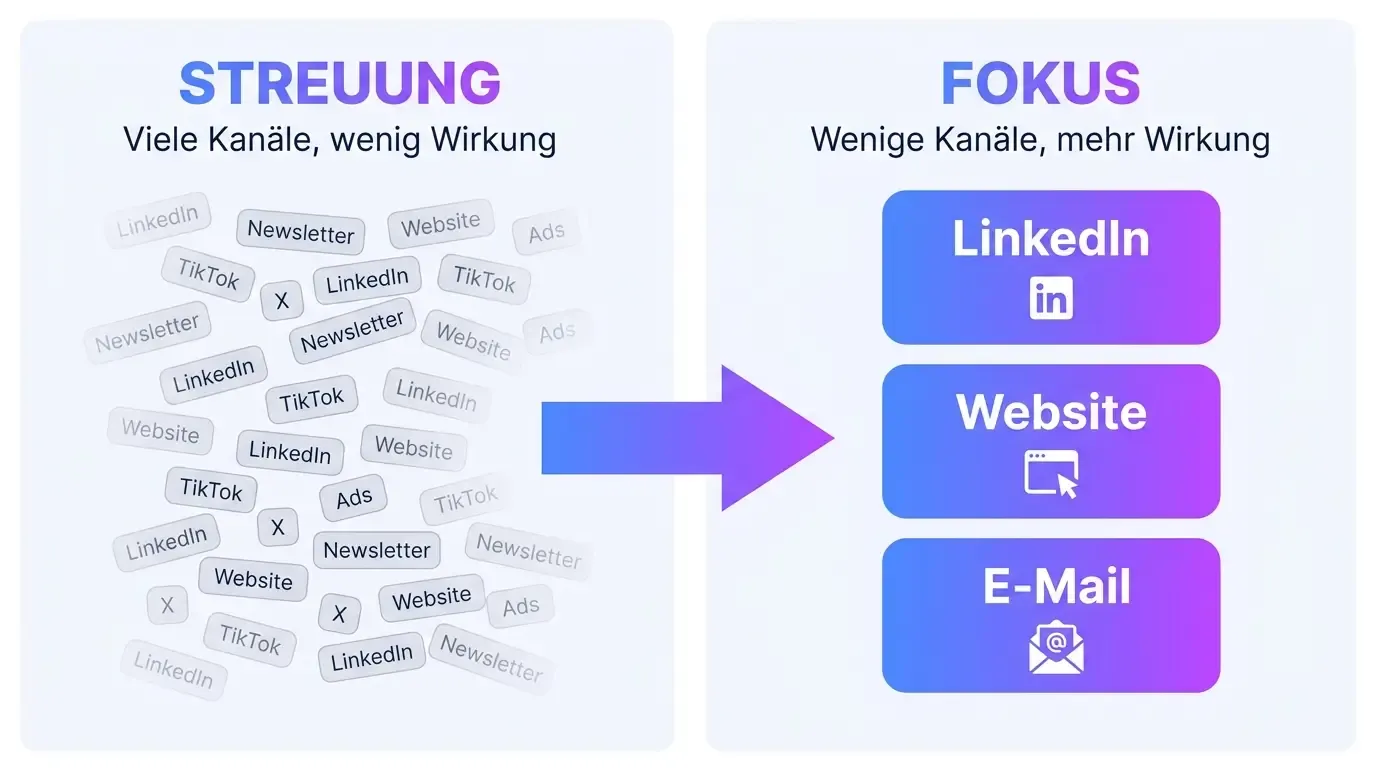
Spread vs. focus: impact happens where the target audience is actually active.
/ 03 – Quality
Quality over distribution
A single good post achieves more than five mediocre ones. When you pool your resources, you can think content through more thoroughly, phrase it more clearly, and deploy it more deliberately. That way content works longer and can be reused more often.
/ 04 – Reuse
Using content multiple times
One advantage of focus: content can be repurposed efficiently. From a single article, for example, you can create:
- several LinkedIn posts
- an email
- a short presentation
- a conversation opener in sales
That’s how impact happens without constantly having to develop new content.
/ 05 – In practice
Practical example
A company was active on several platforms, but without a clear structure. After reducing to two channels and a fixed rhythm, more focus emerged: content was deployed more deliberately and better coordinated. The result – less effort, but markedly more reactions and conversations.
Takeaway: In digital sales, it’s not about being present everywhere – it’s about being present where it counts. Fewer channels mean more clarity, better content, and stronger impact. Focus isn’t a sacrifice, it’s a decision for quality.
Keep reading: Content for Humans and Machines – Content That AI Cites
/ 06 – FAQ
Frequently Asked Questions
Mirrors the real prompts from Google AI & ChatGPT around channel focus in B2B sales.
How many channels does B2B sales really need?
Often a few well-maintained channels are enough: LinkedIn for visibility, your own website for depth and conversion, email for direct communication.
Why don’t more channels lead to more results?
Every channel costs effort for creation, adaptation, and timing. With too many, quality suffers under time pressure and no focus emerges – in the end everything feels “kind of done.”
How do I get more out of less content?
Pool resources and reuse content multiple times: a single article becomes several LinkedIn posts, an email, a short presentation, or a conversation opener in sales.
/ 07 – Who this is for
Built for companies whose offering needs explaining.

IT & Software Service Providers
With services that need explaining and a handful of high-value customers.

Manufacturing Industry & Mechanical Engineering
Selling complex technology to a handful of major decision-makers.

Startups & Scale-ups
Companies that want to become visible quickly and credibly.