Buyer Enablement: Make the Decision Easy for Your Customers
The real bottleneck isn’t in sales – it’s on the customer’s side.
Many companies invest in sales enablement: better pitches, optimized CRM processes, new lead scoring models. One factor is often overlooked: the purchasing process on the customer’s side is long, complicated, and overwhelms many teams. This is exactly where buyer enablement comes in.
/ 01 – What is Buyer Enablement
What is buyer enablement – and why does it matter?
Buyer enablement means: providing support so customers have the right arguments, information, and tools internally to decide in your favor. Because in B2B, the decision-making process is rarely linear – it consists of internal alignment, budget discussions, technical approvals, and risk mitigation. The more complex the product, the more support buyers need.
“Provide everything as if you were no longer in the room.”
/ 02 – Reusable internally
Make your information reusable internally
Just because one person has seen your presentation doesn’t mean they can convincingly pass it on internally. The solution: material-supported reselling.
- One-pagers with value arguments for decision-makers
- A decision matrix comparing alternatives
- An ROI calculator for budget discussions
- Presentation slides or short PDFs for internal alignment
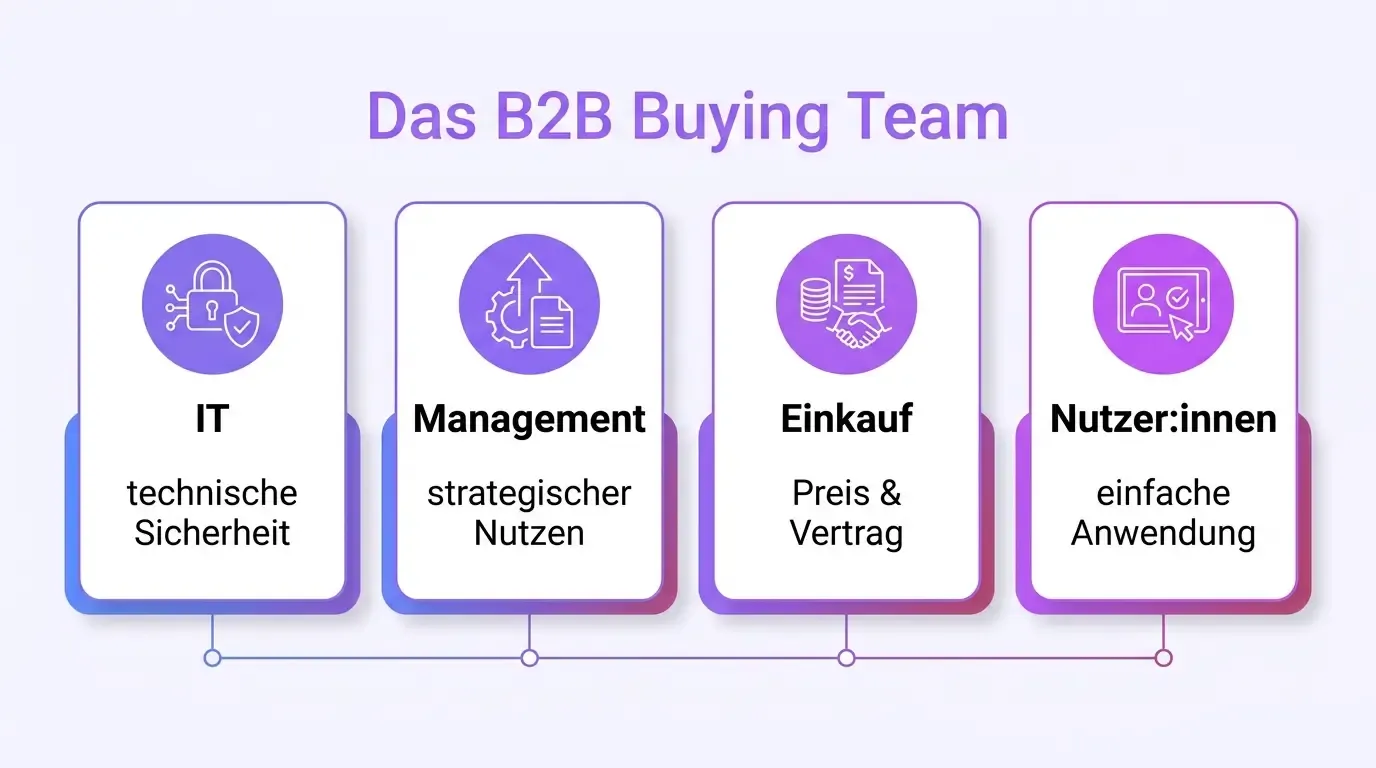
The B2B buying team: four roles with different information needs.
/ 03 – Differentiate by role
Differentiate content by decision-making role
Buyer enablement only works if you understand the roles within the buying team:
- IT needs technical assurance
- Management wants strategic value
- Procurement looks at price and contract details
- Users need simple usability
Uniform materials for everyone rarely work. Better: role-specific supporting arguments – short, understandable, and immediately usable.
/ 04 – Decision roadmap
Navigation aid instead of sales pressure
Especially for products that need explaining, an aggressive sales tactic doesn’t help – a clear decision roadmap does: “Here’s how your decision process with us works”:
- Needs clarification
- Demo with the relevant department
- Technical check
- Quote approval
- Implementation & support
This reduces uncertainty – and builds trust.
/ 05 – Digital touchpoints
Complement with digital touchpoints where it makes sense
Landing pages, chatbots, or follow-up emails also deliver buyer enablement – when they don’t just sell, but help:
- “10 questions you should clarify internally”
- “Checklist for your decision proposal”
- “PDF: decision guide for departments”
This turns your digital presence into a tool – not an advertising space.
/ 06 – FAQ
Frequently Asked Questions
Reflects the real questions from Google AI & ChatGPT around buyer enablement in B2B.
What is buyer enablement?
Enabling customers internally: providing the right arguments, information, and tools so they can decide in your favor.
How does buyer enablement differ from sales enablement?
Sales enablement equips your own sales team; buyer enablement equips the customer to decide internally.
What materials belong to it?
One-pagers, a decision matrix, an ROI calculator, role-specific supporting arguments, and a clear decision roadmap.
Why is buyer enablement important in B2B?
The purchasing process is complex and non-linear. Whoever simplifies it stands out and speeds up the close.
Good salespeople help people buy. Buyer enablement isn’t a marketing gimmick, but a central building block of modern B2B purchasing processes. Whoever simplifies their customers’ internal decision path stands out from the competition – and closes the deal faster.
Keep reading: Modern B2B funnel · Digital buying journey
/ 07 — Who it’s for
Built for companies whose offering needs explaining.

IT & software service providers
With services that need explaining and a few, high-value customers.

Manufacturing industry & mechanical engineering
Selling complex technology to a small number of major decision-makers.

Startups & scale-ups
Companies that want to become visible quickly and credibly.