/ 01 – Predictive Analytics
Gut Feeling Is Good. Data-Based Prediction Is Better.
How predictive models make your B2B sales sharper, faster and more predictable.
Sales was long a field for experience and gut feeling. In a data-driven world, though, intuition alone is no longer enough. Predictive analytics forecasts buying decisions, prioritizes the best leads and puts your sales resources to targeted use.
/ 02 – Fundamentals
01
What Predictive Analytics Delivers
Predictive analytics uses historical data to forecast future behavior. Instead of guessing which contact will buy or which customer will churn, the model delivers a reliable probability. In B2B, this pays off especially in three areas.
+10 to 20% higher sales ROI, which McKinsey reports for AI in marketing and sales.
McKinsey, 2023
Lead Scoring
Which contacts are most likely to buy? The model prioritizes your leads.
Churn Prevention
Which existing customers are at risk of leaving? An early warning instead of a nasty surprise.
Upselling
Where’s the potential for additional products and services? Data shows it.
Three Data Foundations
These three data sources are what a predictive model needs in order to work.
01
CRM history as training data
02
Behavioral data from web and email
03
Well-maintained data as a prerequisite
/ 03 – Approach
02
How Portfolio Scoring Works
The process is usually the same. First, the CRM history gets prepared: won and lost deals, industries, company sizes, contract terms. From this, the model learns which characteristics correlate with a close. It then scores the active portfolio and sorts it by close and upselling probability. The sales team works through this list from top to bottom instead of sorting it by gut feeling.
The value here doesn’t come from the model itself, but from the prioritization. Limited sales time goes to the accounts with the highest expected probability. How big the effect turns out to be depends on the data foundation. Anyone who closes few deals per year or doesn’t keep the CRM clean gets a model that barely outperforms an experienced sales intuition.
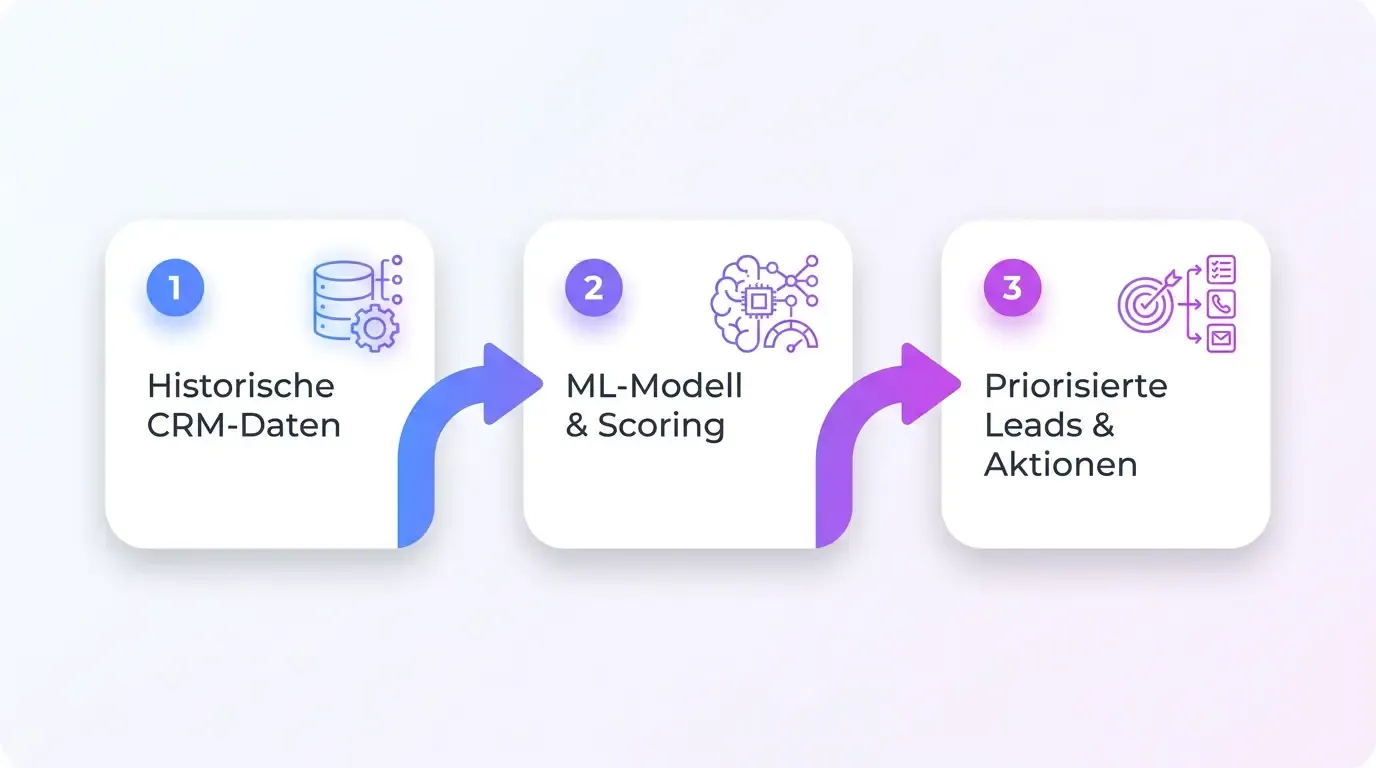
From historical data to prediction
Tools in Use
- Salesforce Einstein
- HubSpot
- Power BI
- ChatGPT
/ 04 – FAQ
Frequently Asked Questions
Mirrors the real prompts from Google AI and ChatGPT around predictive analytics in B2B sales.
What is predictive analytics in B2B sales?
Predictive analytics uses historical data to forecast future buying behavior: lead scoring, churn prevention and upselling.
What are the use cases?
The three most common are lead scoring, churn prevention and upselling.
Which tools are suitable?
Salesforce Einstein, HubSpot and Power BI, often combined with ChatGPT for personalized campaigns.
How much does predictive analytics deliver?
That can’t seriously be stated as a blanket figure. McKinsey reports a 10 to 20% higher sales ROI and a revenue increase of 3 to 15% for the use of AI in marketing and sales, though this applies to AI as a whole, not to predictive analytics alone. The effect in any individual case depends above all on data quality in the CRM and the number of closed deals the model can learn from.
Predictive analytics doesn’t replace a strong sales team, but it makes it many times more effective. Whoever uses data systematically spots market shifts earlier, prioritizes leads cleanly and puts resources where they count. For digital B2B, the rule holds: gut feeling is good, data-based prediction is better.
Keep reading: Which B2B sales KPIs actually matter · GEO guide: visible in AI answers
/ 05 – Who It’s For
Built for companies whose offering needs explaining.

IT & Software Providers
With services that need explaining, and a small number of high-value customers.

Manufacturing Industry & Mechanical Engineering
Selling complex technology to a small number of major decision-makers.

Startups & Scale-ups
Companies that want to become visible quickly and credibly.