Strategy & Positioning
The future of digital B2B sales: strategies for sustainable success
Field sales models and cold calls are giving way to automated processes, data-driven marketing, and smart tools. What does that mean for SMEs in the DACH region who want to grow sustainably?
In this article you’ll learn which strategies will be decisive in digital B2B sales going forward – and how to implement them concretely. It’s not about more volume, but about clear strategy, clean processes, and genuine relevance.
/ 01 – Requirement, not option
Digital sales is no longer optional
According to Gartner, B2B buyers spend only about 17% of their total buying time in direct contact with providers. When comparing multiple providers, a single sales contact even accounts for only 5 to 6%. For context: these figures come from “The New B2B Buying Journey” of 2019, and Gartner did not publish the sample size. That the trend has not reversed since is shown by a more recent survey from the same publisher: in a study of 646 B2B buyers, released on March 9, 2026, 67% say they prefer a buying process without any sales contact. The bulk of purchase preparation therefore happens without you in the room. Whoever isn’t digitally discoverable during this phase doesn’t even make it onto the shortlist for debate. A professional digital sales process is therefore not optional – it’s the prerequisite for even making it into consideration.
The future doesn’t belong to the loudest providers. It belongs to those with the clearest strategy.
Guiding principle of digital B2B sales
17%
of buying time is spent by B2B buyers in contact with all providers combined (Gartner, “The New B2B Buying Journey”, 2019)
70%
of B2B decision-makers say they’re open to self-service or remote purchases over $50,000 (McKinsey, 2020, a snapshot from the first pandemic year)
+14.5%
higher sales productivity through marketing automation, with 12.2% lower marketing overhead (Nucleus Research, 2017)
/ 02 – Target Audience & Positioning
Target audience sharpening & positioning
A clear focus on micro-audiences or profitable niches is the foundation of every sales strategy. Instead of offering everything to everyone, you solve a specific problem for a clearly defined target audience. Tools like SE Ranking or the LinkedIn Campaign Manager help analyze target audiences based on data.
Example: A provider of appointment-booking software targets physiotherapists exclusively – with the result: more relevance, higher trust, less wasted reach.
/ 03 – Systems & Automation
Systematization & automation
A scalable sales process must be clearly structured and digitally supported. Tools like HubSpot, Pipedrive, or Notion guide you from lead capture to close. Automated follow-ups, tasks, and email sequences are especially important. Nucleus Research (2017) puts the effect of marketing automation at roughly 14.5% higher sales productivity and 12.2% lower marketing overhead. That’s a productivity gain, not an automatic conversion boost. The technology takes routine work off your hands; you still have to deliver the quality of the process yourself.
/ 04 – Content as an Accelerator
Content strategy as a sales accelerator
In digital B2B sales, the selling process often begins with content. Whether a lead magnet, LinkedIn post, or SEO blog article: good content builds trust, pre-qualifies leads, and brings your brand visibility. Quality, strategic placement, and consistency are decisive. The mechanism behind it is unspectacular: whoever answers the questions buyers ask anyway during the provider-free research phase shows up exactly when the shortlist is formed. Whitepapers, explainer videos, and checklists therefore only work if they lead to a landing page that clearly names the next step.
What you should do
- Clarify the strategy first, then choose channels
- Structure processes before automating them
- Qualify leads cleanly and use a CRM across the team
What you should avoid
- Running too many channels at once without a clear strategy
- Automating before the sales process is established
- Generic content with no relevance to the target audience
The sales process as a growth engine. A modern B2B sales operation runs digitally, scalably, and data-driven. The future belongs to those with the clearest strategy, the best processes, and the highest relevance. For SMEs in the DACH region, that means: whoever cleans up digitally today will see the first results tomorrow – and build a sales system that runs independently of chance and individual contacts.
Keep reading: How a Modern B2B Funnel Really Works · Which KPIs Really Matter in Digital B2B Sales
/ 05 – FAQ
Frequently Asked Questions about Digital B2B Sales
Mirrors the real questions B2B decision-makers ask Google AI & ChatGPT about the future of digital sales.
Why is digital B2B sales a requirement today?
Because most purchase preparation happens without provider contact. According to Gartner (“The New B2B Buying Journey”, 2019), only about 17% of total buying time goes to direct exchange with providers. More recently, on March 9, 2026, Gartner reported the same direction: 67% of 646 surveyed B2B buyers prefer a buying process without sales contact. Whoever isn’t digitally discoverable during the research phase doesn’t make the shortlist.
What are the most important pillars for sustainable digital sales?
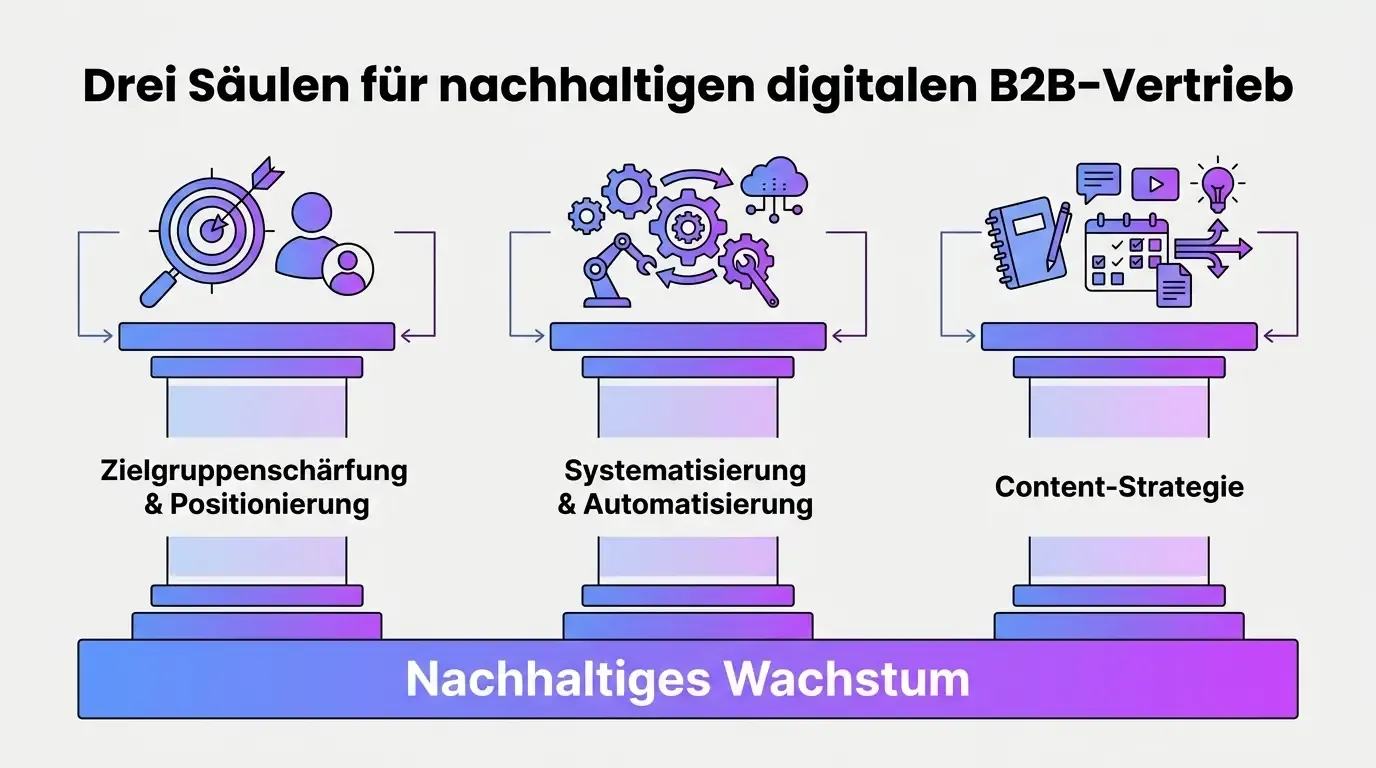
Three: sharp target audiences and positioning, systematized and automated processes, and a consistent content strategy.
Should you automate first or structure the process first?
Always structure the process first. Automation amplifies a good process – and a bad one just as much.
How does content help in digital B2B sales?
Content builds trust, pre-qualifies leads, and makes the brand visible. It’s often the first step in the selling process.
Which mistakes cost the most?
Too many channels without strategy, automation before structure, missing lead qualification, and generic content with no target-audience relevance.
Where should SMEs in the DACH region start?
With digital cleanup: sharpen the target audience, define a clear process, and use a CRM consistently across the team. From there you can scale.
Sources & further reading
- Gartner – “The New B2B Buying Journey”, 2019 (study of the B2B buying process, sample size not published by the publisher)
- Gartner – “Gartner Sales Survey Finds 67% of B2B Buyers Prefer a Rep-Free Experience”, press release of March 9, 2026 (survey of 646 B2B buyers, August to September 2025)
- McKinsey & Company – “These eight charts show how COVID-19 has changed B2B sales forever” / Global B2B Pulse Survey, 2020 (survey of more than 3,600 B2B decision-makers in eleven countries)
- Nucleus Research – “Marketing automation increases productivity”, Research R95, 2017 (sample size not published by the publisher)
/ 06 – Who this is for
Built for companies whose offering needs explaining.

IT & Software Service Providers
With services that need explaining and a handful of high-value customers.

Manufacturing Industry & Mechanical Engineering
Selling complex technology to a handful of major decision-makers.

Startups & Scale-ups
Companies that want to become visible quickly and credibly.