Why does Google AI Search keep citing B2B websites while ChatGPT has cited them less often since October?
The key points in brief
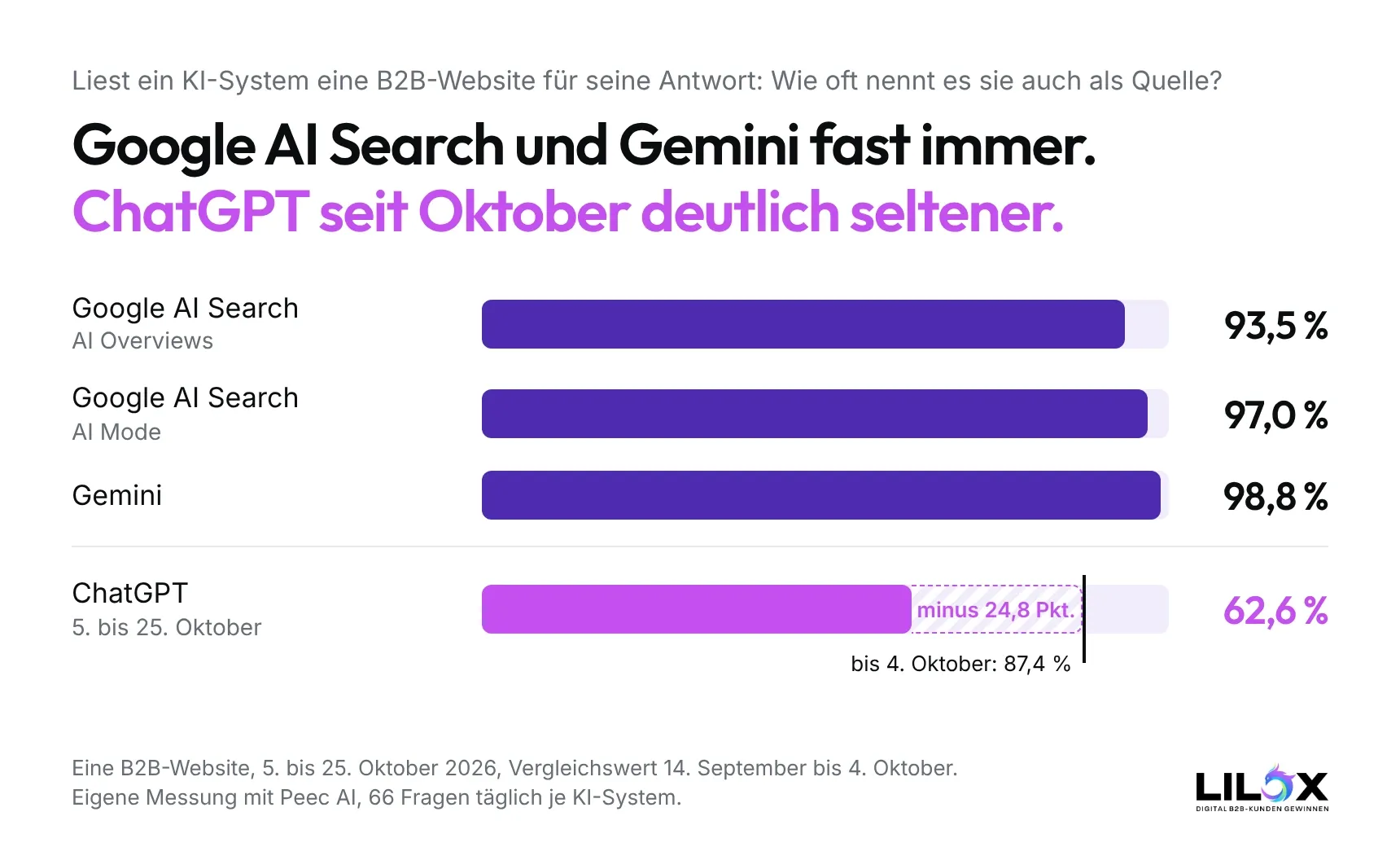
Since October 2026, ChatGPT has retrieved B2B websites as a source about as often as before, but it refers to them in the answer text far less often. In our measurement with one B2B website and seven competitor domains from the DACH region, the share of citing chats among retrieving chats fell for all eight domains. In Google AI Search and Gemini it stayed stable. Retrieved is not cited.
What changed in ChatGPT in October 2026?
OpenAI introduced GPT-6 for the paid ChatGPT plans on 7 October 2026 and for the free version from 8 October. Since then, ChatGPT has been delivering answers in new formats. OpenAI did not describe in its announcement how sources appear in them.
The analytics firm SISTRIX measured the changeover in six countries, including Germany, Austria and Switzerland. In the night from 8 to 9 October 2026, the answer format changed within a few hours. Between 9 and 22 October, only 1 to 19 percent of answers showed a list of sources at the end, compared with around 72 percent before. Since 23 October, the list has again appeared under 70 to 84 percent of answers. The share of answers with at least one source in the text, by contrast, rose slightly, from 72.4 to 76.2 percent. The number of linked pages per answer rose from 3.3 to 4.1.
A second observation comes from the measurement provider cloro. There, a ChatGPT answer with sources contained an average of 14.2 sources in the week starting 4 May 2026, and 37.6 in the week starting 26 October 2026. GPT-6 first appeared in this data in the week starting 5 October.
Both sources show the same picture. ChatGPT collects more material and refers to it differently in the text than before. SISTRIX expressly states that it cannot be said with certainty whether the model or the new presentation makes the difference.
What does the measurement across several AI systems show?
Our measurement uses Peec AI to put the same 66 B2B sales questions to each system every day. This produces 462 chats per system and week, and between 417 and 445 for the AI Overviews in Google AI Search, because Google does not show an overview for every question. The website measured is a B2B consulting website from the DACH region, referred to below as Website A. The metric is simple. It counts, among the chats that retrieve a page of the domain, in how many the answer refers to that page in the text.
| System | 14 Sept. to 4 Oct. 2026 | 5 to 25 Oct. 2026 |
|---|---|---|
| Google AI Search, AI Overviews | 93.0 % (226 of 243) | 93.5 % (215 of 230) |
| Google AI Search, AI Mode | 96.8 % (244 of 252) | 97.0 % (230 of 237) |
| ChatGPT | 87.4 % (595 of 681) | 62.6 % (343 of 548) |
| Gemini | 98.6 % (216 of 219) | 98.8 % (247 of 250) |
In Google AI Search and Gemini, almost every chat that retrieves Website A also refers to it in the text. In ChatGPT, this share fell by 24.8 percentage points. Copilot retrieves Website A too rarely to show a difference (fewer than 10 chats per period). For the comparison domains, Copilot cited every retrieved page in both periods, 669 of 669 and 653 of 653 chats.
For your own analysis, this means that a drop in citations in just one system is first of all a finding about the system. It becomes a finding about your site only after the comparison.
Is the drop down to your own website?
No, not in this case. The same calculation for seven competitor domains from the DACH region shows a drop in ChatGPT for all seven, between 8.1 and 38.4 percentage points. The median is 22.9 percentage points. Taken together, the share fell from 66.3 percent (878 of 1,325 chats) to 43.8 percent (450 of 1,028 chats).
| ChatGPT | 14 Sept. to 4 Oct. 2026 | 5 to 25 Oct. 2026 | Change |
|---|---|---|---|
| Website A | 87.4 % (595 of 681) | 62.6 % (343 of 548) | minus 24.8 percentage points |
| Seven competitor domains, combined | 66.3 % (878 of 1,325) | 43.8 % (450 of 1,028) | minus 22.5 percentage points |
| Gap between Website A and the comparison group | plus 21.1 percentage points | plus 18.8 percentage points | 2.3 percentage points smaller |
Website A thus loses about as much as the comparison group. The gap between the two shrinks by only 2.3 percentage points.
In Google AI Search, the comparison group stayed stable, at 93.3 percent (941 of 1,009) and 92.5 percent (1,036 of 1,120) for the AI Overviews, and at 94.1 percent (716 of 761) and 94.7 percent (789 of 833) in AI Mode. In Gemini, the share rose slightly, from 97.2 percent (492 of 506) to 98.5 percent (735 of 746).
A second cross-check comes from a separate measurement project for the Swiss market. There, the share for a second B2B website (Website B) in ChatGPT fell from 83.7 percent (220 of 263) to 60.1 percent (140 of 233). The twelve other frequently retrieved domains also all fell, between 5.4 and 47.7 percentage points.
At minus 24.8 percentage points, Website A is in the middle of the comparison group. Measured against a threshold of your own alone, this would have looked like a loss. Measured against the competition, it is not one.
From which day does ChatGPT cite less often?
The daily values show the break on 9 October 2026, exactly in the night in which SISTRIX measured the changeover.
| Period 2026 | Website A, cited per retrieving chat | retrieving chats per day | seven competitor domains |
|---|---|---|---|
| 1 to 8 October | 85.8 % (230 of 268) | 33.5 | 58.5 % (279 of 477) |
| 9 to 21 October | 53.6 % (141 of 263) | 20.2 | 42.7 % (226 of 529) |
| 22 to 31 October | 60.7 % (229 of 377) | 37.7 | 41.8 % (264 of 632) |
The values from 26 October are provisional, because Peec is still reclassifying the last few days.
From 22 October, ChatGPT retrieves Website A as often as at the start of October again, on average 37.7 chats per day compared with 33.5. The page is nevertheless cited in a much smaller share of these chats. The pattern is the same for the comparison domains. Between 9 and 21 October, retrieval also fell. This period coincides with the almost two weeks in which, according to SISTRIX, the list of sources was missing.
Is this a change at OpenAI or in the measurement?
That is an open question. In favour of a change at OpenAI is the timing, which coincides with the introduction of GPT-6 and the changeover measured by SISTRIX. In addition, the same pattern appears for all domains checked, in two separate measurement projects.
Against an error in our own measurement speaks the fact that the number of chats per system and week stayed the same over the whole period. Peec’s changelog lists no change to the capture of ChatGPT for October 2026.
An interaction still cannot be ruled out. If ChatGPT presents sources differently, every measurement tool has to read them differently. Whether the smaller citation share reflects the behaviour of ChatGPT or the way tools read the new presentation cannot be separated on the basis of the available data. All that is certain is that it affects all domains in the same system at the same time.
What does this mean for how you measure AI visibility?
Retrieved is not cited. A system can read your page and still name a different source in the answer text. Anyone who only counts how often their own domain is cited sees a drop and looks for the cause on their own website. With the comparison to the competition, you can see within a week whether you are losing ground or whether the system has changed.
In the case of Website A, the absolute figure would have suggested a rework of the service pages. The comparison with seven competitor domains instead showed no sign of a weakness of its own. That saves you weeks of work in the wrong place. And it gives you figures with which you can defend a budget.
Which four metrics support a decision and how monitoring becomes a task is covered in the article Measuring AI visibility is not enough. Why the answers keep naming the same sources is explained in the article on the sources of AI answers.
What B2B companies should do now
Six steps that can be put into practice within a week, each with a measurable quantity.
- Report retrieval and citation separately. For each system, calculate the number of chats that retrieve your domain and the share of them in which it is cited in the text. Weekly, with the case count next to every share. Below 10 chats, you do not report a difference.
- Define a fixed comparison group. Five to eight domains that appear regularly in your answers, with the same calculation. The metric is the gap between your citation share and the median of this group, per system.
- Set a trigger rule. Action is only needed when your citation share is below the median of the comparison group for two weeks in a row. If the whole group falls at the same time, that is a finding about the system.
- Check the timing against known changes. Place the daily values next to the dates of known changeovers, for ChatGPT most recently 7 to 9 October and 23 October 2026. A break on the same day for all domains is not a content problem.
- Adjust the analysis for 9 to 16 October. According to SISTRIX, between 9 and 15 October most ChatGPT links lacked the utm_source identifier, with only 1 to 24 percent of links carrying it. Visits from ChatGPT partly appear as direct traffic on these days. Read both channels together for this week.
- Change pages only after the cross-check. Plan changes to pages only once step 3 triggers. After that, you measure the changed page against the same comparison group for four to six weeks.
Whether a system is allowed to read your page at all can be checked in a minute before any of these calculations.
Do AI systems actually read your website? The AI visibility check tests whether the crawlers of the answer systems are allowed to retrieve your pages and find text there. Free and without sign-up. Start the AI visibility check
Frequently asked questions
Why is my website cited less often in ChatGPT despite being retrieved?
Because since the introduction of GPT-6 in October 2026, ChatGPT collects more sources and refers to them differently in the answer text. In our measurement, the share of citing chats among retrieving chats in ChatGPT fell for one B2B website from 87.4 to 62.6 percent, and for seven competitor domains from 66.3 to 43.8 percent. From 22 October, retrieval reached the level of early October again. A simultaneous drop for all domains points to a change in the system, not on your site.
Does the drop also affect Google AI Search or Gemini?
Not in our measurement. In Google AI Search, the citation share stayed between 93 and 97 percent for the AI Overviews and in AI Mode, and at just under 99 percent in Gemini. For the comparison domains, Copilot cited every retrieved page in both periods. The drop thus affects a single system. Anyone who evaluates all systems as a single total sees it diluted and easily attributes it wrongly.
What is the difference between retrieved and cited?
Retrieved means that an AI system read a page while answering a question. Cited means that the answer visibly refers to that page in the text. Only a citation can trigger a visit and makes your page recognisable to the reader as a source. The two values can move independently, as October 2026 shows. That is why every evaluation should report them separately, per system and with the case count.
How do I tell a system change from a problem with my website?
By comparing with a fixed group of competitor domains, calculated with the same method. If your citation share falls and the group’s median falls by the same amount, the cause lies in the system. If only your value falls, it lies with you. The daily series also helps. A break on a single day for all domains fits a changeover, whereas a slow decline for you alone fits a content or technical problem.
Should we rework our pages now?
Not because of this drop alone. If all domains lose in the same system at the same time, reworking your own pages brings no advantage. Its effect also could not be separated from the system effect. A change makes sense when your citation share is below the median of your comparison group for two weeks in a row. Then the deviation is your own finding. A measure can then be measured against the same group.
Why are visits from ChatGPT missing in my web analytics for mid-October?
Because many links from ChatGPT lacked the utm_source identifier between 9 and 15 October 2026. On those days, SISTRIX counted only 1 to 24 percent tagged links depending on the day, and since 17 October it has been 99 to 100 percent again. Web analytics tools usually assign untagged visits without a referrer to direct traffic. For this week, ChatGPT and direct traffic should therefore be read together.
How often should you measure the citation share?
Weekly, with a fixed set of questions and the comparison to the same group of competitors. A week is short enough to spot a break like the one on 9 October 2026 promptly. It is also long enough for reliable case counts. Daily values help when you want to check a point in time. For decisions about page changes, the weekly value over two weeks in a row is enough, otherwise you are reacting to fluctuations.
Sources
- OpenAI, announcement on GPT-6 in ChatGPT, October 2026: openai.com
- Search Engine Journal, report on the introduction of GPT-6 in ChatGPT, October 2026: searchenginejournal.com
- SISTRIX, evaluation of ChatGPT answers in six countries, 30.10.2026: sistrix.com. Measurement provider with its own tool for AI visibility.
- cloro, AI Citation Tracker, as of 31.10.2026: cloro.dev. Measurement provider with its own tool for AI visibility.
- Peec AI, changelog, retrieved on 01.11.2026: peec.ai
- Own measurement with Peec AI: 66 questions daily per system, domain report per week, day and system, 14.09. to 31.10.2026. Values from 26.10.2026 provisional.