Dark Social in B2B: What You Can’t Track
When your best content gets passed along in the shadows.
Your website has rising traffic, but nobody fills out the form – and then suddenly a lead shows up: “I got your link from a colleague.” Welcome to dark social: all the shares that never show up in your analytics and still decide the fate of your sales.
/ 01 – What is Dark Social
What is dark social?
Dark social refers to the untrackable channels through which content gets shared:
- Direct messages via WhatsApp, LinkedIn, Signal
- Private Slack groups
- Emails from colleagues
- Copy-pasting links into documents or notes
Unlike classic social shares with a UTM tag, these paths leave no clear trace in Google Analytics or your CRM.
“You only ever see a fraction of the actual interest.”
/ 02 – Why this matters in B2B
Why this matters especially in B2B
Content is often shared internally in B2B in particular: an employee sends your blog post to procurement, a whitepaper lands in a Teams project channel, an executive saves your LinkedIn post. None of these paths carries a UTM tag, none generates a referrer. How large this share actually is in B2B isn’t backed by any solid study: the figures circulating on this come from consumer surveys and can’t be applied to purchasing committees. Only the direction is certain. What you see in analytics is less than what interest actually exists.
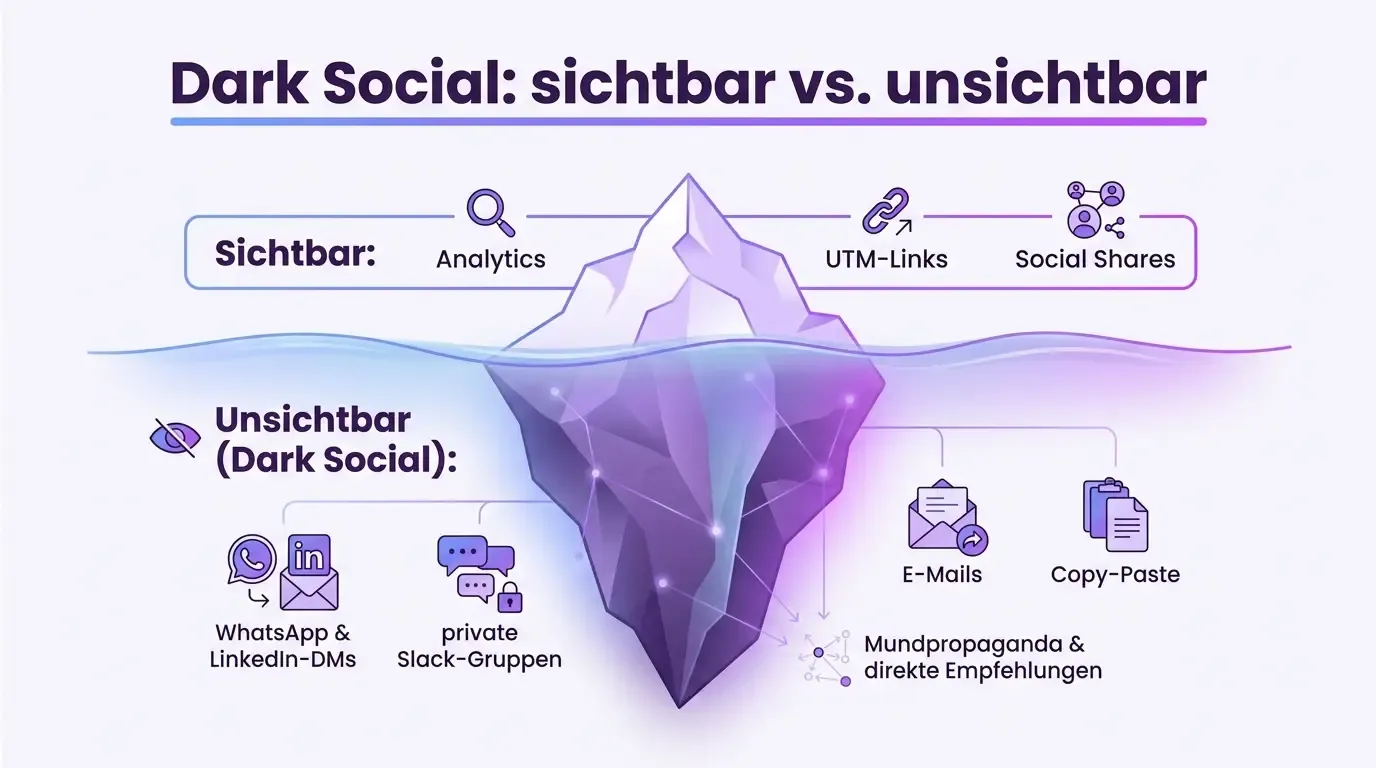
Visible vs. invisible: a significant share of B2B sharing happens beneath the surface.
/ 03 – Serve it deliberately
Don’t fight dark social — serve it
Instead of trying to make everything measurable, the motto is: make sharing easy and enable dialogue.
- Short, copy-paste-friendly URLs
- CTA-optimized PDFs that work even without a landing page
- Email links in plain text for direct forwarding
- Content that’s shareable internally – real value instead of marketing phrases
/ 04 – Measure micro-conversions
Measure micro-conversions and engagement
Just because the source isn’t trackable doesn’t mean you have to act blind. Pay closer attention to:
- Time spent on pages
- Scroll depth and click behavior
- Returning visits
- Direct visits without a referrer – often a dark social indicator
Tools like Hotjar, Plausible Analytics, or Matomo help you understand behavior qualitatively.
/ 05 – Factor in attribution
Factor in attribution – even if it’s fuzzy
Add a simple question to your lead forms: “How did you hear about us?” The answers deliver valuable insights – especially for high-priced products with long decision cycles. And ask specifically during sales conversations; the results feed back into your content strategy.
/ 06 – Strategic content channel
Use dark social as a strategic channel
If your content often gets shared “in the shadows,” produce content specifically for that:
- One-pagers that people quickly post in Slack
- Checklists that get passed along to colleagues
- Short videos or slides that make the case internally
- Text snippets and supporting arguments for reuse
/ 07 – FAQ
Frequently Asked Questions
Reflects the real questions from Google AI & ChatGPT around dark social in B2B.
What is dark social?
Sharing content through untrackable channels – direct messages, private chats, emails, copy-paste – without a trace in analytics or CRM.
Why is dark social important in B2B?
Because a significant share of internal sharing happens via direct messages, private chats, and email, and leaves no trace in analytics or CRM. How large this share actually is in B2B isn’t backed by any solid study. What is certain: visible tracking shows less than the actual interest.
How do you measure dark social?
Not directly, but through proxy signals: direct visits without a referrer, time on page, and returning visits – plus a “How did you find us?” field in the lead form.
How do you use dark social strategically?
Build shareable content: one-pagers, checklists, and supporting arguments – instead of trying to make everything measurable.
Trust forms in the dark. Dark social isn’t a loss of control, but a signal: your content generates relevance, even without attribution. Whoever aligns their strategy with it benefits long-term from referrals, internal shares, and silent advocates.
Keep reading: Content for humans and machines · Buyer enablement
/ 08 — Who it’s for
Built for companies whose offering needs explaining.

IT & software service providers
With services that need explaining and a few, high-value customers.

Manufacturing industry & mechanical engineering
Selling complex technology to a small number of major decision-makers.

Startups & scale-ups
Companies that want to become visible quickly and credibly.